
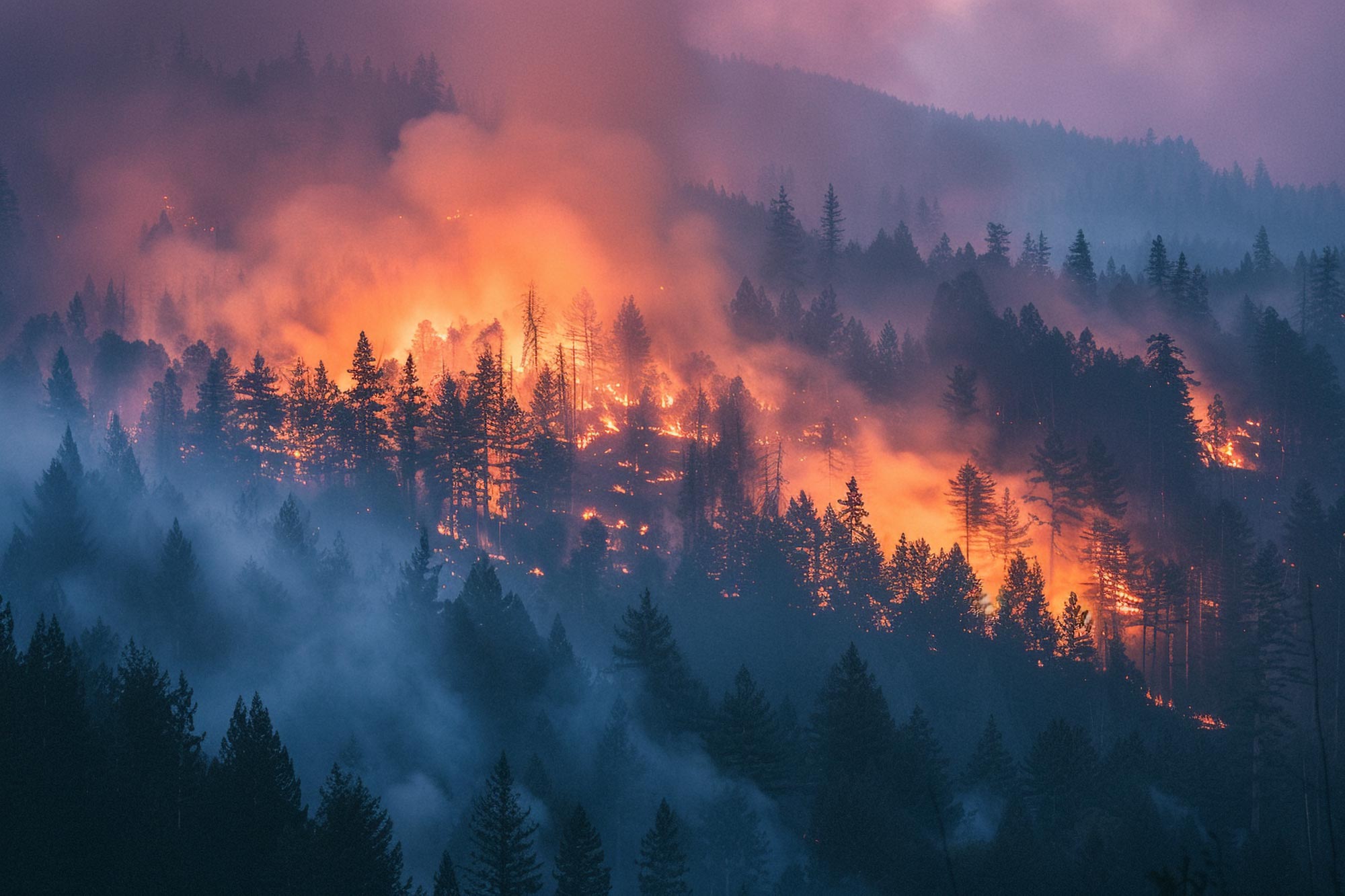
Tree-ring data indicates a decrease in fire activity across many forests, where the lack of fire may lead to more intense wildfires in the future.
Despite common belief, North American forests are actually burning less, not more, according to new data. A study published in Nature Communications suggests that this decline in fire activity may be contributing to more intense and severe wildfires.
“What we see in the record is that widespread wildfires were happening very frequently, about every 10 to 20 years in many areas,” said University of Arizona fire ecologist and professor Donald Falk, who co-authored the study with U of A alumni and with researchers from the USDA Forest Service’s Rocky Mountain Research Station. “We also know that, by and large, these fires were not the severe fires we’re seeing on television today. They were often mixed-severity and surface fires occurring over very large areas.”
With funding from the John Wesley Powell Center, an Earth science research initiative of the U.S. Geological Survey, ecologists sought to better understand how fires happened historically.
Fire has always been a key player in stabilizing forest ecosystems, said Falk, a professor in the School of Natural Resources and the Environment in the U of A College of Agriculture, Life and Environmental Sciences. He said many forests historically burned frequently, naturally clearing out underbrush and keeping tree density in check. However, the prevalence of non-fire years has likely disrupted those natural cycles, leading to denser forests, an accumulation of dead wood and dry debris, and hotter, more destructive wildfires that are destabilizing to humans and forests.
“As a result, today’s extreme wildfires are more likely to harm people and communities, while exposing forests to damaging effects on soils and natural vegetation, from which they may not recover,” Falk said.
A time machine for fire
When wildfires move through forests, heat penetrates the bark of trees, leaving what are known as fire scars. Over time, trees heal and continue to grow, forming new rings. If another fire occurs, the cycle repeats, etching fires into the wood like a time capsule. Those scars help scientists determine how often fires occurred in an area and when.
Using a fire scar dataset known as the North American Tree-Ring Fire Scar Network, which originated from work done at the U of A Laboratory of Tree-Ring Research, researchers were able to compile a clearer picture of historical fire geography and frequency. This allowed them to compare recent seemingly extreme wildfire events – such as the California August Complex Fire and the Arizona Bighorn Fire of 2020 – with events from the past.
“In recent history, between 1984 and 2022, wildfires in 2020 seemed like they were unprecedented in terms of the area they burned, but historically speaking, they were not,” said Sean Parks, who led the study and is a research ecologist at the USDA Forest Service Rocky Mountain Research Station. “There were several years between 1600 and 1880 where much more fire burned than what we experienced in 2020. This said, recent wildfires are unprecedented in terms of their adverse impacts to people, communities, and forests.”
The fire scar data used in the study was collected from more than 1,800 sites across North America, spanning diverse forest types. The data was also used in a separate recent study, led by U of A alumnus and research ecologist Ellis Margolis, that revealed a strong and coherent connection between wildfire and climate patterns like El Niño.
“We have records from Alaska all the way down to southern Mexico going back centuries. This gives scientists an unprecedented ability to understand how fire was working historically, before we started excluding it from the landscape,” said Falk. “Our forests are overgrown now due to 140 years of fire exclusion, but the more we can do to make our forests more resilient to that inevitable fire, the better off we’re going to be.”
Reference: “A fire deficit persists across diverse North American forests despite recent increases in area burned” by Sean A. Parks, Christopher H. Guiterman, Ellis Q. Margolis, Margaret Lonergan, Ellen Whitman, John T. Abatzoglou, Donald A. Falk, James D. Johnston, Lori D. Daniels, Charles W. Lafon, Rachel A. Loehman, Kurt F. Kipfmueller, Cameron E. Naficy, Marc-André Parisien, Jeanne Portier, Michael C. Stambaugh, A. Park Williams, Andreas P. Wion and Larissa L. Yocom, 10 February 2025, Nature Communications.
DOI: 10.1038/s41467-025-56333-8
Never miss a breakthrough: Join the SciTechDaily newsletter.
Follow us on Google and Google News.