
Close Menu
    Facebook X (Twitter) Instagram
    SciTechDaily
    • Biology
    • Chemistry
    • Earth
    • Health
    • Physics
    • Science
    • Space
    • Technology
    Facebook X (Twitter) Pinterest YouTube RSS
    SciTechDaily
    Home»Biology»Different Women’s Eggs Attract Different Men’s Sperm – And Not Necessarily Their Partners
    Biology

    Different Women’s Eggs Attract Different Men’s Sperm – And Not Necessarily Their Partners

    By Stockholm UniversityJune 9, 20202 Comments3 Mins Read
    Facebook Twitter Pinterest Telegram LinkedIn WhatsApp Email Reddit
    Share
    Facebook Twitter LinkedIn Pinterest Telegram Email Reddit

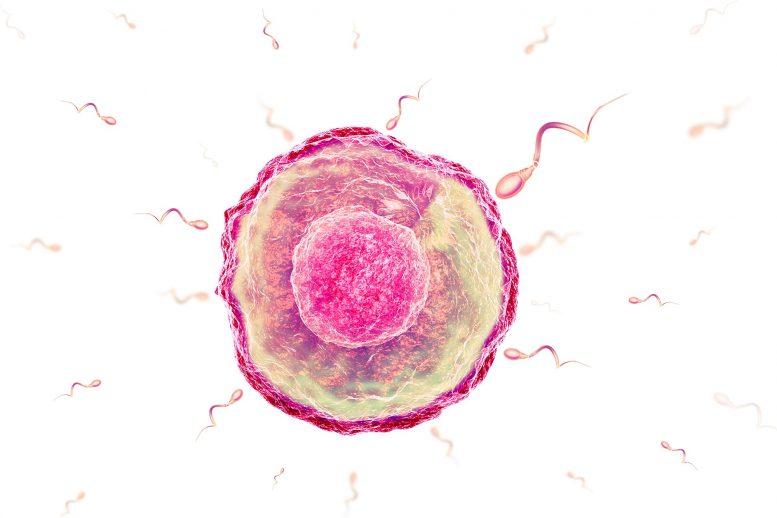
    Sperm and Egg Cell


    Human Eggs Prefer Some Men’s Sperm Over Others

    Human eggs use chemical signals to attract sperm. New research from Stockholm University and Manchester University NHS Foundation Trust shows that eggs use these chemical signals to “choose” sperm. Different women’s eggs attract different men’s sperm — and not necessarily their partners.

    John Fitzpatrick
    Dr John Fitzpatrick, Wallenberg Academy Fellow, Department of Zoology, Stockholm University. Credit: Magnus Bergström/Knut and Alice Wallenberg Foundation

    Humans spend a lot of time and energy choosing their partner. A new study by researchers from Stockholm University and Manchester University NHS Foundation Trust (MFT) shows that choosing your partner continues even after sex — human eggs can “choose” sperm.

    “Human eggs release chemicals called chemoattractants that attract sperm to unfertilized eggs. We wanted to know if eggs use these chemical signals to pick which sperm they attract,” said John Fitzpatrick, an Associate Professor at Stockholm University.

    The researchers examined how sperm respond to follicular fluid, which surrounds eggs and contains sperm chemoattractants. The researchers wanted to find out if follicular fluids from different females attracted sperm from some males more than others.

    Microscopic mate choice

    “Follicular fluid from one female was better at attracting sperm from one male, while follicular fluid from another female was better at attracting sperm from a different male,” said Professor Fitzpatrick.

    Daniel R Brison
    Professor Daniel R Brison, PhD, FRCPath Scientific Director, Department of Reproductive Medicine, Manchester University NHS Foundation Trust. Credit: Manchester University NHS Foundation Trust

    “This shows that interactions between human eggs and sperm depend on the specific identity of the women and men involved.”

    The egg does not always agree with the women’s choice of partner. The researchers found that eggs did not always attract more sperm from their partner compared to sperm from another male.

    Is this egg or sperm choice? Professor Fitzpatrick explained that sperm have only one job — to fertilize eggs — so it doesn’t make sense for them to be choosy. Eggs on the other hand can benefit by picking high quality or genetically compatible sperm.

    “The idea that eggs are choosing sperm is really novel in human fertility,” said Professor Daniel Brison, the Scientific Director of the Department of Reproductive Medicine at Saint Marys’ Hospital, which is part of MFT, and the senior author of this study.

    The University of Manchester Honorary Professor added: “Research on the way eggs and sperm interact will advance fertility treatments and may eventually help us understand some of the currently ‘unexplained’ causes of infertility in couples.”

    “I’d like to thank every person who took part in this study and contributed to these findings, which may benefit couples struggling with infertility in future.”

    The article “Chemical signals from eggs facilitate cryptic female choice in humans” is published in the scientific journal Proceedings of the Royal Society B.

    Reference: “Chemical signals from eggs facilitate cryptic female choice in humans” by John L. Fitzpatrick, Charlotte Willis, Alessandro Devigili, Amy Young, Michael Carroll, Helen R. Hunter and Daniel R. Brison, 10 June 2020, Proceedings of the Royal Society B.
    DOI: 10.1098/rspb.2020.0805

    Never miss a breakthrough: Join the SciTechDaily newsletter.
    Follow us on Google and Google News.

    Biochemistry Fertility Popular Reproductive Biology Stockholm University
    Share. Facebook Twitter Pinterest LinkedIn Email Reddit

    Related Articles

    Scientists Solve Decades-Old Cell Biology Mystery

    Sperm Evolution Becomes Supercharged Only When They Swim Inside Females

    Early Human Embryo Structure Created With Stem Cells in Advance for Fertility Research

    New Sex Hormone Discovered by Biologists

    Scientists Find Link in How Cells Start Process Necessary for Life

    Mitochondrial Transfer Technology Could Reduce Risk of Childhood Disease

    Molecular Code for How PPR Proteins Recognize their RNA Targets Discovered

    Insight on the Evolution of Cocaine Biosynthesis

    Cost-Effective 3-D RNA Modeling Technique

    2 Comments

    1. run 3 on June 13, 2020 2:18 am

      Your share is the great knowledge I have gathered, you are an important person I admire, thank you

      Reply
    2. AwesomeReader on January 28, 2021 12:39 am

      “I’d like to thank every person who took part in this study and contributed to these findings, which may benefit couples struggling with infertility in future.”

      Reply
    Leave A Reply Cancel Reply

    • Facebook
    • Twitter
    • Pinterest
    • YouTube

    Don't Miss a Discovery

    Subscribe for the Latest in Science & Tech!

    Trending News

    Scientists Discover How Coffee Impacts Memory, Mood, and Gut Health

    Why Did the Neanderthals Disappear? Scientists Reveal Humans Had a Hidden Advantage

    Physicists Propose Strange Experiment Where Time Goes Quantum

    Magnesium Magic: New Drug Melts Fat Even on a High-Fat, High-Sugar Diet

    Weight-Loss Drugs Like Ozempic May Come With an Unexpected Cost

    Mezcal “Worm” in a Bottle Mystery: DNA Testing Reveals a Surprise

    New Research Reveals That Your Morning Coffee Activates an Ancient Longevity Switch

    This Is What Makes You Irresistible to Mosquitoes

    Follow SciTechDaily
    • Facebook
    • Twitter
    • YouTube
    • Pinterest
    • Newsletter
    • RSS
    SciTech News
    • Biology News
    • Chemistry News
    • Earth News
    • Health News
    • Physics News
    • Science News
    • Space News
    • Technology News
    Recent Posts
    • Harvard Scientists Reveal Secret Structure Behind How You Smell
    • Scientists Just Discovered the Hidden Trick That Keeps Your Cells Alive
    • This Simple Movement Could Be Secretly Cleaning Your Brain
    • Male Birth Control Breakthrough: Scientists Find Way To Turn Sperm Production Off and Back On
    • A Common Vitamin Could Hold the Key to Treating Fatty Liver Disease
    Copyright © 1998 - 2026 SciTechDaily. All Rights Reserved.
    • Science News
    • About
    • Contact
    • Editorial Board
    • Privacy Policy
    • Terms of Use

    Type above and press Enter to search. Press Esc to cancel.