
Close Menu
    Facebook X (Twitter) Instagram
    SciTechDaily
    • Biology
    • Chemistry
    • Earth
    • Health
    • Physics
    • Science
    • Space
    • Technology
    Facebook X (Twitter) Pinterest YouTube RSS
    SciTechDaily
    Home»Physics»Discovering the Low-Energy “Break Point” for Exotic Quark-Gluon Plasma Creation
    Physics

    Discovering the Low-Energy “Break Point” for Exotic Quark-Gluon Plasma Creation

    By U.S. Department of EnergyJuly 2, 2023No Comments3 Mins Read
    Facebook Twitter Pinterest Telegram LinkedIn WhatsApp Email Reddit
    Share
    Facebook Twitter LinkedIn Pinterest Telegram Email Reddit
    Mapping Nuclear Phase Changes
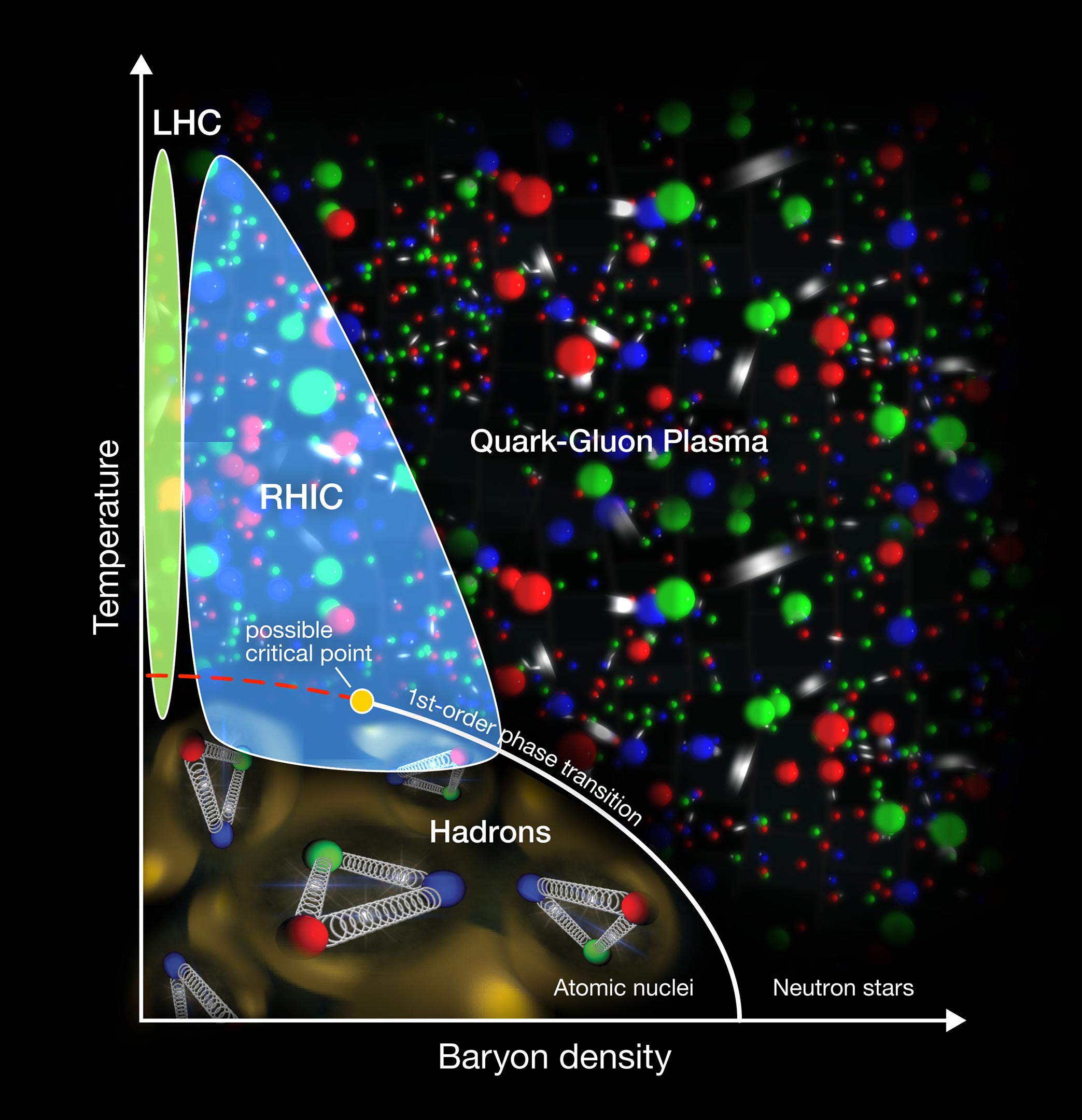
    A conjectured phase diagram of nuclear matter. New data – that show high collision energies produce a quark-gluon plasma (QGP) while the lowest energy collisions do not – will help scientists map out the boundaries between QGP and the hadronic phase. Credit: Brookhaven National Laboratory

    Through gold nuclei collisions at varying energies, physicists have found that the creation of quark-gluon plasma—an exotic state of matter—halts at the lowest collision energy of 3 GeV. This discovery aids in mapping nuclear matter phases and identifying the conditions for QGP existence and its transition from ordinary matter.

    The Science

    Physicists can create an exotic state of matter known as a quark-gluon plasma (QGP) by colliding gold nuclei together. By systematically varying the amount of energy involved in the collision, scientists have shown that the QGP exists in collisions at energies from 200 billion electron volts (GeV) down at least to 19.6 GeV. However, its production appears to be “turned off” at the lowest collision energy, 3 GeV. The “off” signal shows up as a sign change—from negative to positive—in data that describe the distribution of protons produced in these collisions.

    The Impact

    The analysis compared the data with numerical simulations that include the formation of the QGP. If the data match the predictions, it provides evidence that a QGP has been formed. The sign switch at the lowest collision energy is therefore a sign that QGP formation is turned off at that energy. The findings will help physicists map out the phases of nuclear matter and the conditions of temperature and density under which QGP can exist, as well as the transitions between ordinary matter and QGP.

    Summary

    The new analysis used data collected by the Relativistic Heavy Ion Collider  (RHIC) STAR detector during the first phase of the RHIC Beam Energy Scan to systematically search through 10 different collision energies. Scientists from the STAR Collaboration measured event-by-event the number of protons minus the number of antiprotons produced and a variety of characteristics of the distribution of the net-proton production. They compared their observations with “first-principles” calculations using the equations of quantum chromodynamics (QCD), the theory that describes the interactions of quarks and gluons. This approach, known as lattice QCD, simulates quark-gluon interactions on 4D space-time lattices. 

    At collision energies of 200, 62.4, 54.4, 39, 27, and 19.6 GeV, the data were consistent with a QGP. Below 19.6 GeV, the data continued to match the predictions, although with large error bars indicating the range of uncertainty. But at the lowest energy, 3 GeV, the scientists saw a dramatic shift. The order of the hierarchy among the analyzed characteristics flipped—and so did the sign of the key relationships, from negative to positive. This sign change is an indication, supported by these first-principles calculations, that the formation of QGP is turned off at RHIC’s lowest collision energy.

    For more on this research, see When the Universe Changes Its Mind: Critical Point in Matter Transformation.

    Reference: “Beam Energy Dependence of Triton Production and Yield Ratio (Nt×Np/N2d) in Au+Au Collisions at RHIC” by M. I. Abdulhamid et al. (STAR Collaboration), 16 May 2023, Physical Review Letters.
    DOI: 10.1103/PhysRevLett.130.202301

    This research was funded by the Department of Energy Office of Science, Nuclear Physics program, the National Science Foundation, and a range of international organizations and agencies listed in the related paper. The STAR team used computing resources at the Scientific Data and Computing Center at Brookhaven National Laboratory, the National Energy Research Scientific Computing Center (NERSC) at Lawrence Berkeley National Laboratory, and the Open Science Grid consortium.

    Never miss a breakthrough: Join the SciTechDaily newsletter.
    Follow us on Google and Google News.

    DOE Particle Physics Plasma Physics
    Share. Facebook Twitter Pinterest LinkedIn Email Reddit

    Related Articles

    Critical Point in Matter Transformation: When the Universe Changes Its Mind

    5.8 Trillion Degrees: Getting to the Bottom of When the Smallest Meson Melts

    New Rocket Thruster Concept Exploits the Mechanism Behind Solar Flares

    Room Temperature Superconductor Breakthrough at Oak Ridge National Laboratory

    Nanoscale Quantum Sensors Image Stress and Magnetism at High Pressures

    Scientists Invent Way to See Fastest Motions of Electrons That Drive Chemistry for the First Time

    Blowing Bubbles: New Way to Launch and Drive Current in Fusion Plasmas Confirmed

    Researchers Create and Stabilize Pure Polymeric Nitrogen Using Plasma for the First Time

    Physicists Get Closer to Solving the Proton Radius Puzzle With Unique New Measurement

    Leave A Reply Cancel Reply

    • Facebook
    • Twitter
    • Pinterest
    • YouTube

    Don't Miss a Discovery

    Subscribe for the Latest in Science & Tech!

    Trending News

    Scientists Uncover Potential Brain Risks of Popular Fish Oil Supplements

    Scientists Discover a Surprising Way To Make Bread Healthier and More Nutritious

    After 60 Years, Scientists Uncover Unexpected Brain Effects of Popular Diabetes Drug Metformin

    New Research Uncovers Hidden Side Effects of Popular Weight-Loss Drugs

    Scientists Rethink Extreme Warming After Surprising Ocean Discovery

    Landmark Study Links Never Marrying to Significantly Higher Cancer Risk

    Researchers Discover Unknown Beetle Species Just Steps From Their Lab

    Largest-Ever Study Finds Medicinal Cannabis Ineffective for Anxiety, Depression, PTSD

    Follow SciTechDaily
    • Facebook
    • Twitter
    • YouTube
    • Pinterest
    • Newsletter
    • RSS
    SciTech News
    • Biology News
    • Chemistry News
    • Earth News
    • Health News
    • Physics News
    • Science News
    • Space News
    • Technology News
    Recent Posts
    • Early Warning Signals of Esophageal Cancer May Be Hiding in Plain Sight
    • Researchers Have Discovered a THC-Free Cannabis Compound That May Replace Opioids
    • Common Blood Pressure Drug Shows Surprising Power Against Deadly Antibiotic-Resistant Superbug
    • Students Build Dark Matter Detector and Set New Experimental Limits
    • Scientists Discover Caffeine Can Repair Key Memory Circuits After Sleep Loss
    Copyright © 1998 - 2026 SciTechDaily. All Rights Reserved.
    • Science News
    • About
    • Contact
    • Editorial Board
    • Privacy Policy
    • Terms of Use

    Type above and press Enter to search. Press Esc to cancel.