
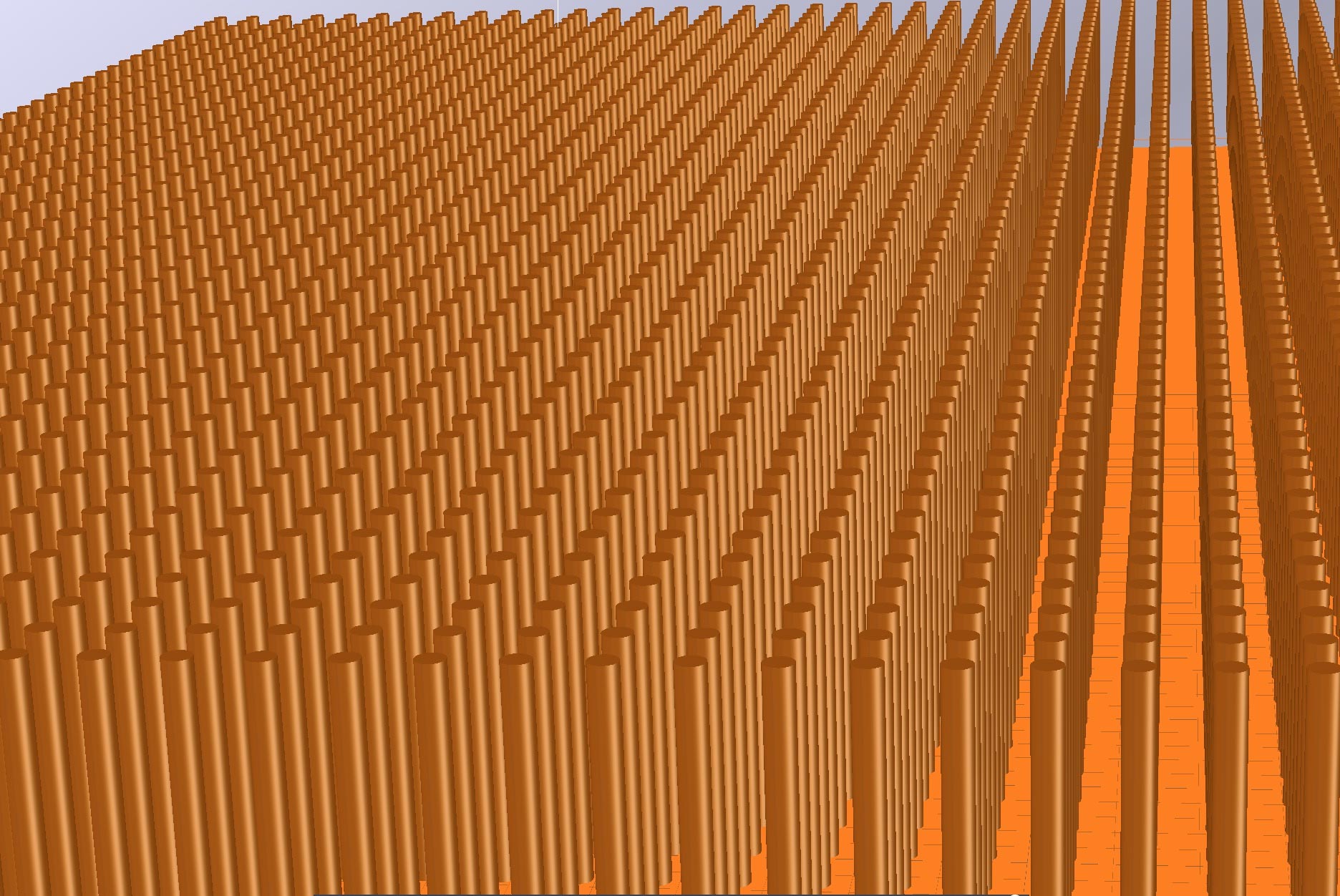
Universitat Rovira i Virgili researchers have developed a nanometric-scale theoretical model to create structures that kill bacteria by using elastic forces. The results of this study pave the way to creating new antibacterial materials.
Resistance to antibiotics has become a serious public health problem. Hospital infections, prostheses or surgical implants that become infected and do not respond to treatment are a real challenge to the research community, which has been seeking alternatives for effectively eliminating these bacteria for years.
In 2012, the researchers from the Department of Chemical Engineering of the Universitat Rovira i Virgili, Vladimir Baulin and Sergey Pogodin, opened a line of research to develop antibacterial models that were inspired by insects. The wings of, for example, dragonflies are made up of complex structures of nanometric geometric shapes, which are highly efficient at killing bacteria. In their attempt to understand these forms and reproduce them as new anti-bacterial materials, a team consisting of Vladimir Baulin, Marc Werner, from the Leibniz-Institut für Polymerforschung (Dresden, Germany) and Elena Ivanova from the Australian university RMIT, discovered that the elasticity of nanopillars is a key factor because they can retain and release sufficient energy to kill the bacteria.
The line of research that had been initiated years before had already found that the wings of these insects are made up of a structure of nanopillars that eliminates bacteria mechanically, which is known as the biocide effect. These mechano-bactericidal properties, by which bacteria are killed almost instantly when they come into contact with the pillars without any need to use a chemical substance, raises numerous questions that researchers are attempting to answer by experimenting with different shapes and geometries that will help them to understand which has the most efficient bactericidal effect.

They investigated the bactericidal capacity on nanometric surfaces by varying the height of the pillars and keeping the other dimensions constant. The results, which have just been published in the journal PNAS, have shown that the flexibility of these pillars is closely connected to their appearance. “Even the solid and rigid materials become flexible if one of the dimensions is much longer than the others (for example, a guitar string or a long pillar),” says Vladimir Baulin. The researchers have developed a physical model that shows that when bacteria come into contact with these pillars they can accumulate elastic energy even at such a small scale. Thanks to this model it is now possible to calculate the elastic response of other structures and optimize their antibacterial properties.
The deformation forces of the pillar caused by the contact of the bacteria are so high that they can even break the bacteria’s cell wall, thus providing a new mechanism for killing them. These forces are associated with surface tensions imposed on the bacterial cells. The pillars under the bacteria that approach stretch more at the edges, whereas the pillars located under the center of the bacteria practically do not change. The study shows, then, that the gradual variation in the height of the pillars of a nanometric surface can determine their bactericidal efficacy.
This discovery may lead to a completely new class of antibacterial materials, which could range from packaging for food to filters or masks. Unlike traditional filters, where the bacteria remain but are not deactivated, the new nanoscale elastic material can safely kill the bacteria in a matter of minutes, which means that they cannot activate any defense mechanisms or give any resistance at all,” concluded Baulin.
Reference: “The multi-faceted mechano-bactericidal mechanism of nanostructured surfaces” by Elena P. Ivanova, Denver P. Linklater, Marco Werner, Vladimir A. Baulin, XiuMei Xu, Nandi Vrancken, Sergey Rubanov, Eric Hanssen, Jason Wandiyanto, Vi Khanh Truong, Aaron Elbourne, Shane Maclaughlin, Saulius Juodkazis and Russell J. Crawford, 26 May 2020, Proceedings of the National Academy of Sciences.
DOI: 10.1073/pnas.1916680117
Never miss a breakthrough: Join the SciTechDaily newsletter.
Follow us on Google and Google News.
1 Comment
We have so much to learn from nature. Perfectly logical that flora and fauna have evolved natural defenses against all sorts of infectious diseases. Otherwise it would just be microscopic bugs eating everything and each other.