
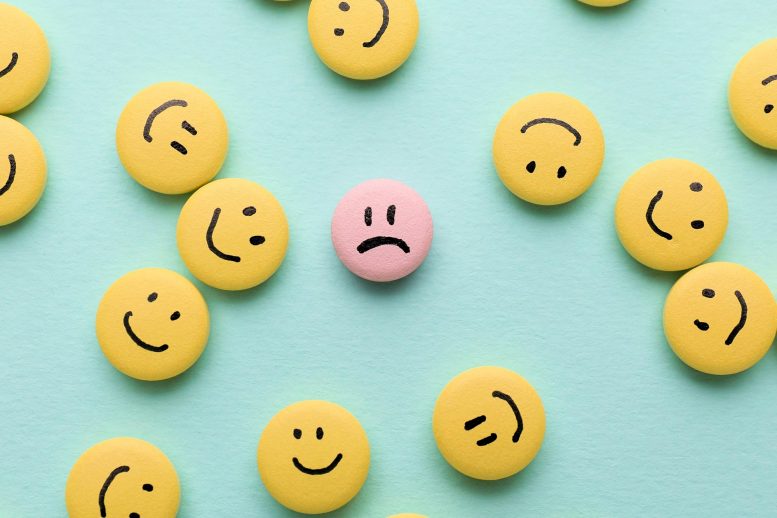
Among people with depression, those using antidepressants had no better quality of life in the long run.
Using antidepressants is not associated with significantly better health-related quality of life over time, compared to people with depression who do not take the drugs. These are the findings of a new study published on April 20, 2022, in the open-access journal PLOS ONE by Omar Almohammed of King Saud University, Saudi Arabia, and colleagues.
It is widely acknowledged that depressive illness has a major impact on patients’ health-related quality of life (HRQoL). While studies have demonstrated the usefulness of antidepressant drugs in the treatment of depression disorder, the effect of these medications on patients’ general well-being and HRQoL remains debatable.
In the new study, the scientists used data from the 2005-2015 United States’ Medical Expenditures Panel Survey (MEPS), a large longitudinal study that tracks the health services that Americans use. Any person with a diagnosis of depressive disorder was identified in the MEPS files. Over the course of the study, 17.47 million adult patients were diagnosed with depression on average each year, with two years of follow-up, and 57.6% of these were treated with antidepressant medicines.
Antidepressants’ Limited Impact on Quality of Life
Use of antidepressants was associated with some improvement on the mental component of SF-12—the survey tracking health-related quality of life. However, when this positive change was compared to the change in a group of people who were diagnosed with depressive disorder but did not take antidepressants, there was no statistically significant association of antidepressants with either the physical (p=0.9595) or mental (p=0.6405) component of SF-12. In other words, the change in quality of life seen among those on antidepressants over two years was not significantly different from that seen among those not taking the drugs.
The study was not able to separately analyze any subtypes or varying severities of depression. According to the authors, future studies should investigate the use of non-pharmacological depression interventions used in combination with antidepressants.
The authors add: “Although we still need our patients with depression to continue using their antidepressant medications, long-term studies evaluating the actual impact for pharmacological and non-pharmacological interventions on these patients’ quality of life is needed. With that being said, the role of cognitive and behavioral interventions on the long-term management of depression needs to be further evaluated in an effort to improve the ultimate goal of care for these patients; improving their overall quality of life.”
Reference: “Antidepressants and health-related quality of life (HRQoL) for patients with depression: Analysis of the medical expenditure panel survey from the United States” by Omar A. Almohammed, Abdulaziz A. Alsalem, Abdullah A. Almangour, Lama H. Alotaibi, Majed S. Al Yami and Leanne Lai, 20 April 2022, PLOS ONE.
DOI: 10.1371/journal.pone.0265928
Funding: Omar A. Almohammed received funding from the Researcher Supporting Project number (RSP-2021/77), King Saud University, Riyadh, Saudi Arabia, to support the publication of this article. The funding agency had no role in designing the study, conducting the analysis, interpreting the data or writing the manuscript.
Never miss a breakthrough: Join the SciTechDaily newsletter.
Follow us on Google and Google News.
11 Comments
This is NOT a randomized, placebo-controlled study. It doesn’t rule out that sicker individuals were more likely to be prescribed anti-depressants; in that case, the study would actually show that anti-depressants helped sicker people to have comparable outcomes to those patients whose condition didn’t seem to warrant medication. That would be evidence of treatment efficacy, not its opposite.
If the statistical results shown in the article are correct, then there is a 96% chance that the drugs resulted in a physical benefit.
After looking at the original paper, my previous comment is wrong.
In the army, I was given antidepressants. 2 of them and half a joint, and nothing bothered me anymore.
What I’ve noticed about anti depressants is that it’s recommended not to use drugs or alcohol when on them.
The problem is that people suffering for whatever reason will tend to self medicate with drugs or alcohol.
The main reason I stopped taking anti depressants in the past was because I missed using drugs.
I now take a high dose of anti depressant which suits me. And I have used a lot of different drugs without any negative effects. In fact I think anti depressants have helped me deal with my addiction issues.
Antidepressants are not meant to be taking long term and only 1% of the population really needs them. They are now prescribing them for almost every ailment. They minimize how powerful they are by saying they are not addictive. LOL. Go visit support groups with people trying to get off this garbage and then say its not addictive. They are destroying lives and families and the morons who say it helps them are medically spellbound by them much like a coke head says the cocaine helps them. Facts
@JC Antidepressants are correctly used to treat lifelong conditions such as anxiety and chronic pain conditions and bipolar depression, thyroid disorder caused depression, endometriosis mood swings, and severe PMDD.
Stating things like ‘only 1% of the population needs them’ and confusing taking meds to make life more tolerable with lifelong conditions that aren’t fixable with ‘addictive’ makes it impossible to take you seriously.
I can attest to this. I stopped taking antidepressants last year and decided to actually do the hard work to figure out why I was depressed and change the way I perceived the world. All I know is my own personal experience, but I’ve never felt better in my entire life. It’s my theory that anxiety and depression are the brains warning signs akin to the physical body’s. If you sprain your ankle, your body tells you to not walk on it with pain. If you’re not living in accordance to your morals and inner self, you’re anxious and depressed. I feel like these prescriptions numb the mental pain and thus let you continue on living life improperly and you never grow or heal. Lime I said, just my personal opinions and observations though. Live well everyone 🙏.
I have worked with a lot of depressed clients and I can tell you they DO WORK and work very well when taken as prescribed. When some have gone off their AD’s, they’re back in jail or psych within two weeks.
Bipolar type II here. Went without antidepressants for 25 years and struggled daily. Been on 10mg Cipralex 2 anf half years now along with 2mg Abilify (anti-psychotic). Ii can attest I wouldn’t be here witout them and my quality of life has been greatly improved..
That study seems to have some flaws to it. I mean I wouldn’t totally discount their findings, but I think their averages are going to skew negatively for 2 main reasons.
1) Anyone who stopped taking antidepressants within the 2 years of the study was excluded from the data set. So if you took antidepressants for like 18 months and then didn’t think you needed them because your QOL improved, you’re not contributing to the data any longer even though you would be a good example of a positive outcome from antidepressants. I guess that’s why they specify “**in the long run**” though. But you’ve gotta think a dataset of only people being treated for 2+ years is going to skew towards people with treatment resistant depression.
2) The study also didn’t take into consideration when the person was first diagnosed. If you’d been taking antidepressants for 10 years without much change when the study kicked off, you were included in the dataset.
3) The study didn’t look at specific antidepressants or categories of antidepressants or even dosage, and lumped all of those people together. That’s like putting you and Snoop Dogg in the same data set as “users who have ingested cannabis within the past 2 years” and drawing conclusions.
4) They also have no data on the severity of the depression the patients were diagnosed with. I think that could skew the data in different ways, but I think it makes it hard to draw conclusions in general