
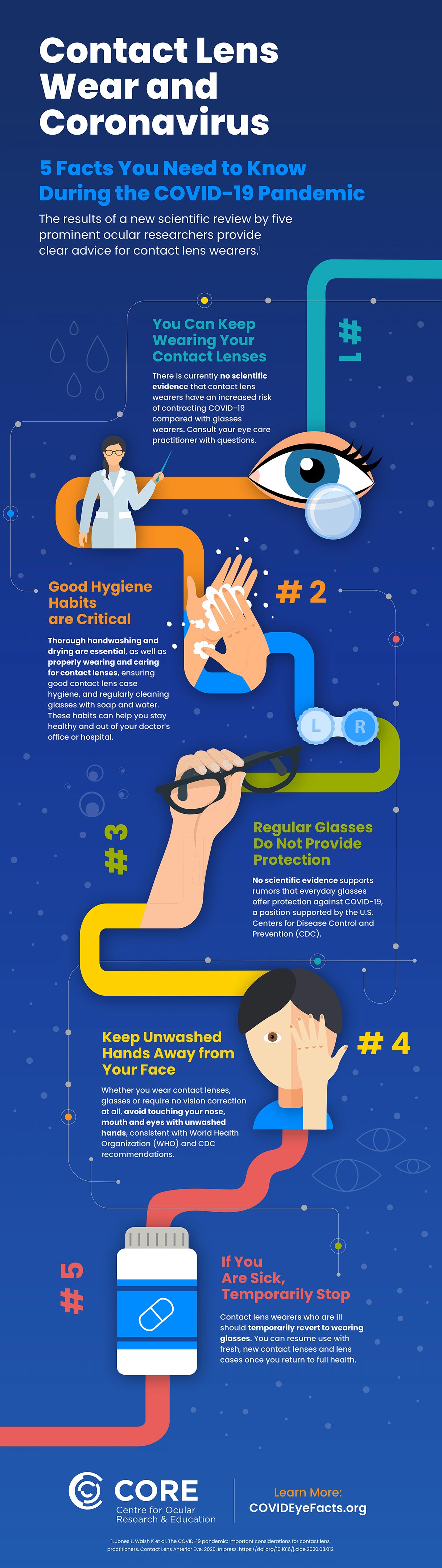
New findings published in Contact Lens & Anterior Eye provide evidence-based guidance for practitioners and patients, including 5 important facts for every contact lens wearer
A new peer-reviewed paper from five prominent ocular scientists will help eye care practitioners (ECPs) instruct and reassure contact lens wearers during the global COVID-19/coronavirus pandemic. Published in Contact Lens & Anterior Eye, “The COVID-19 Pandemic: Important Considerations for Contact Lens Practitioners” delves into multiple aspects of eye health amidst the global health crisis, with a specific emphasis on the safe use of contact lenses.
“Our findings indicate that contact lenses remain a perfectly acceptable form of vision correction during the coronavirus pandemic, as long as people observe good hand hygiene and follow appropriate wear-and-care directions,” said Dr. Lyndon Jones, director of the Centre for Ocular Research & Education (CORE) at the University of Waterloo and the paper’s lead author. “Unfortunately, we have seen a number of erroneous reports regarding contact lenses and spectacles in recent days. Our goal is to make sure that science-backed truths are understood and shared, helping eye care practitioners provide accurate, timely counsel to patients.”
Based on the paper, CORE has developed five facts (also available as a downloadable infographic) for ECPs to share with anyone who relies on contact lenses or glasses/spectacles:
- People Can Keep Wearing Contact Lenses. There is currently no scientific evidence that contact lens wearers have an increased risk of contracting COVID-19 compared with glasses/spectacles wearers. Patients should consult their eye care practitioners with questions.
- Good Hygiene Habits are Critical. Thorough handwashing and drying are essential, as well as properly wearing and caring for contact lenses, ensuring good contact lens case hygiene, and regularly cleaning glasses/spectacles with soap and water. These habits will help wearers stay healthy and out of their doctor’s office or hospital, thereby minimizing impacts on the wider healthcare system.
- Regular Eyeglasses / Spectacles Do Not Provide Protection. No scientific evidence supports rumors that everyday eyeglasses/spectacles offer protection against COVID-19.
- Keep Unwashed Hands Away from the Face. Whether people wear contact lenses, or glasses/spectacles or require no vision correction at all, individuals should avoid touching their nose, mouth, and eyes with unwashed hands, consistent with World Health Organization (WHO) and U.S. Centers for Disease Control and Prevention (CDC) recommendations.
- If You Are Sick, Temporarily Stop Wearing Contact Lenses. Contact lens wearers who are ill should temporarily revert to wearing eyeglasses/spectacles. They can resume use with fresh, new contact lenses and lens cases once they return to full health and have spoken with their eye care practitioner.
On April 8, the CDC issued updated guidance on contact lens wear during the COVID-19 pandemic, further supporting key findings from the Contact Lens & Anterior Eye paper. The CDC additionally points out that personal eyeglasses and contact lenses do not qualify as personal protective equipment (PPE).
The Contact Lens & Anterior Eye paper also reviews why management of adverse events should be retained within optometric systems, offers guidance on sleeping in contact lenses, considers wearing modalities and lens materials, and offers areas for further study.
Reference: “The COVID-19 pandemic: Important considerations for contact lens practitioners” by Lyndon Jones, Karen Walsh, Mark Willcox, Philip Morgan, and Jason Nichols, 6 April 2020, Contact Lens and Anterior Eye.
DOI: 10.1016/j.clae.2020.03.012
Joining Dr. Jones as paper authors were four globally respected researchers, educators and clinicians: Dr. Karen Walsh, professional education team leader and clinical scientist at CORE, Dr. Mark Willcox, director of research at the School of Optometry and Vision Science at UNSW (Sydney), Dr. Philip Morgan, director of Eurolens Research at the University of Manchester (United Kingdom), and Dr. Jason Nichols, associate vice president for research and professor at the University of Alabama at Birmingham School of Optometry (United States) and editor-in-chief of Contact Lens Spectrum.
The latest findings complement and significantly expand on CORE advisories regarding handwashing and safe contact lens wear issued in mid-March 2020.
Never miss a breakthrough: Join the SciTechDaily newsletter.
Follow us on Google and Google News.