
Close Menu
    Facebook X (Twitter) Instagram
    SciTechDaily
    • Biology
    • Chemistry
    • Earth
    • Health
    • Physics
    • Science
    • Space
    • Technology
    Facebook X (Twitter) Pinterest YouTube RSS
    SciTechDaily
    Home»Biology»Dog Brains Decoded: New Study Challenges Old Beliefs
    Biology

    Dog Brains Decoded: New Study Challenges Old Beliefs

    By Hun-Ren Ökológiai KutatóközpontAugust 6, 2024No Comments4 Mins Read
    Facebook Twitter Pinterest Telegram LinkedIn WhatsApp Email Reddit
    Share
    Facebook Twitter LinkedIn Pinterest Telegram Email Reddit
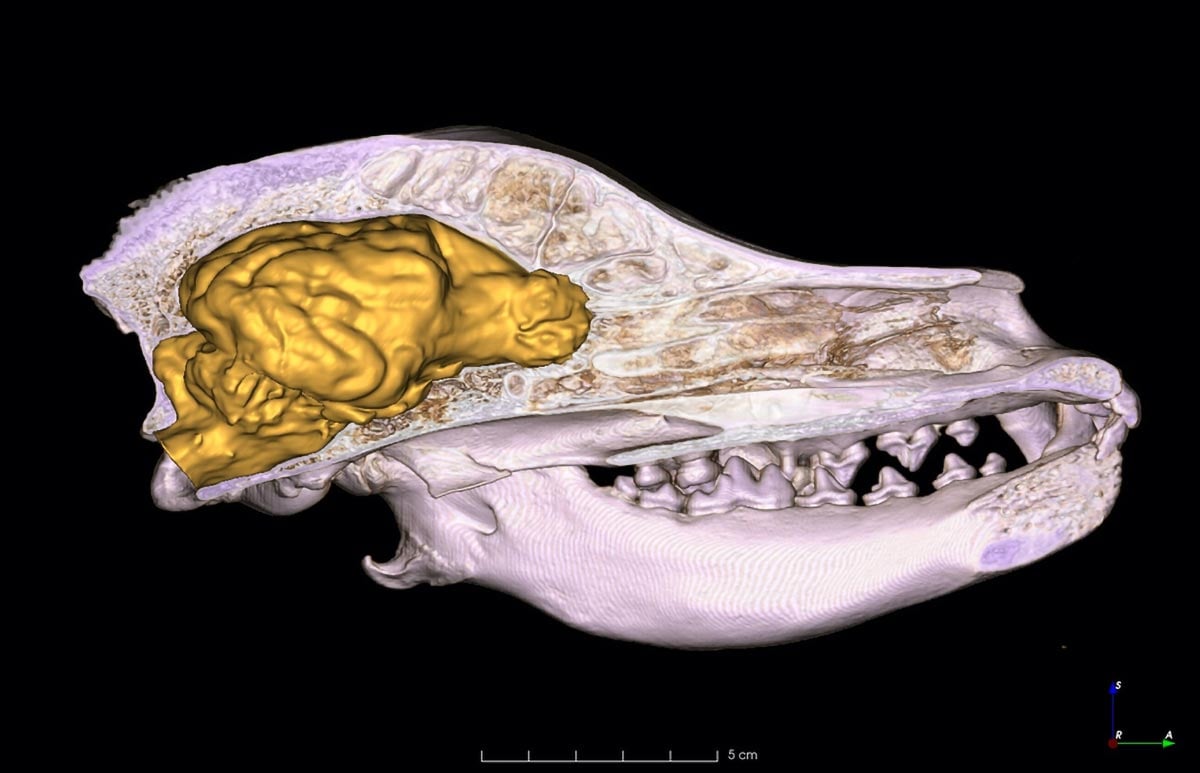
    Dog Skull 3D Brain Model
    The skull of a dog and the 3D model of the brain in it based on high-resolution CT-scanning. Credit: László Zsolt Garamszegi, Enikő Kubinyi, Kálmán Czeibert, Gergely Nagy, Tibor Csörgő, Niclas Kolm, Evolution of relative brain size in dogs—no effects of selection for breed function, litter size, or longevity, Evolution, Volume 77, Issue 7, July 2023, Pages 1591–1606, https://doi.org/10.1093/evolut/qpad063

    Researchers Garamszegi and Kolm have found that domestication isn’t the sole factor in reducing brain size in canids. By examining 25 species, they show that ecological adaptations like hibernation in raccoon dogs also play a crucial role, urging a reconsideration of domestication’s evolutionary impact.

    A recent study by László Zsolt Garamszegi from the Institute of Ecology and Botany, Centre for Ecological Research, Hungary, and Niclas Kolm from the Department of Zoology, Stockholm University, Sweden, challenges the long-held notion that domestication is the primary driver of reduced brain size in domesticated animals, specifically dogs. The study employs a phylogenetic comparative method to analyze whether the domesticated dog (Canis familiaris) exhibits a uniquely small brain relative to its body size compared to other canid species.

    Comparative Analysis of Canid Brain Size

    The prevailing belief has been that domestication leads to a significant reduction in brain size due to relaxed selection pressures, such as reduced need for foraging, mating competition, and predator avoidance. This phenomenon is thought to be a result of the decreased necessity for metabolically costly brain tissue in a domesticated environment.

    While domesticated dogs show a substantial decrease in brain size compared to their wild ancestor, the grey wolf (Canis lupus), this study aimed to determine if this reduction is exceptional when viewed in a broader phylogenetic context.

    Phylogenetic Insights on Brain Size Reduction

    Garamszegi and Kolm analyzed brain and body size data for 25 canid species, including ancient dog breeds that are genetically closer to the ancestral domesticated dog. Their phylogenetic predictions and allometric regressions showed that the reduction in brain size in domesticated dogs is not an unambiguous evolutionary singularity.

    The observed brain size in dogs fell within the expected range for most ancient breeds used in the study, suggesting that domestication is not uniquely influential in reducing brain size among canids.
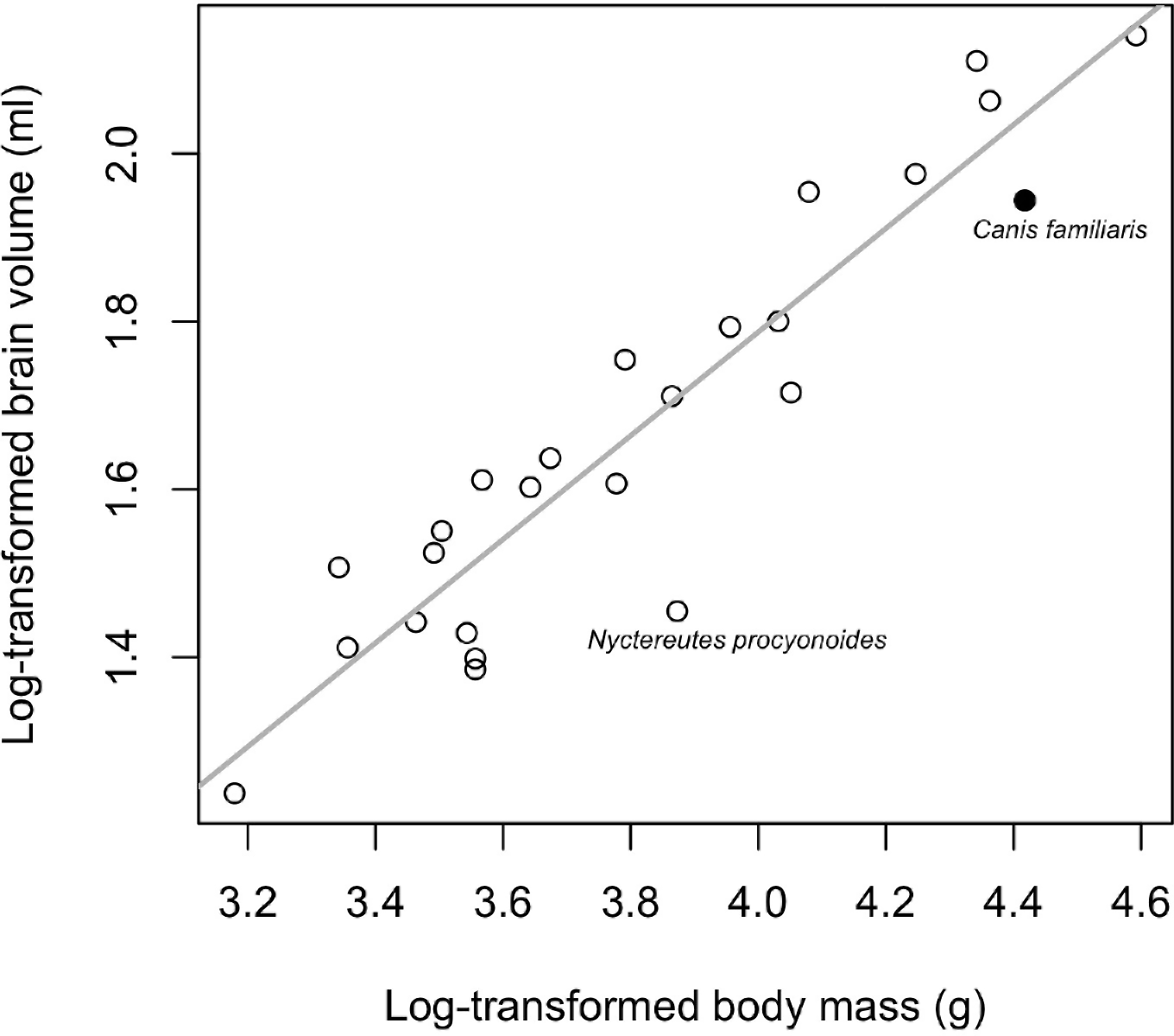
    Allometric Relationship Between Brain and Body Size in Canids
    The allometric relationship between brain and body size in canids. Points are species-specific estimates of bady mass and brain volumes observed in 25 canid species and the line defines the expected relationship between these based on the evolutionary model. The domesticated dog is highlighted with filled point (that shows the mean trait values across 11 ancient breeds). The data point for the common raccoon dog that is the only canid species that hibernates is labelled with its scientific name and shows that this species has the smallest brain size as expected from its body size. Credit: Garamszegi LZ, Kolm N. 2024 The reduction in relative brain size in the domesticated dog is not an evolutionary singularity among the Canids. Biol. Lett. 20: 20240336. https://doi.org/10.1098/rsbl.2024.0336

    Alternative Factors Influencing Brain Size

    Interestingly, the study found that the common raccoon dog (Nyctereutes procyonoides), which hibernates, is a more pronounced outlier in terms of brain size reduction. Hibernation, associated with prolonged periods of low metabolic activity and food scarcity, is hypothesized to constrain brain size evolution due to the high energy demands of large brains.

    The raccoon dog’s significantly smaller brain size supports this hypothesis, highlighting that factors other than domestication, such as ecological adaptations like hibernation, can also drive reductions in brain size.

    Conclusion on Domestication and Brain Evolution

    The study concludes that while domestication does contribute to brain size reduction in dogs, it should not be overemphasized as a uniquely powerful evolutionary force. The findings suggest that other ecological and evolutionary pressures can similarly affect brain size and can mediate extreme variations in non-domesticated species as well.

    A more balanced and less human-focused perspective could refine our understanding of the complex interplay between domestication and brain size evolution in mammals. The work of Garamszegi and Kolm might change how we interpret the evolutionary role of domestication.

    Reference: “The reduction in relative brain size in the domesticated dog is not an evolutionary singularity among the canids” by László Zsolt Garamszegi and Niclas Kolm, 1 August 2024, Biology Letters.
    DOI: 10.1098/rsbl.2024.0336

    Funding: National Research, Development and Innovation Office – NKFIH, Swedish Research Council 244, Sustainable Development and Technologies National Programme of the Hungarian Academy of Sciences (MTA FFT FTA)

    Never miss a breakthrough: Join the SciTechDaily newsletter.
    Follow us on Google and Google News.

    Brain Dogs Evolution
    Share. Facebook Twitter Pinterest LinkedIn Email Reddit

    Related Articles

    fMRI Experiment Reveals Striking Differences in How Dog and Human Brains Process Faces

    “Jet Fuel on the Evolution of the Brain” – Hunting in Savanna-Like “Goldilocks” Landscapes May Have Lead to Higher Intelligence

    Tyrannosaurs to Modern Crows: Evolutionary Tracing to Discover How Birds Evolved Big Brains

    “Hiding in Plain Sight” – Origins of Human Language Pathway in the Brain at Least 25 Million Years Old

    Evolutionary Secrets of Fossil Brains Revealed: “Lucy” Had Ape-Like Brain, but Longer Childhood Like Humans

    Scientists Were Wrong About Human Pattern of Brain Asymmetry Being Unique

    Scientists Reveal the Evolution of Modern Human Brain Shape

    Evolutionary Changes Surrounding the NOS1 Gene

    Similarities Between Acorn Worm and Vertebrate Brain

    Leave A Reply Cancel Reply

    • Facebook
    • Twitter
    • Pinterest
    • YouTube

    Don't Miss a Discovery

    Subscribe for the Latest in Science & Tech!

    Trending News

    Scientists Discover Bizarre 100-Million-Year-Old Insect With Giant Claws

    Scientists Discover “Good” Gut Microbes That Could Protect Against Autism and ADHD

    Scientists Reveal That Eating Almonds Every Day Could Transform Your Gut, Metabolism, and Appetite

    Scientists May Have Solved Two of Fusion Energy’s Biggest Problems at Once

    Scientists Discover Hidden “Switch” That Burns Fat and Could Treat Bone Disease

    After 50 Years of Mystery, Researchers Identify New Human Blood Group

    Beyond Pain Relief: Scientists Discover a Protein That Could Stop Osteoarthritis in Its Tracks

    Scientists Discover Why Alcohol Prevents the Liver From Healing, Even After You Quit

    Follow SciTechDaily
    • Facebook
    • Twitter
    • YouTube
    • Pinterest
    • Newsletter
    • RSS
    SciTech News
    • Biology News
    • Chemistry News
    • Earth News
    • Health News
    • Physics News
    • Science News
    • Space News
    • Technology News
    Recent Posts
    • Scientists Discover Cheap, Natural Remedy for High Blood Pressure
    • Archaeologists Discover Prehistoric Mountain Cave Packed With Mysterious Green Mineral
    • This Common Houseplant Is Secretly Using Advanced Geometry
    • Earth’s Upper Atmosphere Is Cooling Fast and Scientists Finally Know Why
    • 32,000 Olympic Pools of Magma Nearly Erupted Beneath Atlantic Island
    Copyright © 1998 - 2026 SciTechDaily. All Rights Reserved.
    • Science News
    • About
    • Contact
    • Editorial Board
    • Privacy Policy
    • Terms of Use

    Type above and press Enter to search. Press Esc to cancel.