
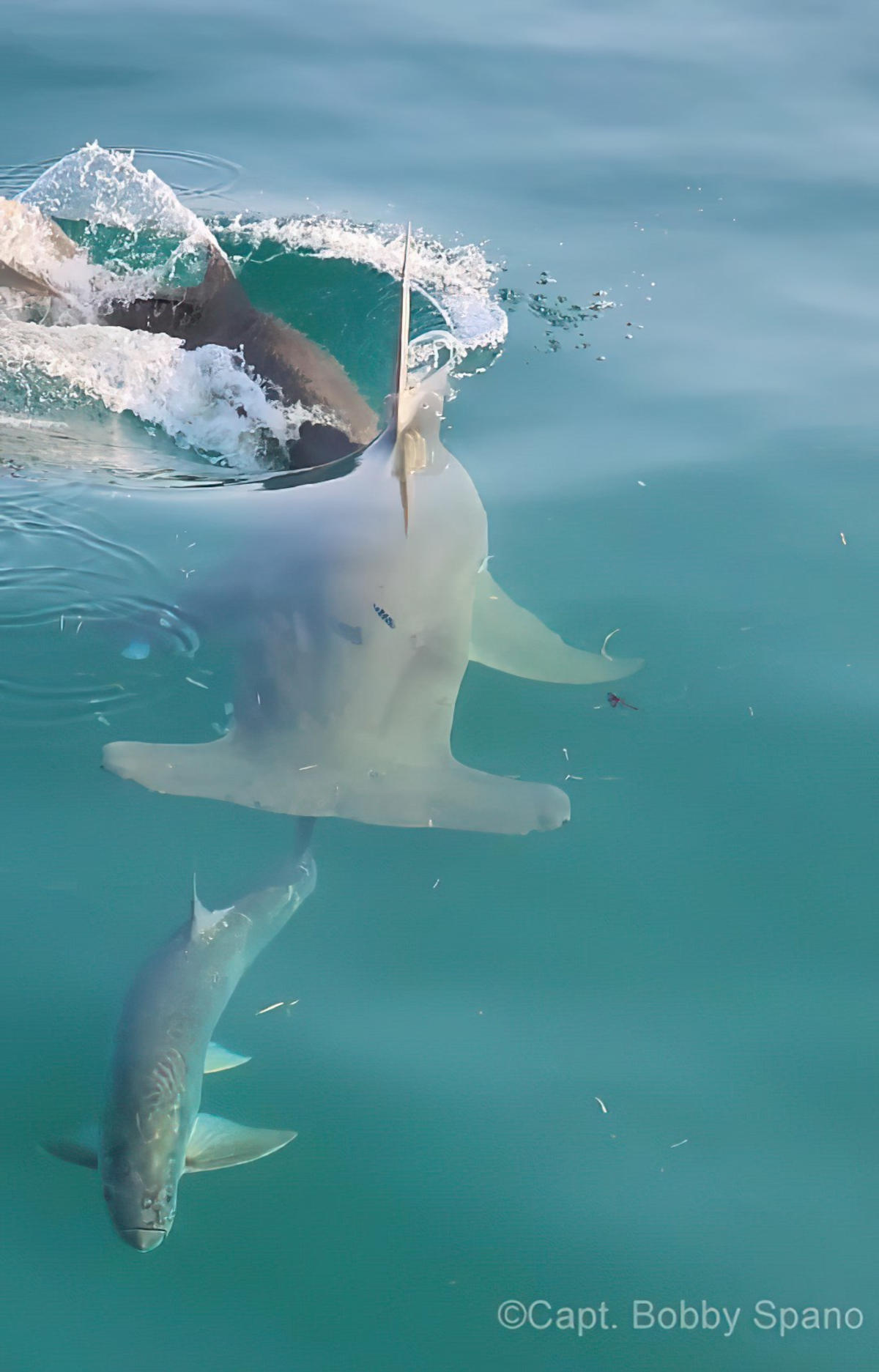
First-of-its-kind research monitors hammerheads, tarpon, and anglers, advocating for an ecological solution.
Wave-making research recently published in Marine and Coastal Fisheries, led by biologists from the University of Massachusetts Amherst, has successfully measured the frequency of great hammerhead sharks preying on Atlantic tarpon caught by fishermen at Bahia Honda, Florida—one of the prime tarpon fishing spots in the Florida Keys.
Called the “depredation rate,” the team found that 15.3% of tarpon that were hooked by anglers and fought for more than five minutes were eaten while still on the line. But the researchers also show that this is not necessarily a sign that the ecosystem is out of balance. To the contrary, increased reports of depredation are to be expected, especially as great hammerhead sharks, listed as critically endangered by the International Union for the Conservation of Nature (IUCN), are seeing their population stabilize in the southeastern United States; the result of decades of conservation and management efforts.
At the same time, angling is an increasingly popular sport. Which means that there is a greater chance for human-fish-shark encounters. To help manage the health of both the tarpon fishery and the hammerhead population, the researchers urge solutions that don’t impact either species.
The Tarpon Fishery and Conservation Concerns
Tarpon are one of the most iconic saltwater fish in the Southeastern and Gulf states. Many an angler spends their life dreaming of hooking a tarpon that could easily exceed 100 pounds, which are known to fight fiercely, often leaping entirely clear of the water in their efforts to shake a hook. The tarpon fishery, which extends from Texas to the Carolinas in the U.S., is, by some estimates, a multi-million-dollar-per-year industry, and the fish is tied deeply to local culture.
A great hammerhead taking a tarpon right at the boat in Bahia Honda. Credit: Grace Casselberry
Yet, despite the legendary toughness of the species, the tarpon is listed as “vulnerable” by the IUCN, and their populations seem to have been affected by fishing, degraded water quality, and habitat loss. Recently, guides have been increasingly reporting that sharks are taking a bigger bite out of the tarpon catch in recent years, and may, in fact, pose a risk to the species’ survival. But, until now, there’s been no hard data on just what the depredation rate might be, which makes it difficult to make informed conservation decisions, for either the tarpon or the hammerheads.
Methodology of the Study
To arrive at the depredation rate, and then to track both the tarpons’ and sharks’ yearly movements through a specific area, you need a few things: high-tech acoustic telemetry equipment, stout fishing gear, and a comfy lawn chair.
Acoustic telemetry has recently revolutionized scientists’ ability to track migratory marine species. The technique involves anchoring an acoustic receiver in the water and implanting a small transmitter into whatever it is you want to track. In this case, lead author Grace Casselberry, a postdoctoral researcher at UMass Amherst, and her colleagues deployed 16 receivers in a gridded array in the Bahia Honda Channel. They then caught and tagged 51 tarpon and 14 hammerhead sharks. Over the course of more than two years, every time one of the tagged tarpon or hammerheads swam within range of the receiver, the receiver would log that individual animal’s unique ID, date, and time.
Then came the lawn chair. “I sat in that chair for two months,” says Casselberry, “watching all day long through binoculars and a camera with a long lens as people fished. Every time someone hooked tarpon, I recorded the time of day, the current, whether the tide was going in or out, which boats were fishing, how many anglers were in the area, how long it took them to bring the tarpon to their boat and whether or not a hammerhead ate the fish. I saw a total of 394 tarpon hooked.”
Findings and Implications
With all that data, the researchers revealed that the longer the angler fought their tarpon, the more likely it was to be eaten, and that when the fight lasted for more than five minutes, there was a 15.3% chance that the tarpon would be snatched by a hammerhead. These depredations most often occur on an outgoing current, which was also supported by the acoustic telemetry data that showed the hammerheads occupied a smaller area within the channel corresponding to where most tarpon are hooked and fought. The team also found that tarpon tends to congregate in Bahia Honda during the spring, pre-spawning seasons—and the hammerheads know it. So do the anglers.
“Bahia Honda has most likely been a place where sharks and tarpon have congregated for a very long time,” says Andy Danylchuk, senior author and professor of fish conservation at UMass Amherst. “If there was less depredation in recent memory, that is likely due to the fact that the population of great hammerheads was dangerously low.” But fishing pressure has also increased in recent decades. “There are more sharks in the water and also more hooks in the water,” Danylchuk continues, “which is the perfect recipe for more shark-fish-human encounters.” In fact, depredation is a growing issue in the United States, as evidenced by the recent SHARKED Act put before Congress to help find solutions.
Challenges and Conservation Recommendations
“It has taken 30 years to get the hammerheads to the point where they are just starting to recover,” says Casselberry, “and all that work could be undone if we start killing sharks indiscriminately.”
“There’s some evidence that the hammerheads are pregnant females,” adds Danylchuk, “and if they are culled, it could decimate their numbers.”
None of this means that anglers need to stop fishing for tarpon in Bahia Honda, but it does mean that conservation efforts, of both tarpon and hammerheads, should be informed by solutions that don’t impact the tarpon, the hammerheads, or the anglers. Casselberry and her colleagues suggest that anglers use fishing gear that will allow them to land tarpon faster, thus reducing fight times and the opportunity for depredation. They should also avoid fishing during the outgoing tide, which is when most depredation events occur. Anglers who use fish-finders should monitor for sharks and consider relocating when hammerheads are in the area.
“We are advocating for anglers to think of themselves as part of the ocean ecosystem, rather than working against it,” says Casselberry.
Reference: “Depredation rates and spatial overlap between Great Hammerheads and Tarpon in a recreational fishing hot spot” by Grace A. Casselberry, Gregory B. Skomal, Lucas P. Griffin, Jacob W. Brownscombe, Alex Filous, Peter E. Holder, Joseph Dello Russo, Campbell Morgan, Jeff Kneebone, Aaron J. Adams, Steven J. Cooke and Andy J. Danylchuk, 22 January 2024, Marine and Coastal Fisheries.
DOI: 10.1002/mcf2.10277
Never miss a breakthrough: Join the SciTechDaily newsletter.
Follow us on Google and Google News.