

December offers a celestial treat with Venus shining as the “Evening Star” and Jupiter at its brightest during opposition. Highlights include Venus pairing with the crescent Moon, Jupiter flanked by the Moon and Aldebaran, and Mars nearing opposition, glowing brightly beside the Moon mid-month. Winter skies introduce Orion, Taurus, and Gemini, while the Winter Triangle dominates the season. The Geminid meteor shower peaks under moonlit conditions, and the winter solstice marks the start of the new season.
Catch December’s Celestial Highlights!
This month, Venus dazzles as the “Evening Star,” Jupiter reaches its brightest for the year, and the Geminid meteor shower peaks under challenging moonlit skies.
Skywatching Highlights
All Month – Planet Visibility:
- Mercury: Visible very low in the southeast just before sunrise during the last half of the month.
- Venus: Shines brightly as the “Evening Star” in the southwest after sunset, climbing higher each evening.
- Mars: Brightens significantly during December, rising in the east-northeast and visible from late evening to early morning.
- Jupiter: Reaches opposition on December 7, making it visible all night, rising in the east-northeast.
- Saturn: Visible after sunset in the southern sky, shifting slightly westward as the month progresses.
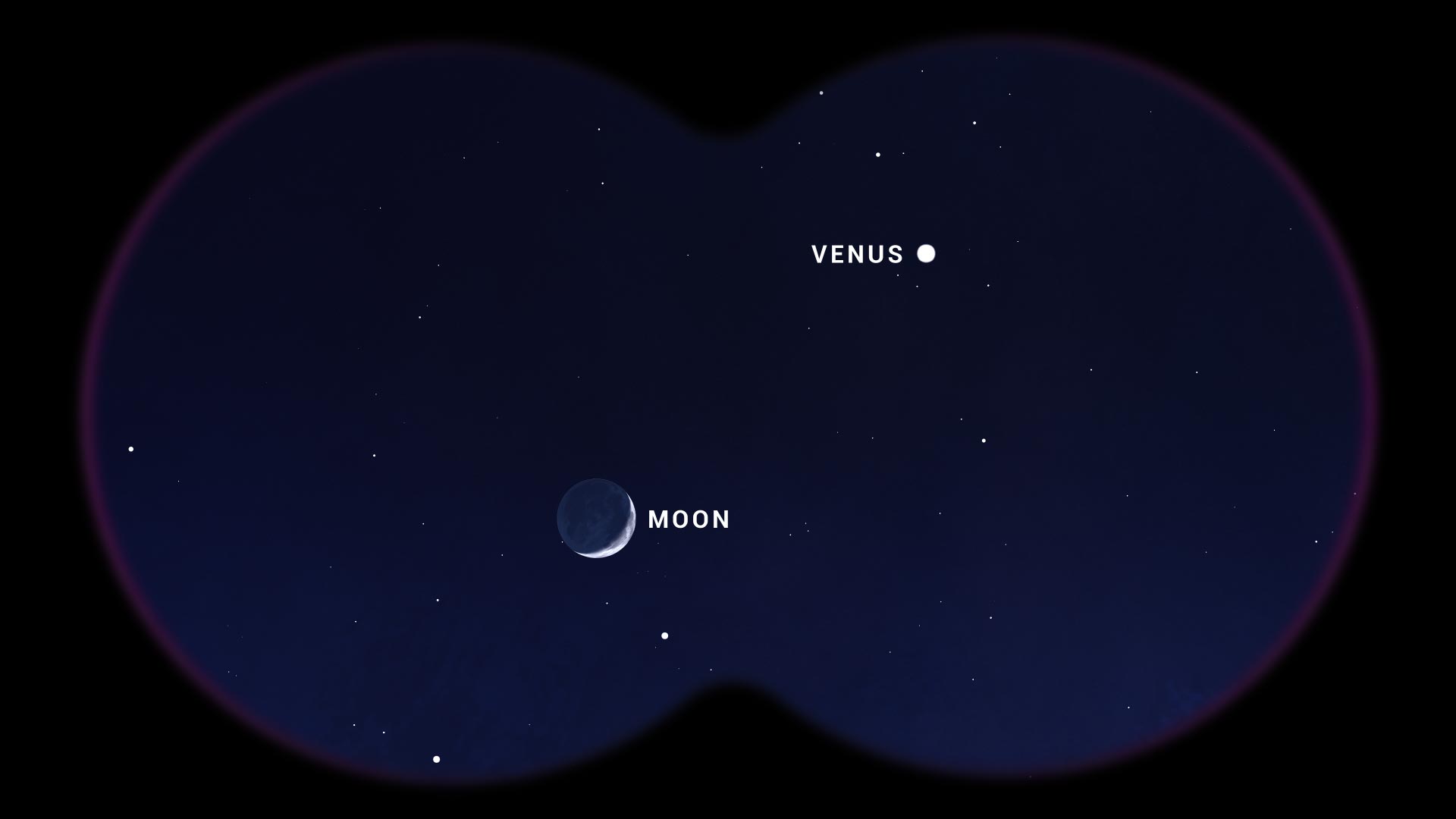
December 3-5 – Venus and the Moon: Look southwest after sunset to see a beautiful pairing. On December 4, a slim crescent Moon will sit directly below Venus.
December 7 – Jupiter at Opposition: Jupiter will shine at its brightest for the year, rising in the east-northeast among Taurus’s stars. Best viewed through a telescope for details like the Galilean moons and atmospheric belts.
December 14 – Jupiter, the Moon, and Aldebaran: Look for Jupiter midway between the nearly full Moon and bright orange star Aldebaran in the evening sky.
December 17 – Mars and the Moon: Mars, glowing brightly in its approach to opposition, appears super close to the waning gibbous Moon.
All Month – Winter Triangle: Formed by Sirius, Procyon, and Betelgeuse, this asterism marks the arrival of winter skies and is a prominent feature throughout the season.
December 13-14 – Geminid Meteor Shower: The peak occurs under a nearly full Moon, reducing visibility, but bright meteors may still be spotted the week before.
December 21 – Winter Solstice: At 4:20 a.m. EST, the solstice marks the beginning of winter in the Northern Hemisphere and summer in the Southern Hemisphere.
Video Transcript
What’s Up for December?
Venus, Jupiter, and Mars shine brightly; the stars of winter and their pointy little friend; and “Meteors, meet the Moon.”
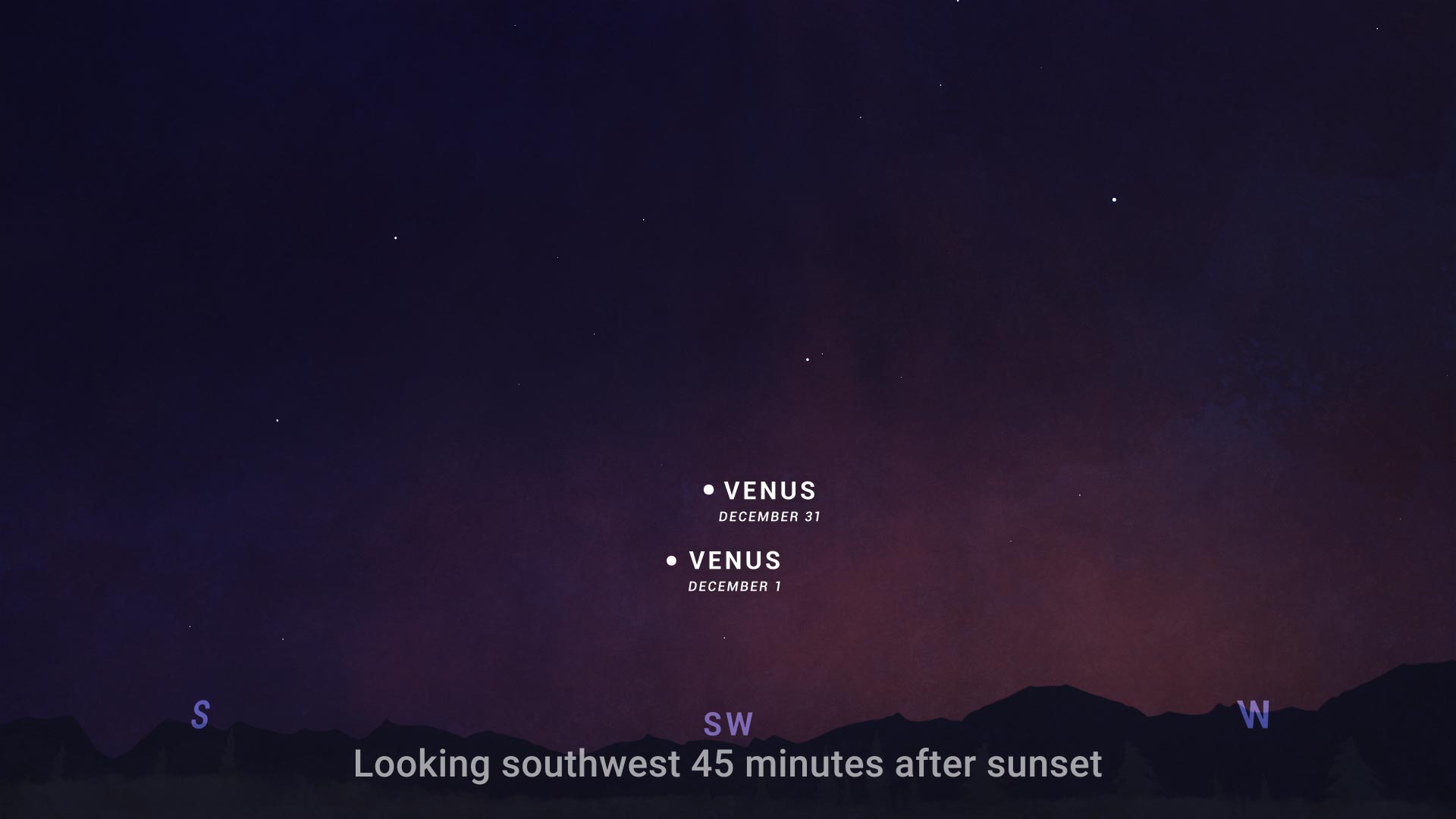
Starting off with the planets, Venus is hard to miss in the southwest after sunset – it’s that dazzling bright “evening star.” You’ll find it getting a bit higher in the sky each evening through the month. On December 4th, look for a slim crescent Moon hanging right below it, making for a great photo opportunity!
Saturn is visible toward the south beginning at nightfall. Look for it to track a bit farther to the west as the weeks go by. Meanwhile, Jupiter reaches opposition on December 7th, meaning it’s at its brightest for the year and visible all night long. You’ll find it rising in the east-northeast as darkness falls, among the stars of the constellation Taurus. Mid-month, around December 14th, watch for Jupiter sitting between the nearly full Moon and Taurus’s brightest star, orange-colored Aldebaran.
Next, Mars will also be putting on its own show, doubling its brightness during December as it heads toward its own opposition in January. Early in the month, it rises about four hours after dark, but by New Year’s Eve, it’s rising just about 90 minutes after sunset – always shining with its distinctive reddish hue. And on December 17th, you’ll find the Red Planet super close to the Moon, which will be just two days past its full phase.
The stars of winter are making their grand entrance in December. As evening falls, you’ll see the mighty hunter Orion rising in the east, with Taurus the bull above it, and the stars of the twins in Gemini to their left. These constellations host some wonderful sights – like the Crab Nebula and Pleiades star cluster in Taurus and the misty Orion Nebula, which hangs below Orion’s belt. If you look to the western sky soon after dark, you can still spot the three bright stars of the Summer Triangle getting quite low on the horizon. But as they depart, three bright stars of winter bring their own prominent triangular shape to mark the season.
Once you spot Orion’s distinctive belt of three stars, you’re well on your way to finding what we call the Winter Triangle. Just follow the belt stars to the left and slightly downward – they point right to Sirius, the brightest star in the night sky. Then look upward and to the left of Sirius to spot Procyon, and back up toward Orion to find reddish Betelgeuse at its shoulder. These three bright stars form an equilateral triangle that’s visible throughout the season.
The Geminid meteor shower peaks after midnight in the early morning of December 14th, and they’re usually one of the best meteor showers of the year under good conditions. This year, the nearly full Moon will wash out the fainter meteors on the peak night. Still, the Geminids are known for bright meteors, and it’s common to spot their shooting stars up to a week before the peak. If you’re up before dawn that week, it’s worth looking up, just in case you spot a speck of dust from space streaking through the morning sky.
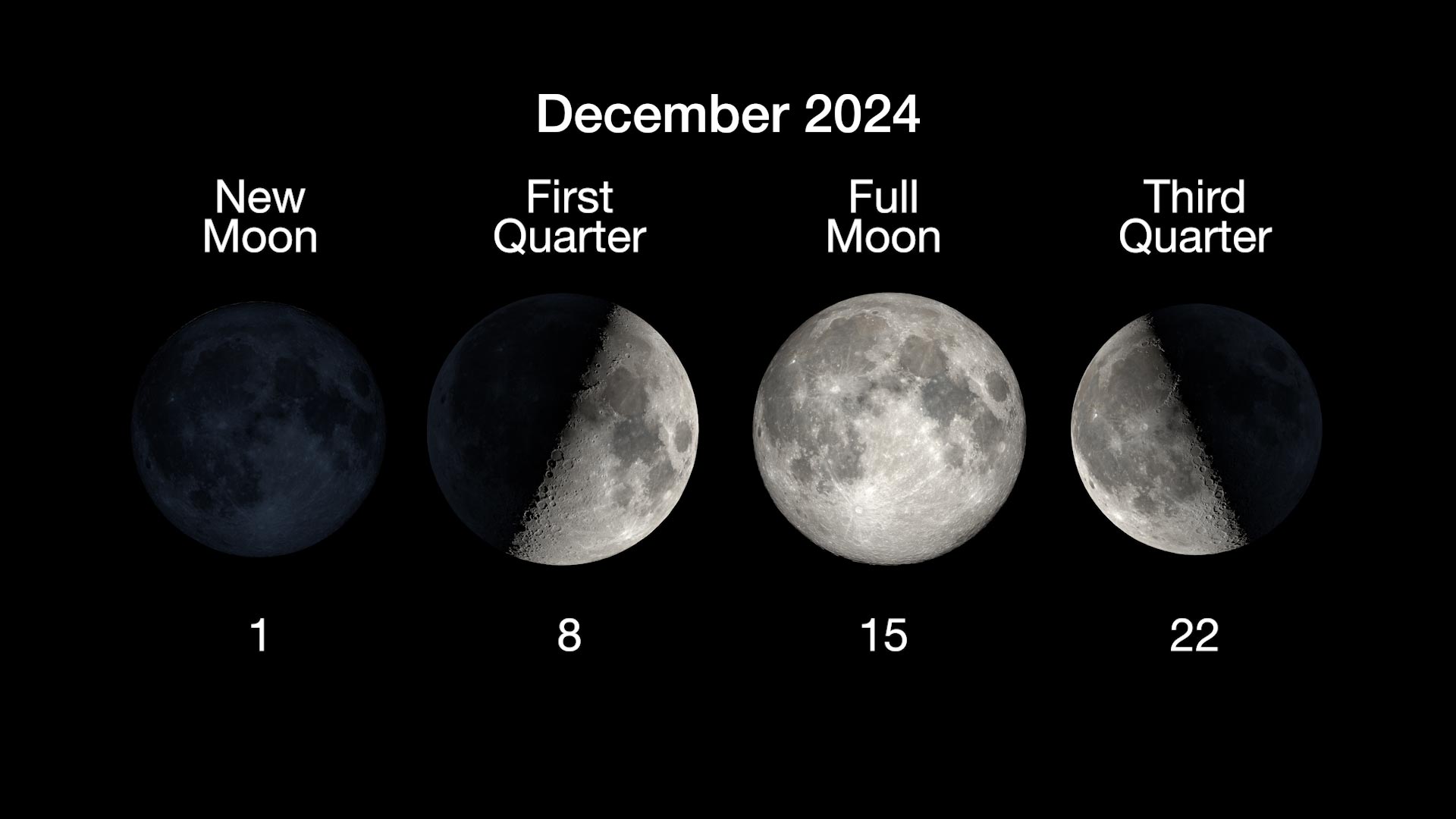
And here are the phases of the Moon for December.
Never miss a breakthrough: Join the SciTechDaily newsletter.
Follow us on Google and Google News.
2 Comments
So informative. I will keep my eyes on the sky this month.
It’s been a great view this week from Melbourne’s warm overnight skies with these night bodies clearly visible to the naked eye even 10minutes from the CBD.