
Close Menu
    Facebook X (Twitter) Instagram
    SciTechDaily
    • Biology
    • Chemistry
    • Earth
    • Health
    • Physics
    • Science
    • Space
    • Technology
    Facebook X (Twitter) Pinterest YouTube RSS
    SciTechDaily
    Home»Space»Don’t Miss the Total Solar Eclipse 2021 – Where To See It in Person & How To Watch a Live Stream
    Space

    Don’t Miss the Total Solar Eclipse 2021 – Where To See It in Person & How To Watch a Live Stream

    By NASADecember 3, 20211 Comment4 Mins Read
    Facebook Twitter Pinterest Telegram LinkedIn WhatsApp Email Reddit
    Share
    Facebook Twitter LinkedIn Pinterest Telegram Email Reddit
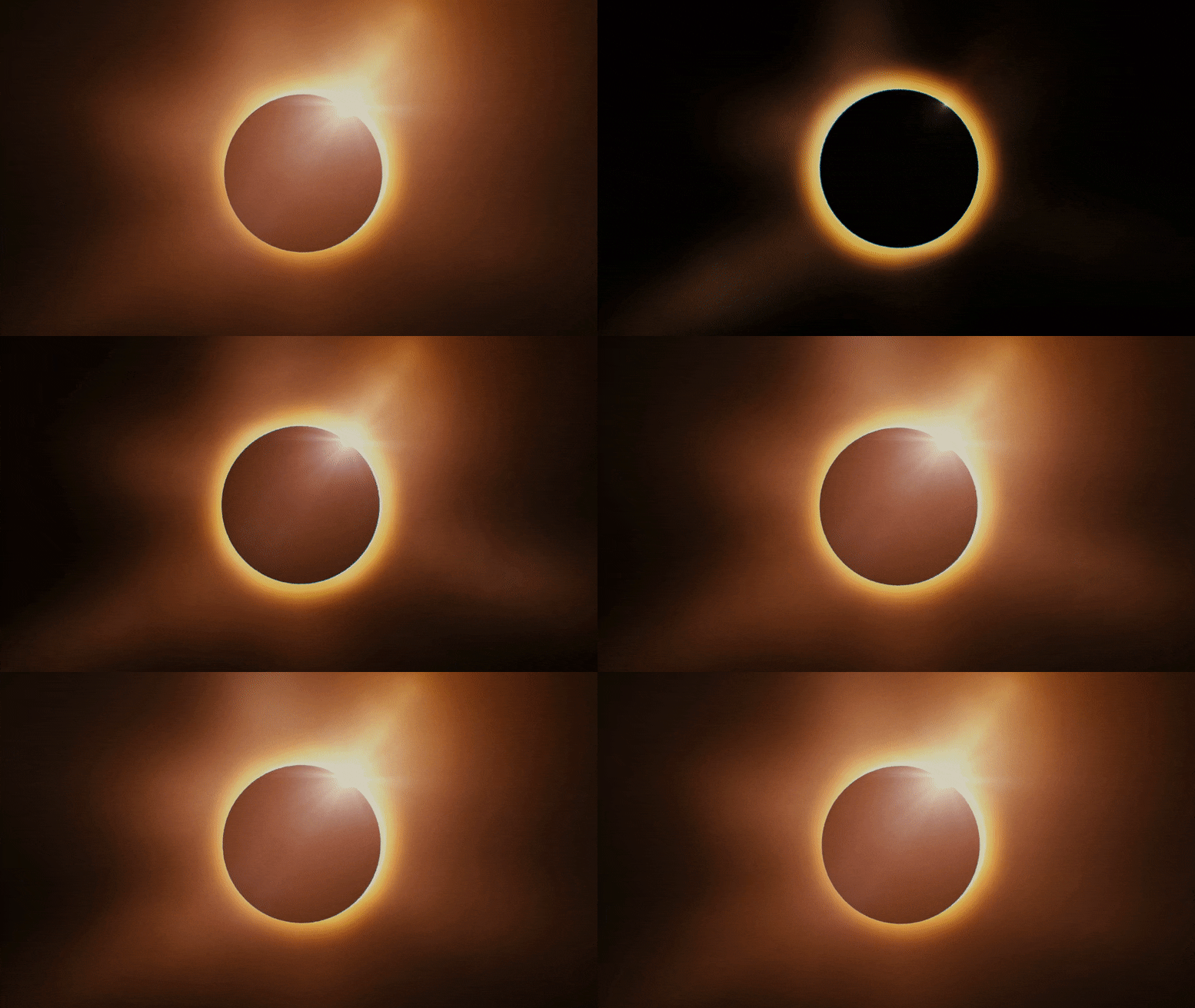
    Total Solar Eclipse
    During a total solar eclipse, the Sun, Moon, and Earth line up so that the Sun is blocked when viewed from within the Moon’s shadow on Earth.

    On Saturday, December 4, 2021, some people in the Southern Hemisphere will have the chance to experience a total or partial eclipse of the Sun.

    A solar eclipse happens when the Moon moves between the Sun and Earth, casting a shadow on Earth, fully or partially blocking the Sun’s light in some areas. For a total solar eclipse to take place, the Sun, Moon, and Earth must be in a direct line. People located in the center of the Moon’s shadow when it hits Earth will see a total eclipse. The sky becomes very dark, as if it were dawn or dusk. Weather permitting, people in the path of a total solar eclipse can see the Sun’s corona, the outer atmosphere, which is otherwise usually obscured by the bright face of the Sun.

    The only place where this total solar eclipse can be seen is Antarctica.

    In some places, while viewers won’t get to see the total solar eclipse, they’ll instead experience a partial solar eclipse. This happens when the Sun, Moon, and Earth are not exactly lined up. The Sun will appear to have a dark shadow on only part of its surface. Viewers in parts of Saint Helena, Namibia, Lesotho, South Africa, South Georgia and Sandwich Islands, Crozet Islands, Falkland Islands, Chile, New Zealand, and Australia will see a partial solar eclipse on December 4.

    In many of these locations, the eclipse will occur before, during, and after sunrise or sunset. This means that viewers will need to get a clear view of the horizon during sunrise or sunset in order to see the eclipse.

    To see more details about exactly where this eclipse will occur, as well as more in-depth scientific information, please use this image:
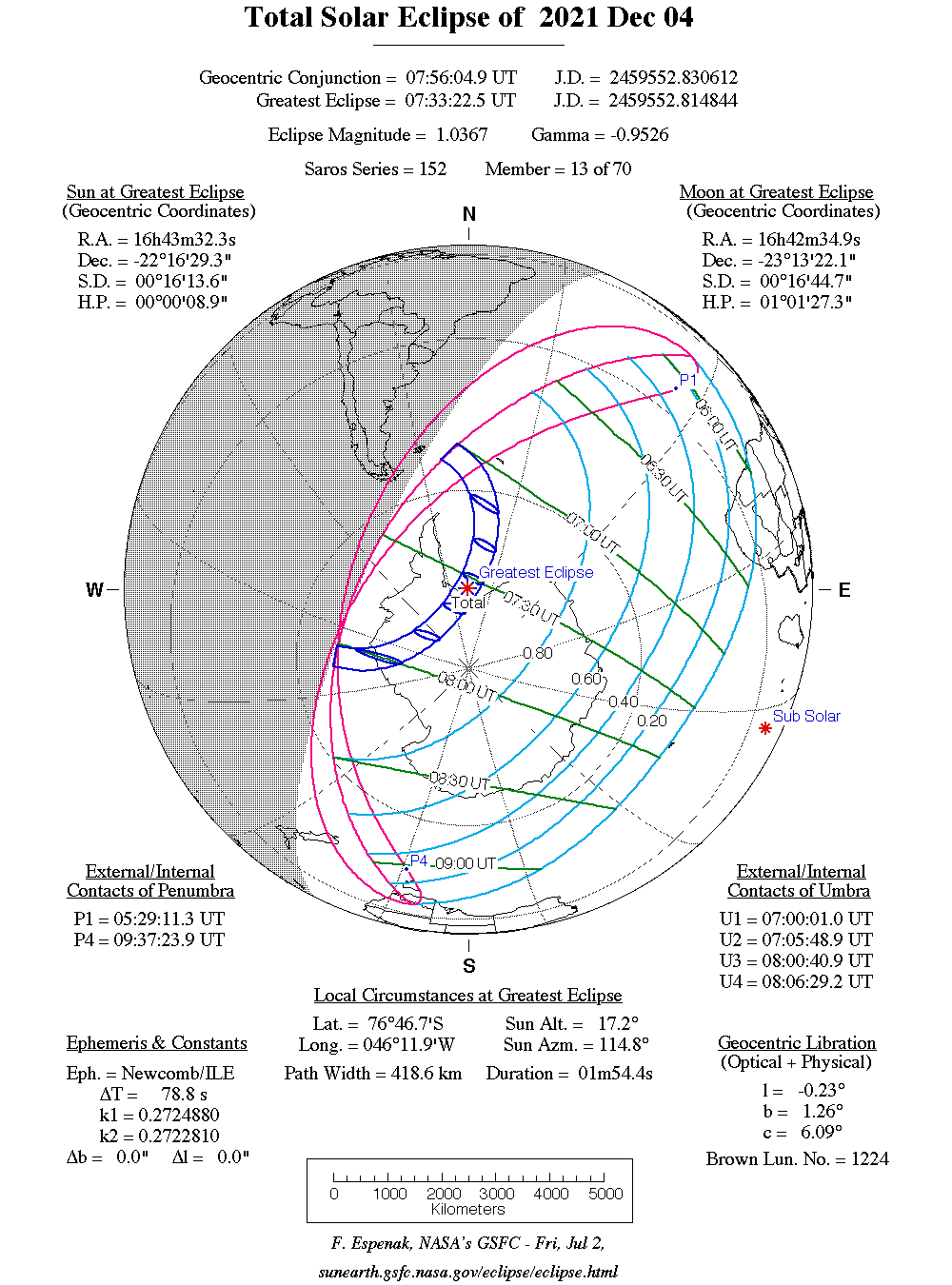
    Total Solar Eclipse 2021

    Download this fact sheet to learn more about eclipses, eclipse safety, and fun eclipse activities:

    Live Stream

    Weather permitting, a view of the total solar eclipse from Union Glacier, Antarctica, will be streamed on YouTube and on nasa.gov/live. This stream is courtesy of Theo Boris and Christian Lockwood of the JM Pasachoff Antarctic Expedition.

    The stream starts at 1:30 a.m. EST. Totality begins at 2:44 a.m. EST. The stream ends at 3:37 a.m. EST.

    How to Safely Watch a Total or Partial Solar Eclipse

    It is never safe to look directly at the Sun, even if the Sun is partly or mostly obscured. When viewing a partial solar eclipse, you must wear solar viewing or eclipse glasses throughout the entire eclipse if you want to face the Sun. Solar viewing or eclipses glasses are NOT regular sunglasses; regular sunglasses are not safe for viewing the Sun.

    If you are in the path of a total solar eclipse, you can take off your solar viewing or eclipse glasses only when the Moon is completely blocking the Sun. To learn when you can safely remove your glasses, see this page.

    If you don’t have solar viewing or eclipse glasses, you can use an alternate indirect method, such as a pinhole projector. Pinhole projectors shouldn’t be used to look directly at the Sun, but instead to project sunlight onto a surface. Read a how-to guide for creating a pinhole viewer.

    In October 2023, an annular solar eclipse will cross North America. Then, just six months later, in April 2024, a total solar eclipse will cross the continent. These events provide a unique opportunity for people in the United States to experience an eclipse.


    Never miss a breakthrough: Join the SciTechDaily newsletter.
    Follow us on Google and Google News.

    Astronomy Moon NASA Solar Eclipse Sun
    Share. Facebook Twitter Pinterest LinkedIn Email Reddit

    Related Articles

    A “Ring of Fire” in the Sky: The Solar Eclipse Experience

    Five NASA Tips for Photographing the “Ring of Fire” Solar Eclipse

    Don’t Miss: A “Ring of Fire” in the Sky

    NASA Science in the Shadows: Five Exciting Experiments for 2024 Total Solar Eclipse

    Don’t Miss Eclipses: NASA Releases New Map of Upcoming Solar Eclipses

    Total Solar Eclipse Below the Bottom of the World Captured From Airplane

    NASA’s ACE Mission: Total Solar Eclipses Shine a Light on the Solar Wind

    Don’t Miss the Breathtaking “Ring of Fire” Solar Eclipse

    NASA’s Solar Dynamics Observatory Spots First Lunar Transit of 2021

    1 Comment

    1. Dorit Vanderwilden on December 3, 2021 7:57 am

      Unsubscribe me! This is my, at least, 20th request to UNSUBSCRIBE!

      Reply
    Leave A Reply Cancel Reply

    • Facebook
    • Twitter
    • Pinterest
    • YouTube

    Don't Miss a Discovery

    Subscribe for the Latest in Science & Tech!

    Trending News

    The Universe Is Expanding Too Fast and Scientists Can’t Explain Why

    “Like Liquid Metal”: Scientists Create Strange Shape-Shifting Material

    Early Warning Signals of Esophageal Cancer May Be Hiding in Plain Sight

    Common Blood Pressure Drug Shows Surprising Power Against Deadly Antibiotic-Resistant Superbug

    Scientists Uncover Dangerous Connection Between Serotonin and Heart Valve Disease

    Scientists Discover a “Protector” Protein That Could Help Reverse Hair Loss

    Bone-Strengthening Discovery Could Reverse Osteoporosis

    Scientists Uncover Hidden Trigger Behind Stem Cell Aging

    Follow SciTechDaily
    • Facebook
    • Twitter
    • YouTube
    • Pinterest
    • Newsletter
    • RSS
    SciTech News
    • Biology News
    • Chemistry News
    • Earth News
    • Health News
    • Physics News
    • Science News
    • Space News
    • Technology News
    Recent Posts
    • A Common Diabetes Drug May Hold the Key to Stopping HIV From Coming Back
    • Ancient “Syphilis-Like” Disease in Vietnam Challenges Key Scientific Assumptions
    • Drinking Alcohol To Cope in Your 20s Could Damage Your Brain for Life
    • Scientists Crack Alfalfa’s Chromosome Mystery After Decades of Debate
    • Ancient Ant-Plant Alliance Collapses As Predatory Wasps Move In
    Copyright © 1998 - 2026 SciTechDaily. All Rights Reserved.
    • Science News
    • About
    • Contact
    • Editorial Board
    • Privacy Policy
    • Terms of Use

    Type above and press Enter to search. Press Esc to cancel.