

New Earth-sized exoplanet HD 63433 d, discovered by astronomers using TESS, is exceptionally young and orbits closely around a Sun-like star, presenting extreme heat and unique research opportunities.
In a system with two known planets, astronomers spotted something new: a small object transiting across the Sun-sized star. This turned out to be another planet: extra hot and Earth-sized.
Key Features of HD 63433 d
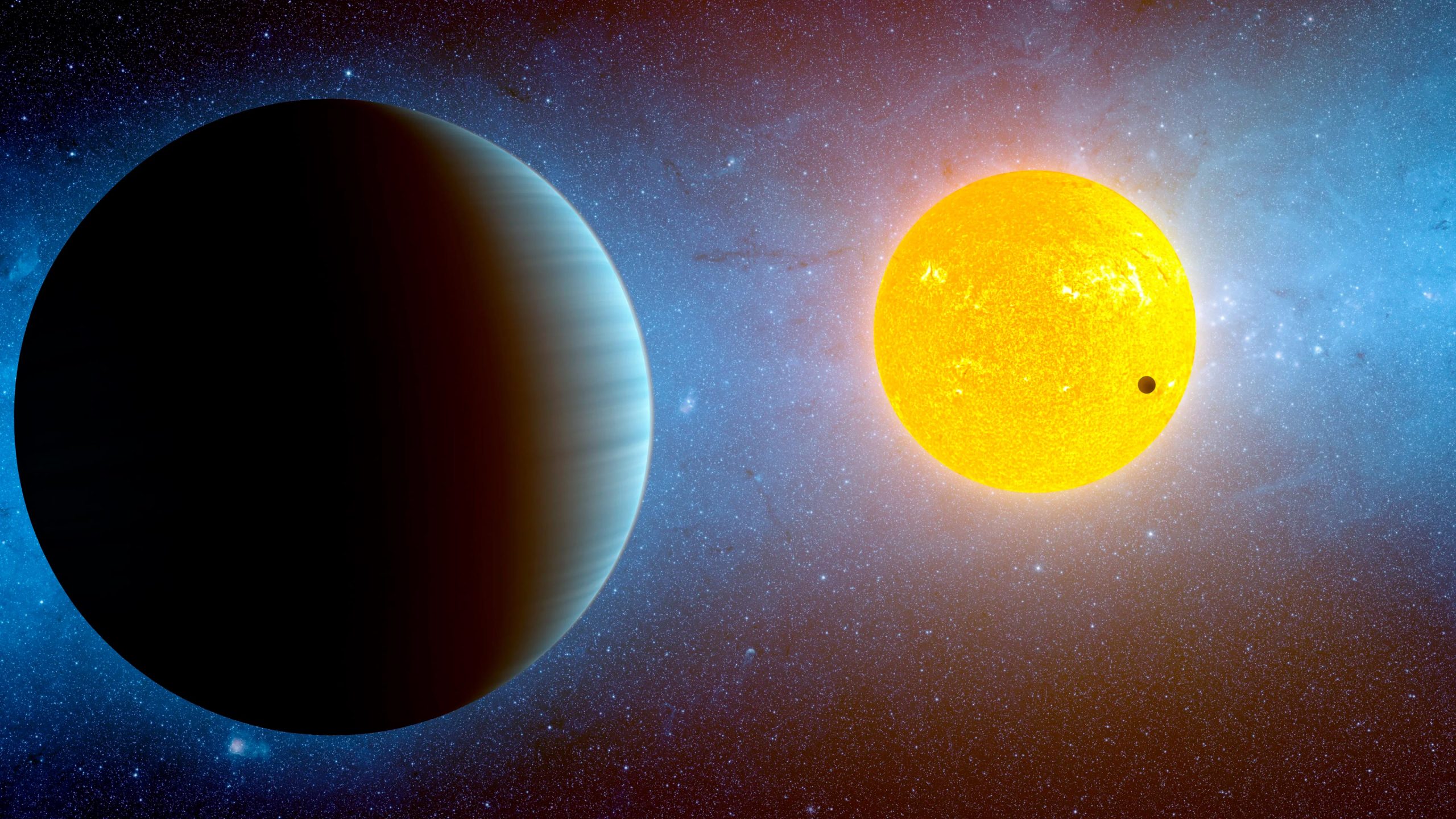
The newly-spotted planet, called HD 63433 d, is tidally locked, meaning there is a dayside that always faces its star and a side that is constantly in darkness. This exoplanet, or planet outside of our solar system, orbits around the star HD 63433 (TOI 1726) in the HD 63433 planetary system. This scorching world is the smallest confirmed exoplanet younger than 500 million years old. It’s also the closest discovered Earth-sized planet this young, at about 400 million years old.
In-Depth Analysis by Astronomers
A team of astronomers analyzed this system using data from NASA’s TESS (Transiting Exoplanet Survey Satellite), which spots “transits,” or instances where planets cross in front of their star as they orbit, blocking a tiny piece of the starlight. Two planets had already been previously discovered in this planetary system, so to see what else might be lurking in the star’s orbit, the team took the data and removed the signals of the two known planets. This allowed them to see an additional signal — a small transit that would reappear every 4.2 days. Upon further investigation, they were able to validate that this was actually a third, smaller planet.
The tidally locked planet is very close to Earth size (it is approximately 1.1 times the diameter of our own planet) and it’s orbiting a star that’s similar to the size of our Sun (the star is about 0.91 the size and 0.99 the mass of the Sun).
The star in this system is a G-type star, the same type as our Sun. But HD 63433 d orbits much closer to its star than we do, with a minuscule 4.2-day-long “year” and extremely high temperatures on its dayside.
Interesting Aspects of HD 63433 d
While this newly found planet and its star are just about the size of our own planet and Sun, HD 63433 d is quite different from our home world.
Firstly, it is a very young planet in a very young system. The planetary system itself is about 10 times younger than ours and this 400-million-year-old planet is in its infancy compared to our 4.5-billion-year-old world.
It is also much closer to its star than we are to ours. This planet is 8 times closer to its star than Mercury is to the Sun. Being so close to its star, this dayside of this tidally-locked planet can reach temperatures of about 2,294 Fahrenheit (1,257 Celsius). Being so hot, so close to its star, and so small, this planet likely lacks a substantial atmosphere.
These scorching temperatures are comparable to lava worlds like CoRoT-7 b and Kepler-10 b, and the team behind this discovery thinks that the planet’s dayside could be a “lava hemisphere.”
The planet’s small size, young age, and closeness to its star make it an interesting candidate for further exploration. A follow-up study could confirm the results of this study and potentially reveal more information about the planet’s “dark side,” and the status of its (possible) atmosphere. As this study states, “Young terrestrial worlds are critical test beds to constrain prevailing theories of planetary formation and evolution.”
The Discovery Team
This discovery was described in a new study, published in the Astronomical Journal, titled “TESS Hunt for Young and Maturing Exoplanets (THYME) XI: An Earth-sized Planet Orbiting a Nearby, Solar-like Host in the 400 Myr Ursa Major Moving Group.” The study, led by co-authors Benjamin Capistrant and Melinda Soares-Furtado, was discussed in a presentation at the 2024 American Astronomical Society Meeting.
For more on this study, see Earth-Sized Planet Discovered in “Our Solar Backyard.”
Reference: “TESS Hunt for Young and Maturing Exoplanets (THYME). XI. An Earth-sized Planet Orbiting a Nearby, Solar-like Host in the 400 Myr Ursa Major Moving Group” by Benjamin K. Capistrant, Melinda Soares-Furtado, Andrew Vanderburg, Alyssa Jankowski, Andrew W. Mann, Gabrielle Ross, Gregor Srdoc, Natalie R. Hinkel, Juliette Becker, Christian Magliano, Mary Anne Limbach, Alexander P. Stephan, Andrew C. Nine, Benjamin M. Tofflemire, Adam L. Kraus, Steven Giacalone, Joshua N. Winn, Allyson Bieryla, Luke G. Bouma, David R. Ciardi, Karen A. Collins, Giovanni Covone, Zoë L. de Beurs, Chelsea X. Huang, Jon M. Jenkins, Laura Kreidberg, David W. Latham, Samuel N. Quinn, Sara Seager, Avi Shporer, Joseph D. Twicken, Bill Wohler, Roland K. Vanderspek, Ricardo Yarza and Carl Ziegler, 10 January 2024, The Astronomical Journal.
DOI: 10.3847/1538-3881/ad1039
This study was conducted as part of the TESS Hunt for Young and Maturing Exoplanets, which is a project focused on searching for young exoplanets that are in moving groups, stellar associations, or open clusters.
Never miss a breakthrough: Join the SciTechDaily newsletter.
Follow us on Google and Google News.