
Novel method, developed by McGovern Institute researchers, may lead to safer, more efficient gene therapies.
Gene editing, or purposefully changing a gene’s DNA sequence, is a powerful tool for studying how mutations cause disease, and for making changes in an individual’s DNA for therapeutic purposes. A novel method of gene editing that can be used for both purposes has now been developed by a team led by Guoping Feng, the James W. (1963) and Patricia T. Poitras Professor in Brain and Cognitive Sciences at MIT.
“This technical advance can accelerate the production of disease models in animals and, critically, opens up a brand-new methodology for correcting disease-causing mutations,” says Feng, who is also a member of the Broad Institute of Harvard and MIT and the associate director of the McGovern Institute for Brain Research at MIT. The new findings were published online on May 26, 2021, in the journal Cell.
Genetic Models of Disease
A major goal of the Feng lab is to precisely define what goes wrong in neurodevelopmental and neuropsychiatric disorders by engineering animal models that carry the gene mutations that cause these disorders in humans. New models can be generated by injecting embryos with gene editing tools, along with a piece of DNA carrying the desired mutation.
In one such method, the gene editing tool CRISPR is programmed to cut a targeted gene, thereby activating natural DNA mechanisms that “repair” the broken gene with the injected template DNA. The engineered cells are then used to generate offspring capable of passing the genetic change on to further generations, creating a stable genetic line in which the disease, and therapies, are tested.
Although CRISPR has accelerated the process of generating such disease models, the process can still take months or years. Reasons for the inefficiency are that many treated cells do not undergo the desired DNA sequence change at all, and the change only occurs on one of the two gene copies (for most genes, each cell contains two versions, one from the father and one from the mother).
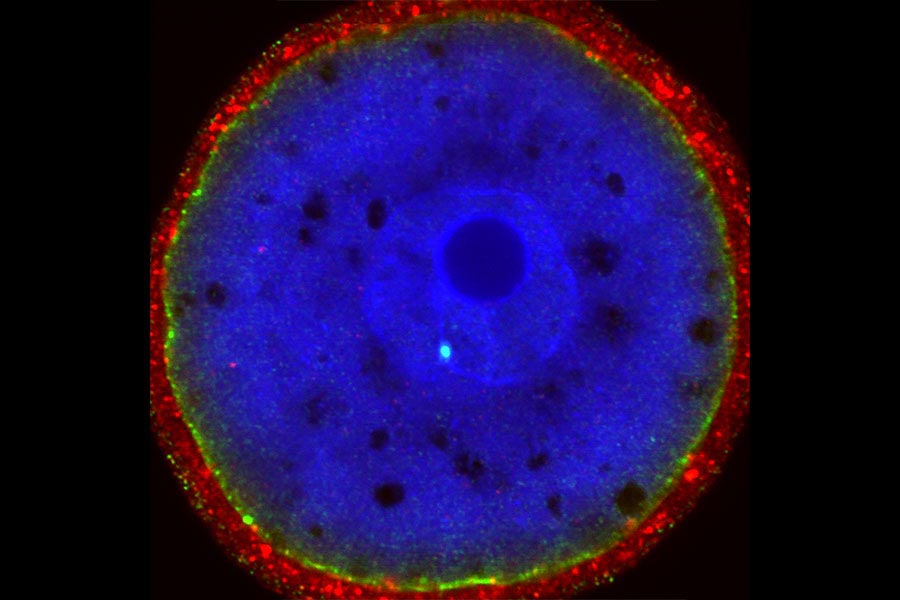
In an effort to increase the efficiency of the gene editing process, the Feng lab team initially hypothesized that adding a DNA repair protein called RAD51 to a standard mixture of CRISPR gene editing tools would increase the chances that a cell (in this case a fertilized mouse egg, or one-cell embryo) would undergo the desired genetic change.
As a test case, they measured the rate at which they were able to insert (“knock-in”) a mutation in the gene Chd2 that is associated with autism. The overall proportion of embryos that were correctly edited remained unchanged, but to their surprise, a significantly higher percentage carried the desired gene edit on both chromosomes. Tests with a different gene yielded the same unexpected outcome.
“Editing of both chromosomes simultaneously is normally very uncommon,” explains postdoc Jonathan Wilde. “The high rate of editing seen with RAD51 was really striking, and what started as a simple attempt to make mutant Chd2 mice quickly turned into a much bigger project focused on RAD51 and its applications in genome editing,” says Wilde, who co-authored the Cell paper with research scientist Tomomi Aida.
A Molecular Copy Machine
The Feng lab team next set out to understand the mechanism by which RAD51 enhances gene editing. They hypothesized that RAD51 engages a process called interhomolog repair (IHR), whereby a DNA break on one chromosome is repaired using the second copy of the chromosome (from the other parent) as the template.
To test this, they injected mouse embryos with RAD51 and CRISPR but left out the template DNA. They programmed CRISPR to cut only the gene sequence on one of the chromosomes, and then tested whether it was repaired to match the sequence on the uncut chromosome. For this experiment, they had to use mice in which the sequences on the maternal and paternal chromosomes were different.
They found that control embryos injected with CRISPR alone rarely showed IHR repair. However, addition of RAD51 significantly increased the number of embryos in which the CRISPR-targeted gene was edited to match the uncut chromosome.
“Previous studies of IHR found that it is incredibly inefficient in most cells,” says Wilde. “Our finding that it occurs much more readily in embryonic cells and can be enhanced by RAD51 suggest that a deeper understanding of what makes the embryo permissive to this type of DNA repair could help us design safer and more efficient gene therapies.”
A New Way To Correct Disease-Causing Mutations
Standard gene therapy strategies that rely on injecting a corrective piece of DNA to serve as a template for repairing the mutation engage a process called homology-directed repair (HDR).
“HDR-based strategies still suffer from low efficiency and carry the risk of unwanted integration of donor DNA throughout the genome,” explains Feng. “IHR has the potential to overcome these problems because it relies upon natural cellular pathways and the patient’s own normal chromosome for correction of the deleterious mutation.”
Feng’s team went on to identify additional DNA repair-associated proteins that can stimulate IHR, including several that not only promote high levels of IHR, but also repress errors in the DNA repair process. Additional experiments that allowed the team to examine the genomic features of IHR events gave deeper insight into the mechanism of IHR and suggested ways that the technique can be used to make gene therapies safer.
“While there is still a great deal to learn about this new application of IHR, our findings are the foundation for a new gene therapy approach that could help solve some of the big problems with current approaches,” says Aida.
Reference: “Efficient embryonic homozygous gene conversion via RAD51-enhanced interhomolog repair” by Jonathan J. Wilde, Tomomi Aida, Ricardo C.H. del Rosario, Tobias Kaiser, Peimin Qi, Martin Wienisch, Qiangge Zhang, Steven Colvin and Guoping Feng, 26 May 2021, Cell.
DOI: 10.1016/j.cell.2021.04.035
This study was supported by the Hock E. Tan and K. Lisa Yang Center for Autism Research at MIT, the Poitras Center for Psychiatric Disorders Research at MIT, an NIH/NIMH Conte Center Grant, and the NIH Office of the Director.
Never miss a breakthrough: Join the SciTechDaily newsletter.
Follow us on Google and Google News.