
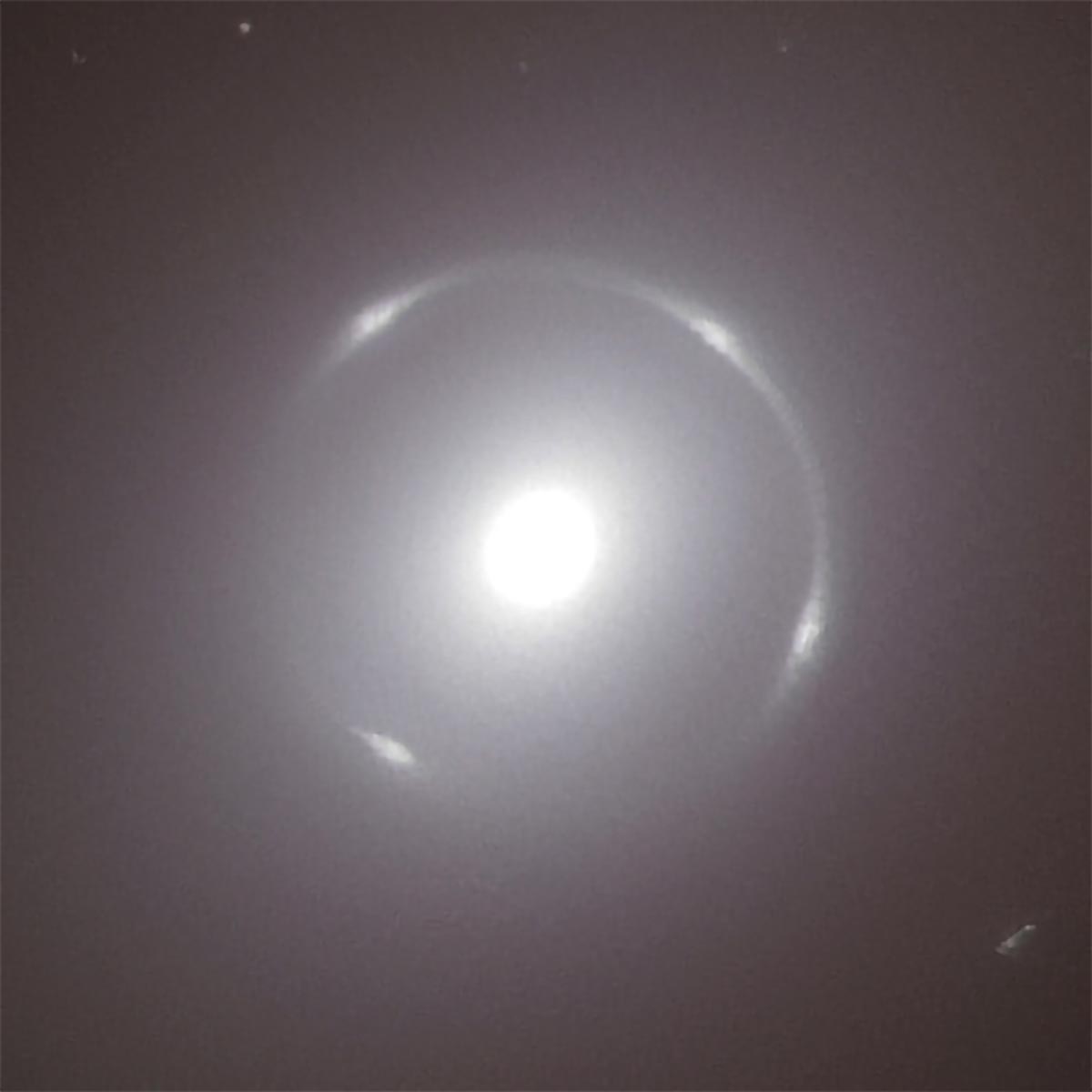
Euclid, a space telescope on a mission to uncover the secrets of dark matter and dark energy, has already made a stunning discovery: a perfectly formed Einstein ring hidden in a well-known galaxy.
This rare phenomenon, predicted by Einstein’s theory of relativity, reveals the power of gravitational lensing, allowing scientists to glimpse far-off galaxies otherwise invisible. The find is a testament to Euclid’s groundbreaking capabilities, suggesting a future filled with even more cosmic surprises.
Euclid’s Mission Begins
Euclid launched on July 1, 2023, beginning its six-year mission to explore the dark universe. Before the spacecraft could start its full survey, scientists and engineers on Earth needed to ensure all systems were functioning properly. As part of this early testing phase, Euclid sent back its first images in September 2023. These initial images were intentionally blurred for calibration purposes, but one caught the attention of Euclid Archive Scientist Bruno Altieri. Within the fuzzy data, he noticed something unusual — possibly a rare cosmic phenomenon — and decided to investigate further.
“I look at the data from Euclid as it comes in,” Altieri explains. “Even from that first observation, I could see it, but after Euclid made more observations of the area, we could see a perfect Einstein ring. For me, with a lifelong interest in gravitational lensing, that was amazing.”
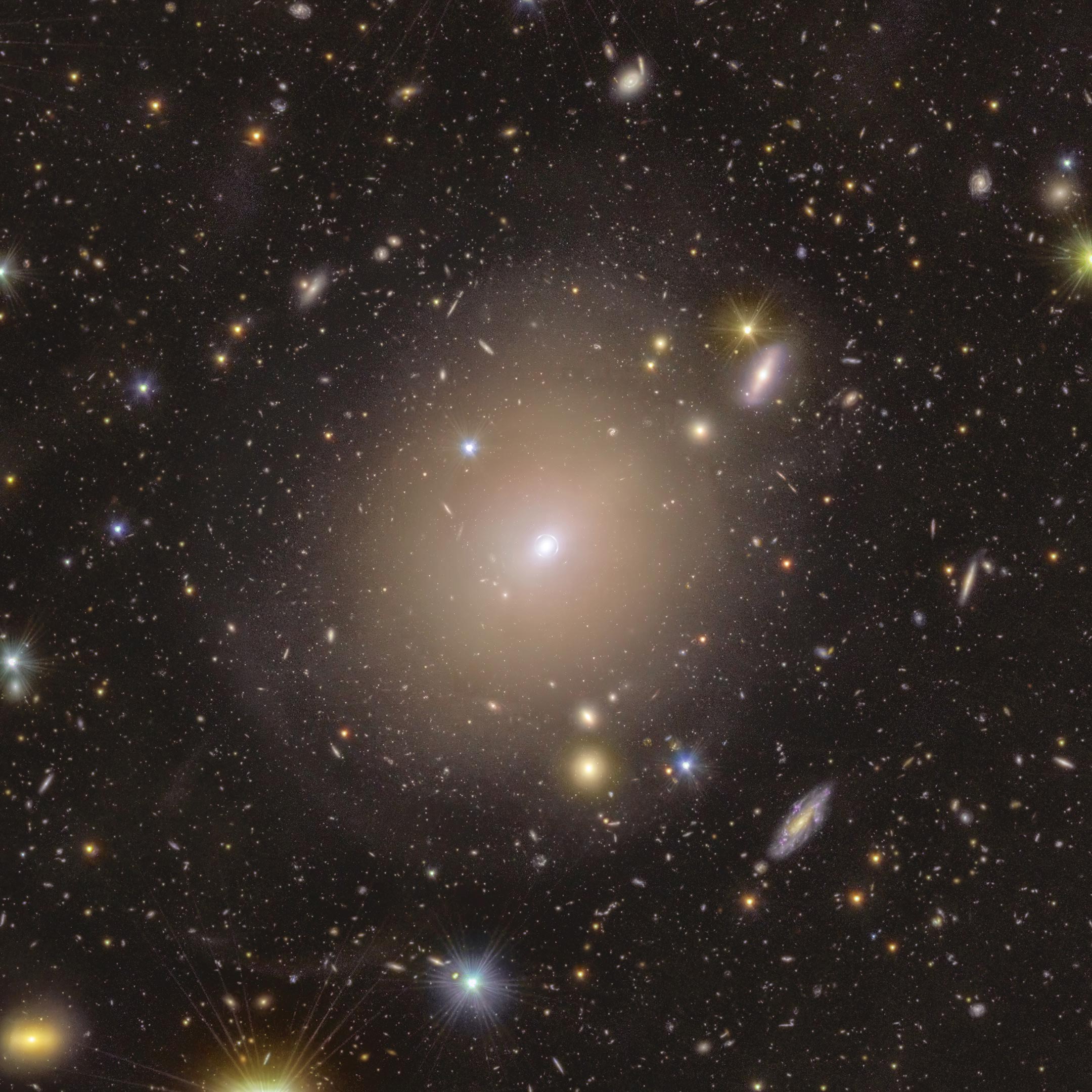
This wide field shows the extended stellar halo of NGC 6505 and showcases the Einstein ring, surrounded by colorful foreground stars and background galaxies.
Credit: ESA/Euclid/Euclid Consortium/NASA, image processing by J.-C. Cuillandre, G. Anselmi, T. Li
A Rare Cosmic Discovery
This Einstein ring, a rare and striking example of gravitational lensing, had been hiding in plain sight in a nearby galaxy. Known as NGC 6505, the galaxy sits about 590 million light-years from Earth — relatively close in cosmic terms. Thanks to Euclid’s advanced high-resolution instruments, this is the first time the luminous ring around its center has been detected.
The Einstein Ring, an extremely rare phenomenon, turned out to be hiding in plain sight in a galaxy not far away. The galaxy, called NGC 6505, is around 590 million light-years from Earth, a stone’s throw away in cosmic terms. But this is the first time that the ring of light surrounding its center is detected, thanks to Euclid’s high-resolution instruments.
The ring around the foreground galaxy is made up of light from a farther-out bright galaxy. This background galaxy is 4.42 billion light-years away, and its light has been distorted by gravity on its way to us. The far-away galaxy hasn’t been observed before and doesn’t yet have a name.

How Einstein Predicted the Ring
“An Einstein ring is an example of strong gravitational lensing,” explains Conor O’Riordan, of the Max Planck Institute for Astrophysics, Germany, and lead author of the first scientific paper analyzing the ring. “All strong lenses are special, because they’re so rare, and they’re incredibly useful scientifically. This one is particularly special, because it’s so close to Earth and the alignment makes it very beautiful.”
Albert Einstein’s general theory of relativity predicts that light will bend around objects in space, so that they focus the light like a giant lens. This gravitational lensing effect is bigger for more massive objects – galaxies and clusters of galaxies. It means we can sometimes see the light from distant galaxies that would otherwise be hidden.
If the alignment is just right, the light from the distant source galaxy bends to form a spectacular ring around the foreground object. These Einstein rings are a rich laboratory for scientists. Studying their gravitational effects can help us learn about the expansion of the Universe, detect the effects of invisible dark matter and dark energy, and investigate the background source whose light is bent by dark matter in between us and the source.

A Surprise in a Well-Known Galaxy
“I find it very intriguing that this ring was observed within a well-known galaxy, which was first discovered in 1884,” says Valeria Pettorino, ESA Euclid Project Scientist. “The galaxy has been known to astronomers for a very long time. And yet this ring was never observed before. This demonstrates how powerful Euclid is, finding new things even in places we thought we knew well. This discovery is very encouraging for the future of the Euclid mission and demonstrates its fantastic capabilities.
By exploring how the Universe has expanded and formed over its cosmic history, Euclid will reveal more about the role of gravity and the nature of dark energy and dark matter. The space telescope will map more than a third of the sky, observing billions of galaxies out to 10 billion light-years. It is expected to find around 100,000 strong lenses, but to find one that’s so spectacular – and so close to home – is astonishing. Until now, less than 1000 strong lenses were known, and even fewer were imaged at high resolution.
“Euclid is going to revolutionize the field, with all this data we’ve never had before,” adds Conor.
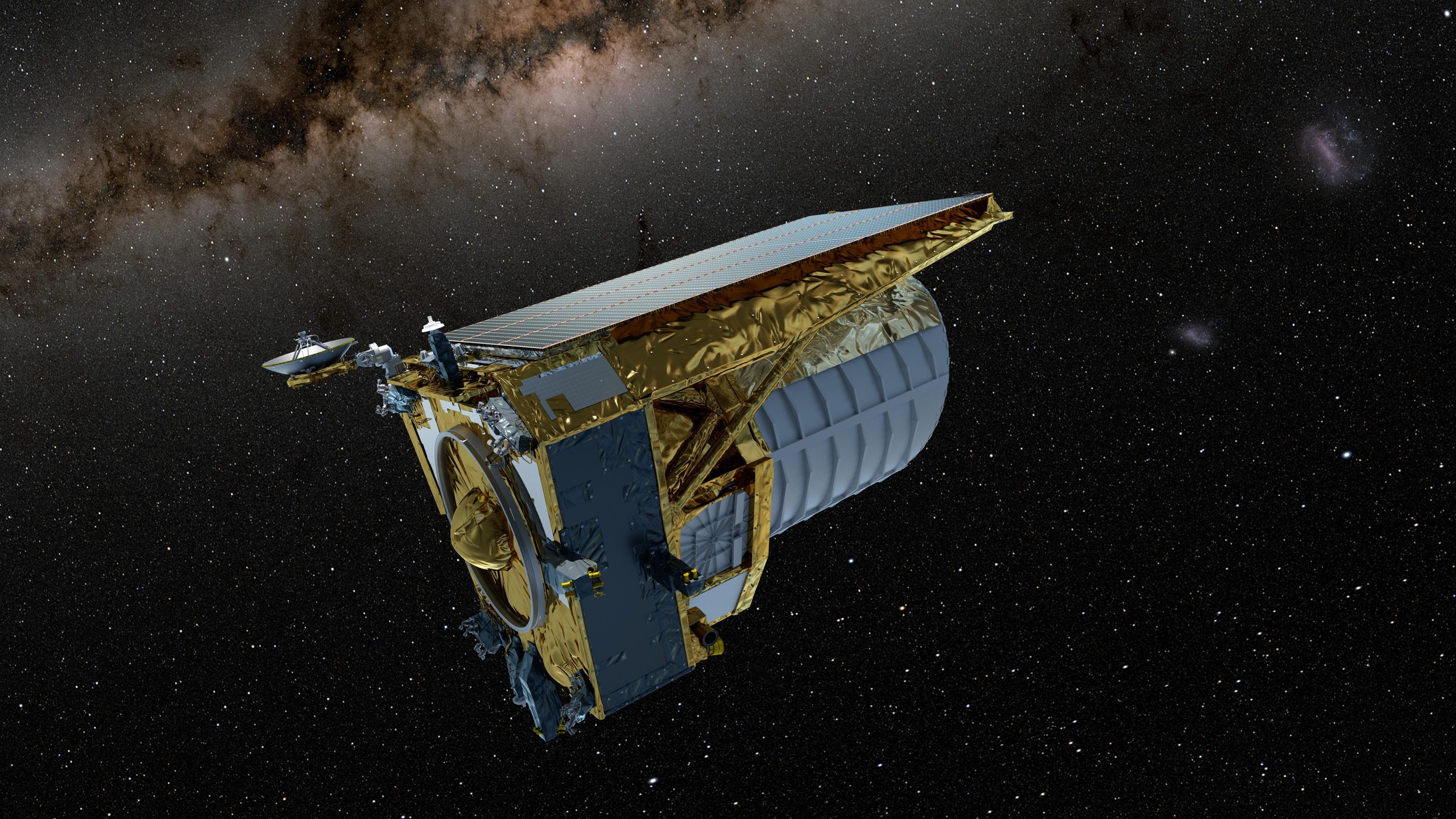
A Stunning Start to the Mission
Although this Einstein ring is stunning, Euclid’s main job is searching for the more subtle effects of weak gravitational lensing, where background galaxies appear only mildly stretched or displaced. To detect this effect, scientists will need to analyze billions of galaxies. Euclid began its detailed survey of the sky on 14 February 2024 and is gradually creating the most extensive 3D map of the Universe yet. Such an amazing find, so early in its mission, means Euclid is on course to uncover many more hidden secrets.
Reference: “Euclid: A complete Einstein ring in NGC 6505” by C. M. O’Riordan, L. J. Oldham, A. Nersesian, T. Li, T. E. Collett, D. Sluse, B. Altieri, B. Clément, K. G. C. Vasan, S. Rhoades, Y. Chen, T. Jones, C. Adami, R. Gavazzi, S. Vegetti, D. M. Powell, J. A. Acevedo Barroso, I. T. Andika, R. Bhatawdekar, A. R. Cooray, G. Despali, J. M. Diego, L. R. Ecker, A. Galan, P. Gómez-Alvarez, L. Leuzzi, M. Meneghetti, R. B. Metcalf, M. Schirmer, S. Serjeant, C. Tortora, M. Vaccari, G. Vernardos, M. Walmsley, A. Amara, S. Andreon, N. Auricchio, H. Aussel, C. Baccigalupi, M. Baldi, A. Balestra, S. Bardelli, A. Basset, P. Battaglia, R. Bender, D. Bonino, E. Branchini, M. Brescia, J. Brinchmann, A. Caillat, S. Camera, V. Capobianco, C. Carbone, J. Carretero, S. Casas, F. J. Castander, M. Castellano, G. Castignani, S. Cavuoti, A. Cimatti, C. Colodro-Conde, G. Congedo, C. J. Conselice, L. Conversi, Y. Copin, L. Corcione, F. Courbin, H. M. Courtois, M. Cropper, A. Da Silva, H. Degaudenzi, G. De Lucia, A. M. Di Giorgio, J. Dinis, F. Dubath, C. A. J. Duncan, X. Dupac, S. Dusini, M. Farina, S. Farrens, F. Faustini, S. Ferriol, N. Fourmanoit, M. Frailis, E. Franceschi, M. Fumana, S. Galeotta, W. Gillard, B. Gillis, C. Giocoli, B. R. Granett, A. Grazian, F. Grupp, L. Guzzo, S. V. H. Haugan, J. Hoar, H. Hoekstra, W. Holmes, I. Hook, F. Hormuth, A. Hornstrup, P. Hudelot, K. Jahnke, M. Jhabvala, B. Joachimi, E. Keihänen, S. Kermiche, A. Kiessling, M. Kilbinger, R. Kohley, B. Kubik, M. Kümmel, M. Kunz, H. Kurki-Suonio, O. Lahav, R. Laureijs, D. Le Mignant, S. Ligori, P. B. Lilje, V. Lindholm, I. Lloro, G. Mainetti, E. Maiorano, O. Mansutti, O. Marggraf, K. Markovic, M. Martinelli, N. Martinet, F. Marulli, R. Massey, E. Medinaceli, S. Mei, M. Melchior, Y. Mellier, E. Merlin, G. Meylan, M. Moresco, L. Moscardini, R. Nakajima, R. C. Nichol, S.-M. Niemi, J. W. Nightingale, C. Padilla, S. Paltani, F. Pasian, K. Pedersen, W. J. Percival, V. Pettorino, S. Pires, G. Polenta, M. Poncet, L. A. Popa, L. Pozzetti, F. Raison, R. Rebolo, A. Renzi, J. Rhodes, G. Riccio, H.-W. Rix, E. Romelli, M. Roncarelli, E. Rossetti, B. Rusholme, R. Saglia, Z. Sakr, A. G. Sánchez, D. Sapone, B. Sartoris, P. Schneider, T. Schrabback, A. Secroun, G. Seidel, S. Serrano, C. Sirignano, G. Sirri, L. Stanco, J. Steinwagner, P. Tallada-Crespí, I. Tereno, R. Toledo-Moreo, F. Torradeflot, I. Tutusaus, L. Valenziano, T. Vassallo, G. Verdoes Kleijn, A. Veropalumbo, Y. Wang, J. Weller, A. Zacchei, G. Zamorani, E. Zucca, C. Burigana, P. Casenove, A. Mora, V. Scottez, M. Viel, M. Jauzac and H. Dannerbauer, 10 February 2025, Astronomy & Astrophysics.
DOI: 10.1051/0004-6361/202453014
Never miss a breakthrough: Join the SciTechDaily newsletter.
Follow us on Google and Google News.
20 Comments
Gravity never bend light beams. Gravity bends just space. Light traverse through the bend space which resulted the bend of light.
So True and so amazing.
Only 590 million light years away? So it’s just right around the corner and Einstein is a part of the Antichrist. Glad he knows what his o ring is though. Freaks. Well known for how long? There is or was and Einstein ring, it was known as the asshole
I have always had a problem with the idea of bending space time. So as I travel towards the earth, space time is bent. My speed remains constant, relative to the medium of space time. But because that medium is bent by the earth, the straight line I am following curves towards the earth. But when I hit tbe earth, I am tra elling at enormous speedand give off lot of energy. But I was following a “straight” line in curved space-time. I should not have been accelerating, and there was no “force” acting on me to impart kinetic energy.
Gravity must be a force. Otherwise, hydro electric dams wouldn’t work. They harness energy from the accelleration of water by gravity. Real energy. If the water is merely flowing in curved spacetime, it should not be accelerating. If I put two spaceships in a row, and tie a rope between them, then send them both on the same path towards earth, the distance between them should not change, since they are both following a straight path through curved space time. But the lead ship will pull away, and exert a force on the following ship. Gravity can not be just a curvature of space time.
Correct. Spacetime distorts and thus photons must travel along the new path.
You have know idea what you’re talking about about
A lens focuses light to a point, not a ring. That looks like light from the local galaxy reflecting off of the dust cloud around the galaxy.
Inveterate Baiters-and-switchers will disagree, but
LIGHT IS BENT.BY GRAVITY!
Never forget!
No, light bends space. Phontons just have to travel the new path.
It says this was seen in 1880s. But then it says we are able to see it now with this space telescope……huh?…hmmmm? Did some one else catch that?
I think the galaxy should be called sowegovia2115
It was discovered in 1800’s, but now it’s seen through a modern telescope. To the side chatterer, at least take the time to find out how “know” and “no” are used in English. I will end with this, I love space, everything about it. I just have to believe there are schools in every state that could have used that money.
Uh… it’s a European Space Agency spacecraft, don’t think that money would have to schools in any US state anyway.
In the lensing ring I will definitely go with the gravity causing atmosphere of a structure to be compacted forming a eye glass transition showing a magnification of light , I just can’t go with the distortion of time the lensing is perspective to the magnification , time in my thoughts is the flat plain of the universe piling up like building an ice cream come but the cone is filled from the narrowest beginning pushing the filling in one direction and expanding as more is applied and the filling reacts or builds with particles coleles forming greater masses somewhat similar to soda pop foaming as it is poured in a glass . Imagen a cone when first filling from the narrowest point the mass would be at its simplest breakdown as it is forced out into the cone it would have room to increase in size . We look at the Big bang and what I’m gathering is science thinking the phenomenon has stopped , don’t think so the phenomenon just can’t be seen light and energy hasn’t formed at that point it is still pushing outward forming more time to build on . It’s our perspective that changes and the universe is so massive as we look out it would give you the illusion of ageing for instance , our galaxy makes one full rotation every 250 million years and in the estimated 13.8 billion years scene the Bang it has only made 552 rotations . If we could see and live long enough a 180 degree perspective of 250 mill yrs our perspective would drastically change , look for exoplanets on our own flat plain of existence rather than others , that’s where we need to be .
Enlarging space objects by lenses that are natural in nature to see stuff bigger and better. Wow, very interesting and mathematical!!
I thought there was no gravity in space. How is it there to bend the light? I’m no astrophysicist just space-curious. Please forgive my question… although there’s not supposed to be stupid questions; yet I’ve heard of some myself. So please forgive me.
Objects with big mass like stars or black holes are warping the space around them therefore the space will have a curvature in their proximity much like a heavy ball you place on a blanket . Since the light has to travel to us though that deformed space it will not follow a direct path but followowing the sha;e of the blanket. Sort of
There is lots of gravity in space. In orbit it is balanced by the centrifugal force of the Space Ship’s circular path around the earth. Like spinning a ball around you on a string, where gravity is the string. If you hit the retrorockets on a spacecraft and stop its forward travel, gravity will drag it down to earth. In deep space you don’t feel the gravity because you are in freefall. Eventually something will suck you in.
Sin, what Raul says is true but I also think the perspective we see often makes it seem like there is no gravity in space when there is, oftentimes just weaker due to distances and sometimes counteracted by other forces like centripetal forces. We live on a massive object that holds us and our atmosphere down with gravity, but if you see astronauts floating in the space station you think they have no gravity pulling them down? True it’s weaker up there because they are further away from earth, but they are being held up there because of the centripetal force of their orbit. If the space station stopped moving it would drop to the earth like a rock (meteor). Same thing keeps earth from flying away from the sun (gravity) or falling into it (centripetal force of the orbit). If the earth stopped its orbit it would fall into to the sun. So gravitational forces are all over the place in space but just distances make it weaker.
Sin, what Raul says is true but I also think the perspective we see often makes it seem like there is no gravity in space when there is, oftentimes just weaker due to distances and sometimes counteracted by other forces like centripetal forces. We live on a massive object that holds us and our atmosphere down with gravity, but if you see astronauts floating in the space station you think they have no gravity pulling them down? True it’s weaker up there because they are further away from earth, but they are being held up there because of the centripetal force of their orbit. If the space station stopped moving it would drop to the earth like a rock (meteor). Same thing keeps earth from flying away from the sun (gravity) or falling into it (centripetal force of the orbit). If the earth stopped its orbit it would fall into to the sun. So gravitational forces are all over the place in space but just distances make it weaker.