
The advance could enable the development of compact 3D photonic integrated devices capable of processing large amounts of data and more.
Researchers have developed a new way to control and manipulate optical signals by embedding a liquid crystal layer into waveguides created with direct laser writing. The new devices enable electro-optical control of polarization, which could open new possibilities for chip-based devices and complex photonic circuits based on femtosecond-written waveguides.
“Laser writing of waveguides and electro-optical modulation via liquid crystals has not been combined in this way before,” said Alessandro Alberucci from Friedrich Schiller University Jena in Germany. “The hope is that this technology could be used to create a new class of integrated photonic devices that can process large amounts of information for data centers and other data-intensive applications.”
In the journal Optical Materials Express, the researchers describe how they created a tunable wave plate inside a fused silica waveguide. When voltage is applied to the liquid crystal its molecules rotate, which changes the polarization of light transmitted through the waveguide. In experiments, the researchers demonstrated full modulation of optical polarization at two different visible wavelengths.
“Our work paves the way to integrating new types of optical functions into the whole volume of a single glass chip, enabling compact 3D photonic integrated devices that weren’t possible previously,” said Alberucci. “The unique 3D nature of femtosecond-written waveguides could be used to create new spatial light modulators where each pixel is separately addressed by one waveguide. The technology could also find application in the experimental realization of dense optical neural networks.”
Bringing two key technologies together
Femtosecond lasers can be used to write waveguides deep within a material — as opposed to only on the surface like other methods — making it a promising approach to maximize the number of waveguides on a single chip. This approach involves focusing an intense laser beam inside a transparent material. When the optical intensity is high enough, the beam modifies the material under illumination, thus acting like a sort of pen with micrometer precision.
“The most important shortcoming of using femtosecond laser writing technology to create waveguides is the difficulty in modulating the optical signal in these waveguides,” said Alberucci. “Since a complete communication network needs devices capable of controlling the transmitted signal, our work explores new solutions to overcome this limitation.”

In the new paper, the researchers combined two fundamental photonic technologies by embedding a layer of liquid crystal inside a waveguide. When the beam propagating inside the waveguide enters the liquid crystal layer it modifies the light’s phase and polarization when an electric field is applied. The modified beam then travels through the second section of the waveguide, so that a beam with modulated properties is propagating.
“The hybridization permits access to the advantages of both technologies in the same device: a large concentration of light due to the guiding effect, and a large degree of tunability associated with liquid crystals,” said Alberucci. “This research leads the way to using liquid crystal properties as a modulator in photonic devices that have waveguides embedded in their whole volume.”
Benefits of the hybrid approach
Although optical modulation in femtosecond laser-written waveguides has previously been achieved by locally heating the waveguide, the use of liquid crystals in the new work allows direct control of the polarization. “Our approach has several potential advantages: lower power consumption, the possibility to address single waveguides in the bulk independently, and less crosstalk between adjacent waveguides,” said Alberucci.
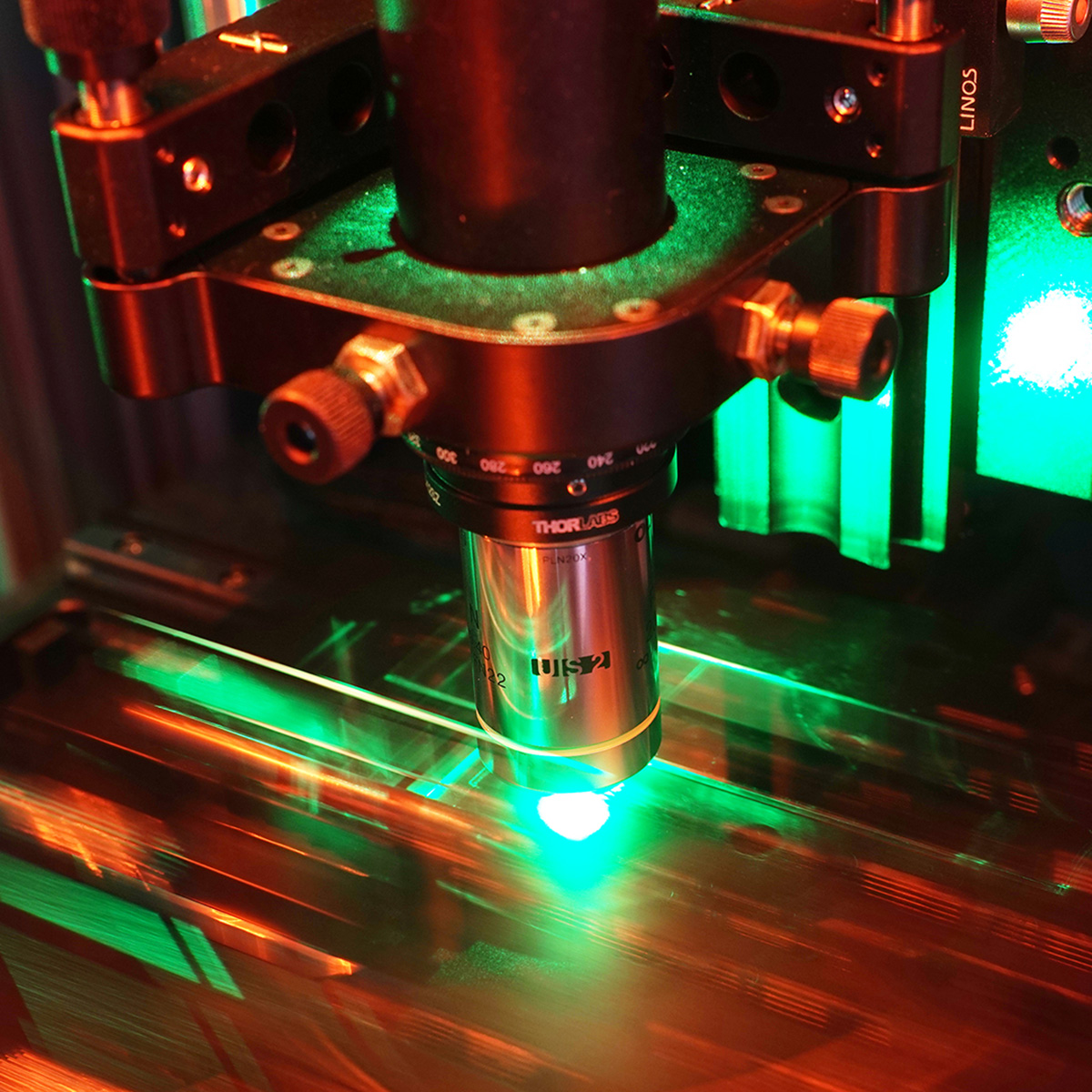
To test the devices, the researchers injected laser light in the waveguide and then varied the voltage applied to the liquid crystal layer, which modulated the light. The measured polarization at the output varied as predicted by theory. They also found that integrating the liquid crystal with the waveguides left the modulation properties of the liquid crystals unvaried.
The researchers point out that this study is only a proof of concept, so more work needs to be done before the technology is ready for practical applications. For example, the current device modulates every waveguide in the same manner, so they are working to achieve independent control on each waveguide.
Reference: “Electro-optical control of polarization in femtosecond-laser written waveguides using an embedded liquid crystal cell” by Stefan Nolte, Alessandro Alberucci, Chandroth P. Jisha, Alexander Szameit and Kim Lammers, 31 March 2024, Optical Materials Express.
DOI: 10.1364/OME.507230
Never miss a breakthrough: Join the SciTechDaily newsletter.
Follow us on Google and Google News.