
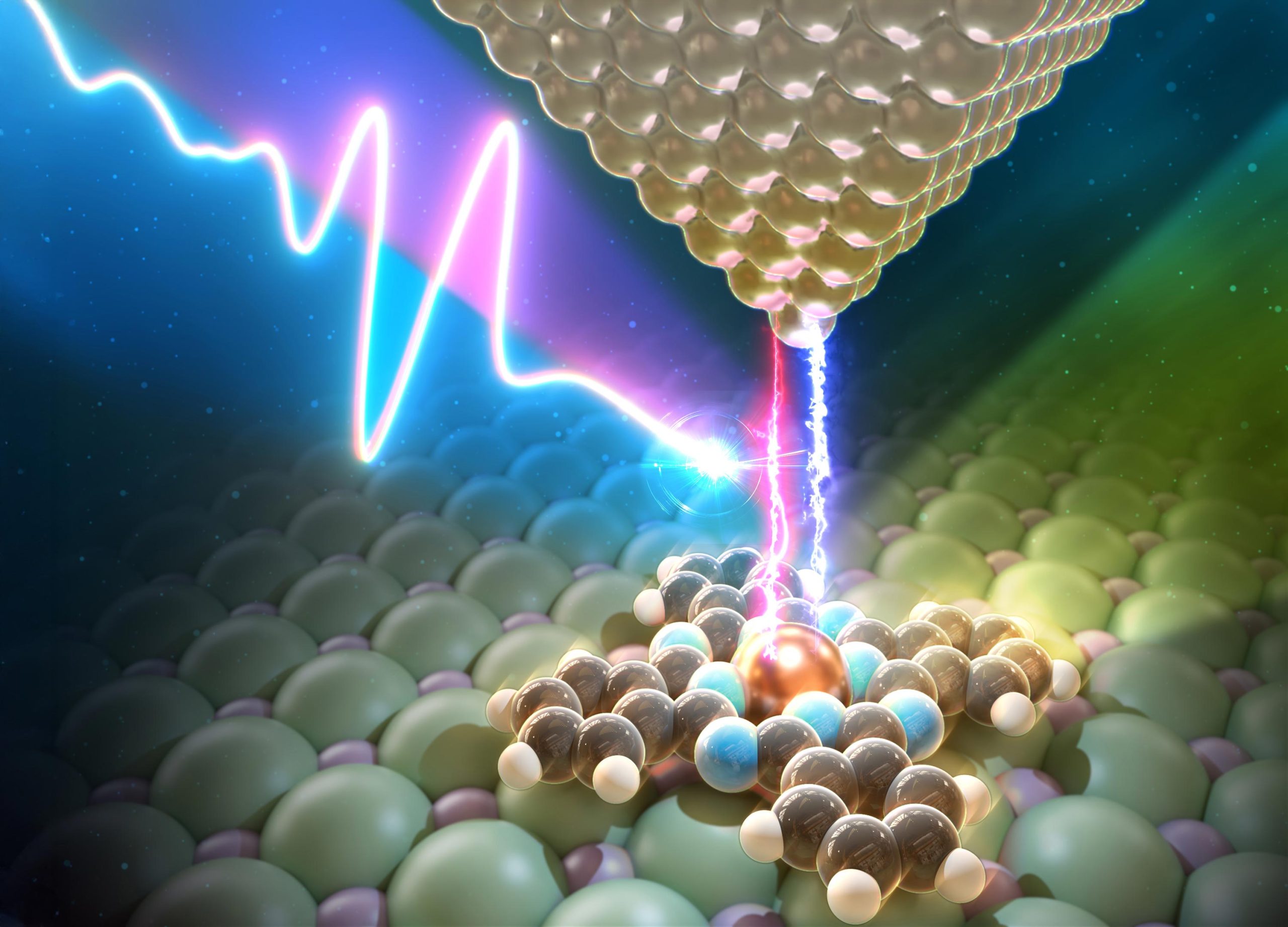
Researchers have unlocked a new way to manipulate electrons in molecules with terahertz light, paving the way for faster electronics, efficient solar cells, and next-gen materials.
Their work reveals a method to precisely control excitons and charge movement at an atomic level, leading to major advances in energy and chemical technologies.
Electrons in Motion: A Breakthrough Discovery
Scientists at Yokohama National University, working with RIKEN and other institutions in Japan and Korea, have made a major breakthrough in understanding how electrons move and interact within molecules. Their discovery, published today (March 6) in Science, could lead to advancements in electronics, energy transfer, and chemical reactions. The researchers found a new way to control electron distribution in molecules using ultrafast, phase-controlled terahertz light pulses.
Electrons, which carry negative charges, typically occupy specific energy levels within atoms and molecules, forming structured layers around the positively charged nucleus. The way these electrons are arranged determines how a molecule behaves, influencing key processes such as light emission, charge transfer, and chemical reactions.
For instance, when light provides an electron with enough energy, it jumps to a higher energy level, leaving behind a positively charged “hole.” Together, the electron and hole form an exciton, a tiny energy packet that can emit light. Excitons play a crucial role in technologies like solar cells, where they help convert sunlight into electricity, and LEDs, where they release energy as visible light.
The Challenge of Controlling Charged States
However, there are other important states that molecules can exist in, like charged states and charged excited states. Charged states occur when a molecule gains or loses an electron, while charged excited states involve both a charge change and an electron in a higher energy level.
These are important for many processes, but it has been very difficult to control these states, especially on ultrafast timescales, using traditional technology. Normally, light from the visible spectrum doesn’t provide enough energy to change the charge of the molecule and therefore cannot change the number of electrons in it.
Harnessing Terahertz Light for Precise Control
To overcome this challenge, the researchers used terahertz light pulses, a type of light with a much lower frequency than visible light. These pulses cause electrons to move between a molecule and the metal tip of a specialized microscope that can manipulate individual molecules, allowing the team to either remove or add an electron to the molecule.
This new method offers a way to control not only excitons in a controlled manner, which is both quick and precise, but also other important molecular states that are essential for chemical reactions, energy transfer and many other processes.
The team also demonstrated that terahertz light, which is invisible to the human eye, can be converted into visible light within a molecule, revealing a novel way to transform one type of light into another through molecular energy changes.
Turning Invisible Light into a Powerful Tool
“While excitons typically form when light is absorbed by a material, our findings reveal they can also be created through charged states using these specially designed terahertz pulses,” says Professor Ikufumi Katayama, the study’s corresponding author from the Faculty of Engineering at Yokohama National University.
“This opens new possibilities for controlling how charge moves within molecules, which could lead to better solar cells, smaller light-based devices, and faster electronics.”
A New Era for Nanotechnology and Energy Transfer
The team’s main achievement was the ability to control exciton formation at the single-molecule level.
Professor Jun Takeda, another corresponding author from the Faculty of Engineering at Yokohama National University, explains: “By precisely controlling how electrons move between a single molecule and the metal tip of the specialized microscope, we were able to guide exciton formation and the chemical reactions that follow.
“These processes usually happen randomly, but with terahertz pulses, we can determine exactly when and how reactions occur at the molecular level. This could lead to breakthroughs in nanotechnology, advanced materials, and more efficient catalysts for energy and industry.”
Reference: “Ultrafast on-demand exciton formation in a single-molecule junction by tailored terahertz pulses” by Kensuke Kimura, Ryo Tamaki, Minhui Lee, Xingmei Ouyang, Satoshi Kusaba, Rafael B. Jaculbia, Yoichi Kawada, Jaehoon Jung, Atsuya Muranaka, Hiroshi Imada, Ikufumi Katayama, Jun Takeda and Yousoo Kim, 6 March 2025, Science.
DOI: 10.1126/science.ads2776
Other contributors include Kensuke Kimura (RIKEN); Ryo Tamaki (Yokohama National University [YNU], Kanagawa Institute of Industrial Science and Technology); Minhui Lee (RIKEN, The University of Tokyo [UTokyo]); Xingmei Ouyang (RIKEN); Satoshi Kusaba (YNU); Rafael B. Jaculbia (RIKEN, Institute for Basic Science); Yoichi Kawada (Hamamatsu Photonics K.K.); Jaehoon Jung (University of Ulsan); Atsuya Muranaka (RIKEN); Hiroshi Imada (RIKEN, Gwangju Institute of Science and Technology [GIST]); and Yousoo Kim (RIKEN, UTokyo, Institute for Basic Science, GIST).
Never miss a breakthrough: Join the SciTechDaily newsletter.
Follow us on Google and Google News.