
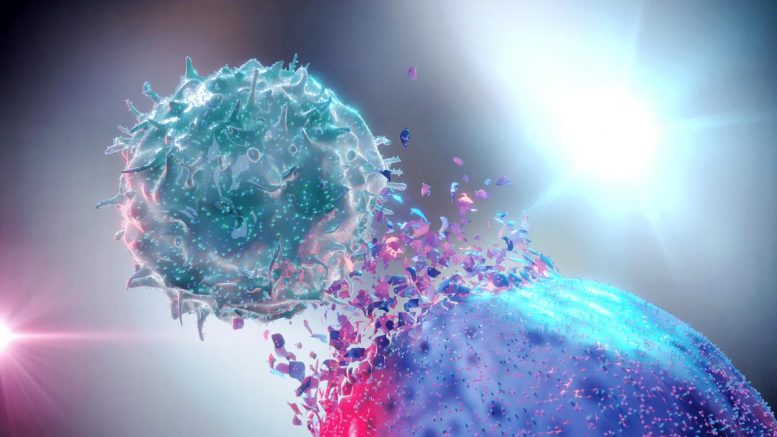
Deleting the TFG-β receptor in NK cells overcame immune suppression and enabled anti-tumor activity in preclinical models.
Preclinical research from The University of Texas MD Anderson Cancer Center finds that although glioblastoma stem cells (GSCs) can be targeted by natural killer (NK) cells, they are able to evade immune attack by releasing the TFG-β signaling protein, which blocks NK cell activity. Deleting the TFG-β receptor in NK cells, however, rendered them resistant to this immune suppression and enabled their anti-tumor activity.
The findings, published today (June 17, 2021) in the Journal of Clinical Investigation, suggest that engineering NK cells to resist immune suppression may be a feasible path toward using NK cell-based immunotherapies for treating glioblastoma.

Genetic Engineering Offers Hope for Immunotherapy
“There is tremendous interest in utilizing immunotherapy to improve treatments for patients with glioblastoma, but there has been limited success to date,” said senior author Katy Rezvani, M.D., Ph.D., professor of Stem Cell Transplantation & Cellular Therapy. “We were able to overcome the immunosuppressive environment in the brain by genetically engineering NK cells, which were then able to eliminate the tumor-regenerating GSCs. We are encouraged by these early results and hope to apply similar strategies to explore NK cell therapies in additional solid tumor types.”
Glioblastoma is the most common and aggressive form of primary brain tumor in adults. Current treatments are only effective for a short time, with recurrences driven largely by small populations of therapy-resistant GSCs. Therefore, developing new treatments that can effectively target GSCs is necessary.
Published data suggests that NK cells may be capable of targeting GCSs, but it was unclear whether the stem cells would indeed be susceptible to NK-cell killing, Rezvani explained. Therefore, her team designed the study to evaluate how effective NK cells may be against GSCs.
Rezvani and her research team have worked to advance NK cells as a cancer therapy with the support of MD Anderson’s Moon Shots Program®, a collaborative effort to rapidly develop scientific discoveries into meaningful clinical advances that save patients’ lives. The current work was supported by the adoptive cell therapy platform and the Glioblastoma Moon Shot®, in collaboration with Frederick Lang, M.D., chair of Neurosurgery, and Amy Heimberger, M.D., now at Northwestern University Feinberg School of Medicine.
The researchers first confirmed that NK cells could target GSCs in vitro. Non-edited NK cells from healthy donors were able to eliminate patient-derived GSCs, whereas normal brain cells, called astrocytes, were unaffected.
To explore whether NK cells are able to cross the blood-brain barrier to infiltrate brain tumors, the team examined tumor samples removed during surgery. Glioblastoma samples contained high numbers of tumor-infiltrating NK (TI-NK) cells. However, isolated TI-NK cells were unable to kill GCSs in vitro, suggesting that NK cells were suppressed in the brain.
Single-Cell Sequencing Reveals Suppression Signatures
The researchers next profiled TI-NK cells to study their level of activity using protein markers and single-cell RNA sequencing. TI-NK cells displayed signals of inhibitory responses and immune suppression relative to NK cells isolated from the blood of healthy donors.
The single-cell analysis also revealed an activation of the TGF-β signaling pathway in TI-NK cells, identifying this as a potential mechanism of immune suppression. Indeed, blocking TGF-β signaling with various inhibitors prevented GSCs from activating this pathway in NK cells and suppressing NK cell activity.
The study went on to clarify that GSCs produce TGF-β in response to direct cell-cell contact with NK cells, a process regulated by αν integrin proteins. TGF-β released by GSCs activates its corresponding receptor on NK cells, TGFBR2, to block their anti-tumor activity.
Targeting TGF-ß and Integrins Boosts Tumor Control
Using an in vivo model of patient-derived GSCs, the researchers showed that combining donor-derived, or allogeneic, NK cells with inhibitors targeting either αν integrins or TGF-β receptors improved tumor control relative to untreated controls.
More impressive were the results using allogeneic NK cells with TGFBR2 genetically removed. Treatment with these gene-edited NK cells resulted in a significant improvement in overall survival relative to untreated controls or treatment with unedited NK cells.
“These findings support a combinatorial approach of NK cell-based immunotherapy together with disruption of the TGF-β signaling axis to overcome the immune defenses of GSCs in the brain,” Rezvani said. “Based on these findings, we are working to launch a clinical trial evaluating this experimental approach as a novel treatment for glioblastoma.”
Reference: “Targeting the αv integrin-TGF-β axis improves natural killer cell function against glioblastoma stem cells” by Hila Shaim, Mayra Shanley, Rafet Basar, May Daher, Joy Gumin, Daniel B. Zamler, Nadima Uprety, Fang Wang, Yuefan Huang, Konrad Gabrusiewicz, Qi Miao, Jinzhuang Dou, Abdullah Alsuliman, Lucila N. Kerbauy, Sunil Acharya, Vakul Mohanty, Mayela Mendt, Sufang Li, JunJun Lu, Jun Wei, Natalie W. Fowlkes, Elif Gokdemir, Emily Ensley, Mecit Kaplan, Cynthia Kassab, Li Li, Gonca Ozcan, Pinaki P. Banerjee, Yifei Shen, April L. Gilbert, Corry M. Jones, Mustafa Bdiwi, Ana K. Nunez-Cortes, Enli Liu, Jun Yu, Nobuhiko Imahashi, Luis Muniz-Feliciano, Ye Li, Jian Hu, Giulio Draetta, David Marin, Dihua Yu, Stephan Mielke, Matthias Eyrich, Richard E. Champlin, Ken Chen, Frederick F. Lang, Elizabeth J. Shpall, Amy B. Heimberger and Katayoun Rezvani, 17 June 2021, Journal of Clinical Investigation.
DOI: 10.1172/JCI142116
In addition to the Moon Shots Program, this research was supported by Ann and Clarence Cazalot Jr., the Dr. Marnie Rose Foundation, the Specialized Program of Research Excellence (SPORE) in Brain Cancer (P50CA127001) and the National Institutes of Health (NIH) (CA016672; CA120813; P30CA16672). A full list of collaborating authors and their disclosures can be found with the paper here.
Never miss a breakthrough: Join the SciTechDaily newsletter.
Follow us on Google and Google News.