

A study reveals that a protein called RPA is essential for maintaining chromosome stability by stimulating telomerase.
New findings from the University of Wisconsin-Madison suggest that problems with a key protein that helps preserve chromosome stability may contribute to the development of severe, and sometimes fatal, diseases.
The study, published in Science, offers new clues for identifying mutations in this protein that could help doctors screen for certain cancers and disorders affecting bone marrow.
Chromosomes (bundles of proteins and DNA that hold our genetic blueprint) are shielded from damage by telomeres, the protective caps made of repeating DNA sequences and proteins at each chromosome’s end. Although telomeres naturally shorten as we age, disruptions in how they are formed or maintained can destabilize DNA, potentially triggering premature aging and disease.
Researchers in the laboratory of Ci Ji Lim, a biochemistry professor at UW–Madison, worked with colleagues in the university’s Department of Chemistry to search for proteins that interact with telomerase, the enzyme that maintains telomeres. They suspected that defects in these associated proteins might contribute to certain illnesses that arise when telomeres become abnormally short.
“This line of research goes beyond a biochemical understanding of a molecular process. It deepens clinical understanding of telomere diseases,” says Lim, whose work is supported by the National Institutes of Health.
Discovering RPA’s Hidden Role
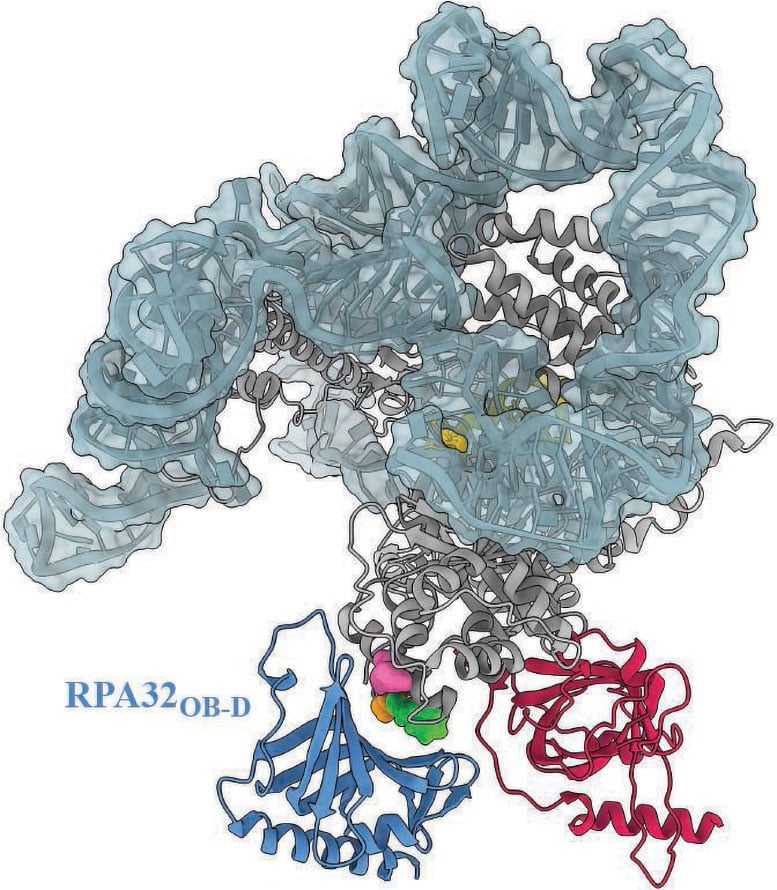
The researchers, led by graduate student Sourav Agrawal, research scientist Xiuhua Lin, and postdoctoral researcher Vivek Susvirkar, searched for proteins likely to interact with telomerase using AlphaFold, a machine learning tool that predicts the 3D structure of proteins and protein-protein interactions. They found that a molecule called replication protein A (RPA) plays an essential role in maintaining telomeres by stimulating telomerase. RPA’s role in DNA replication and repair has long been understood, but its role in maintaining long, healthy telomeres in humans was previously unconfirmed. Guided by their findings from AlphaFold, the team experimentally validated that, in humans, RPA is required to stimulate telomerase and help maintain telomeres.
Their findings, Lim says, have immediate implications for some patients with often fatal illnesses resulting from shortened telomeres, including aplastic anemia, myelodysplastic syndrome and acute myeloid leukemia.
“There are some patients with shortened telomere disorders that couldn’t be explained with our previous body of knowledge,” explains Lim. “Now we have an answer to the underlying cause of some of these short telomere disease mutations: it is a result of RPA not being able to stimulate telomerase.”
A Global Impact and Future Testing
Lim and his team have received inquiries from clinicians and scientists around the world asking if their patients’ diseases could be the result of genetic mutations inhibiting RPA’s newfound function.
“There are colleagues reaching out from France, Israel, and Australia. They just want to give a cause for their patients’ short telomere disease so that the patients and their families can understand what is happening and why,” says Lim. “With biochemical analysis, we can test their patients’ mutation to see if it impacts how RPA interacts with telomerase, and give the doctors insights into possible causes of their patients’ diseases.”
Reference: “Human RPA is an essential telomerase processivity factor for maintaining telomeres” by Sourav Agrawal, Xiuhua Lin, Vivek Susvirkar, Michael S. O’Connor, Bianca L. Chavez, Victoria R. Tholkes, Grace P. Tauber, Qixiang He, Kaitlyn M. Abe, Xuhui Huang and Ci Ji Lim, 30 October 2025, Science.
DOI: 10.1126/science.ads5297
This research was funded in part by the National Institutes of Health (R01GM153806 and DP2GM150023), the UW–Madison Office of the Vice Chancellor for Research, the Wisconsin Alumni Research Foundation and UW–Madison Department of Biochemistry.
Never miss a breakthrough: Join the SciTechDaily newsletter.
Follow us on Google and Google News.