
Close Menu
    Facebook X (Twitter) Instagram
    SciTechDaily
    • Biology
    • Chemistry
    • Earth
    • Health
    • Physics
    • Science
    • Space
    • Technology
    Facebook X (Twitter) Pinterest YouTube RSS
    SciTechDaily
    Home»Chemistry»Engineering Life: Chemists Have Created the Functional Synthetic Cells That Act Like Real Ones
    Chemistry

    Engineering Life: Chemists Have Created the Functional Synthetic Cells That Act Like Real Ones

    By University of North Carolina at Chapel HillMay 3, 2024No Comments3 Mins Read
    Facebook Twitter Pinterest Telegram LinkedIn WhatsApp Email Reddit
    Share
    Facebook Twitter LinkedIn Pinterest Telegram Email Reddit
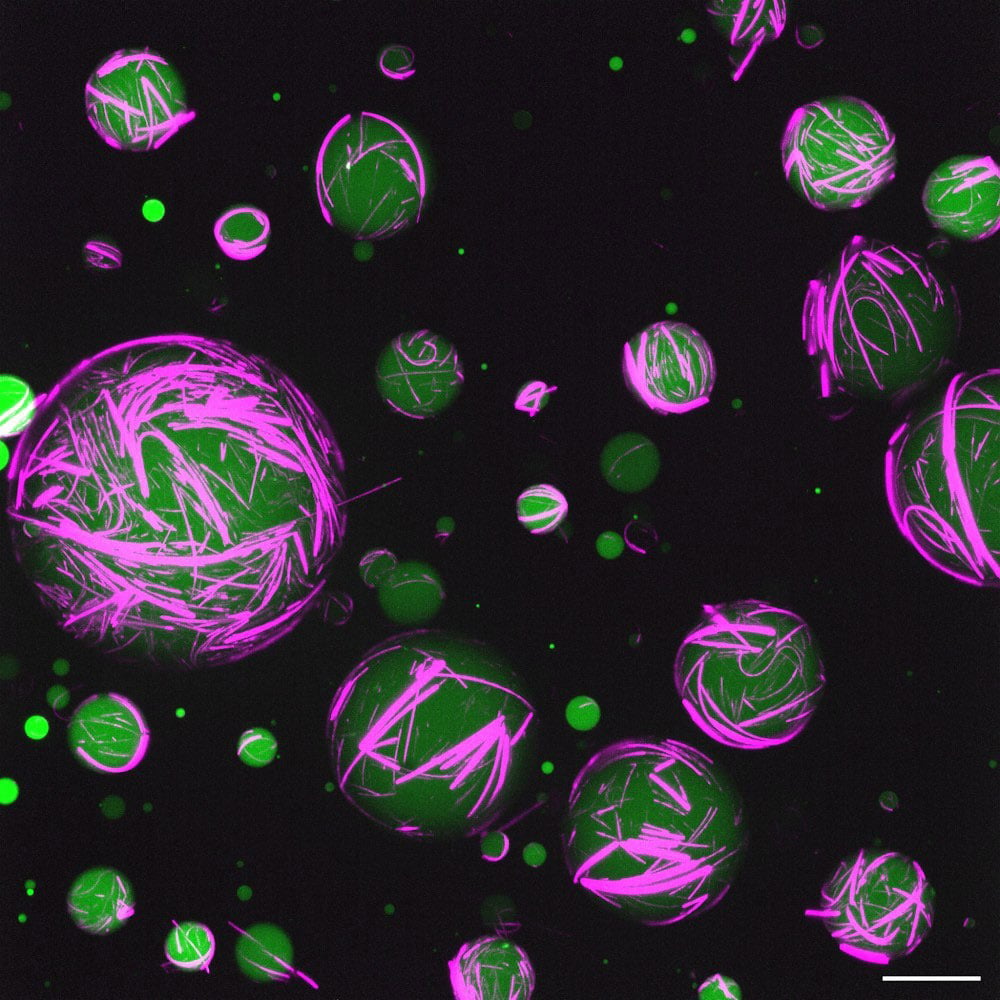
    Synthetic Cells Illustration
    Synthetic cells created with programmable peptide-DNA technology that directs peptides, the building blocks of proteins, and repurposed genetic material to work together to form a cytoskeleton, shown in fuscia. Credit: UNC-Chapel Hill

    Researchers employ cutting-edge methods to create functional cells, closing the divide between synthetic and biological materials.

    In a new study published in Nature Chemistry, UNC-Chapel Hill researcher Ronit Freeman and her colleagues describe the steps they took to manipulate DNA and proteins — essential building blocks of life — to create cells that look and act like cells from the body. This accomplishment, a first in the field, has implications for efforts in regenerative medicine, drug delivery systems, and diagnostic tools.

    “With this discovery, we can think of engineering fabrics or tissues that can be sensitive to changes in their environment and behave in dynamic ways,” says Freeman, whose lab is in the Applied Physical Sciences Department of the UNC College of Arts and Sciences.

    Cells and tissues are made of proteins that come together to perform tasks and make structures. Proteins are essential for forming the framework of a cell, called the cytoskeleton. Without it, cells wouldn’t be able to function. The cytoskeleton allows cells to be flexible, both in shape and in response to their environment.

    Without using natural proteins, the Freeman Lab built cells with functional cytoskeletons that can change shape and react to their surroundings. To do this, they used a new programmable peptide-DNA technology that directs peptides, the building blocks of proteins, and repurposed genetic material to work together to form a cytoskeleton.

    Innovative DNA Programming

    “DNA does not normally appear in a cytoskeleton,” Freeman says. “We reprogrammed sequences of DNA so that it acts as an architectural material, binding the peptides together. Once this programmed material was placed in a droplet of water, the structures took shape.”

    The ability to program DNA in this way means scientists can create cells to serve specific functions and even fine-tune a cell’s response to external stressors. While living cells are more complex than the synthetic ones created by the Freeman Lab, they are also more unpredictable and more susceptible to hostile environments, like severe temperatures.

    “The synthetic cells were stable even at 122 degrees Fahrenheit, opening up the possibility of manufacturing cells with extraordinary capabilities in environments normally unsuitable to human life,” Freeman says.

    Instead of creating materials that are made to last, Freeman says their materials are made to task — perform a specific function and then modify themselves to serve a new function. Their application can be customized by adding different peptide or DNA designs to program cells in materials like fabrics or tissues. These new materials can integrate with other synthetic cell technologies, all with potential applications that could revolutionize fields like biotechnology and medicine.

    “This research helps us understand what makes life,” Freeman says. “This synthetic cell technology will not just enable us to reproduce what nature does, but also make materials that surpass biology.”

    Reference: “Designer peptide–DNA cytoskeletons regulate the function of synthetic cells” by Margaret L. Daly, Kengo Nishi, Stephen J. Klawa, Kameryn Y. Hinton, Yuan Gao and Ronit Freeman, 23 April 2024, Nature Chemistry.
    DOI: 10.1038/s41557-024-01509-w

    Never miss a breakthrough: Join the SciTechDaily newsletter.
    Follow us on Google and Google News.

    Cells Chemical Engineering DNA University of North Carolina at Chapel Hill
    Share. Facebook Twitter Pinterest LinkedIn Email Reddit

    Related Articles

    Researchers Discover Unexpected New Form of Molecular Motion

    Carbon Alchemy: MIT’s Revolutionary CO2 Conversion Technology

    Engineers Develop New Method to Detect Epigenetic Modifications

    Study Shows Four-Stranded ‘Quadruple Helix’ DNA Structure in Human Cells

    Graphene’s Behavior Can Be Strongly Affected by an Underlying Material

    Bioengineers Develop Deformability Cytometer to Help Diagnose Disease

    New DNA Entity in Mammalian Cells

    Researchers Develop DNA Nanorobot to Seek Specific Cell Targets

    Researchers Study Metabolic Errors and Their Effect on DNA

    Leave A Reply Cancel Reply

    • Facebook
    • Twitter
    • Pinterest
    • YouTube

    Don't Miss a Discovery

    Subscribe for the Latest in Science & Tech!

    Trending News

    First-of-Its-Kind Discovery: Homer’s Iliad Found Embedded in a 1,600-Year-Old Egyptian Mummy

    Beyond Inflammation: Scientists Uncover New Cause of Persistent Rheumatoid Arthritis

    A Simple Molecule Could Unlock Safer, Easier Weight Loss

    Scientists Just Built a Quantum Battery That Charges Almost Instantly

    Researchers Unveil Groundbreaking Sustainable Solution to Vitamin B12 Deficiency

    Millions of People Have Osteopenia Without Realizing It – Here’s What You Need To Know

    Researchers Discover Boosting a Single Protein Helps the Brain Fight Alzheimer’s

    World-First Study Reveals Human Hearts Can Regenerate After a Heart Attack

    Follow SciTechDaily
    • Facebook
    • Twitter
    • YouTube
    • Pinterest
    • Newsletter
    • RSS
    SciTech News
    • Biology News
    • Chemistry News
    • Earth News
    • Health News
    • Physics News
    • Science News
    • Space News
    • Technology News
    Recent Posts
    • This Simple Exercise Trick Builds Muscle With Less Effort, Study Finds
    • Middle Age Is Becoming a Breaking Point in America, Study Reveals
    • Scientists Discover How Coffee Impacts Memory, Mood, and Gut Health
    • How Cells Copy DNA Might Matter More Than We Ever Realized
    • Scientists Just Solved the Mystery of the Twelve Apostles
    Copyright © 1998 - 2026 SciTechDaily. All Rights Reserved.
    • Science News
    • About
    • Contact
    • Editorial Board
    • Privacy Policy
    • Terms of Use

    Type above and press Enter to search. Press Esc to cancel.