
Close Menu
    Facebook X (Twitter) Instagram
    SciTechDaily
    • Biology
    • Chemistry
    • Earth
    • Health
    • Physics
    • Science
    • Space
    • Technology
    Facebook X (Twitter) Pinterest YouTube RSS
    SciTechDaily
    Home»Chemistry»Environmentally Friendly, Self-Templating Supramolecular Polymer Synthesis
    Chemistry

    Environmentally Friendly, Self-Templating Supramolecular Polymer Synthesis

    By RIKENApril 8, 2022No Comments3 Mins Read
    Facebook Twitter Pinterest Telegram LinkedIn WhatsApp Email Reddit
    Share
    Facebook Twitter LinkedIn Pinterest Telegram Email Reddit
    Polymer Molecule
    Researchers have developed a polymer that self-catalyzes its formation in a solvent-free process, potentially leading to recyclable polymers made sustainably.

    A green method for producing crystalline supramolecular fibers promises to make polymer production more sustainable.

    A polymer that catalyzes its own formation in an environmentally friendly solvent-free process has been developed by an all-RIKEN team of chemists. The discovery could lead to the development of inherently recyclable polymer materials that are made using a sustainable process.

    Polymers are ubiquitous today, but they are detrimental to the environment through the accumulation of plastic waste and the unsustainable nature of conventional polymer manufacture. Polymers are generally made by linking together strings of building blocks, known as monomers, using covalent bonds. But these strong bonds make it difficult to take used, end-of-life plastic items and de-polymerize them to recover the monomers for reuse.
    Wedge-Shaped Precursor Molecules Build Rod-Shaped Supramolecular Polymer
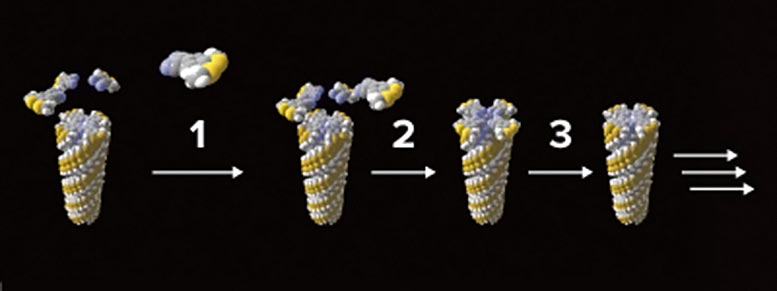
    Figure 1: Wedge-shaped precursor molecules (top left) come together to build a rod-shaped supramolecular polymer composed of their reductively cyclotetramerized disk-shaped monomers, with each new layer of the growing polymer templating the formation of the next (1 and 2 show the preorganization of wedge-shaped precursor phthalonitrile molecules, and 3 shows reductive cyclotrimerization to give a disk-shaped phthalocyanine monomer). Credit: © 2022 RIKEN Center for Emergent Matter Science

    Supramolecular polymers, in contrast, consist of arrays of monomers held together by interactions such as hydrogen bonds, which are weaker, and hence more reversible, than covalent bonds.

    However, the solvents used for manufacturing supramolecular polymers limit their application and sustainability. “Within two decades, solvent-free chemical manufacturing may be the only approved chemical processes, since the large volumes of solvent used in other manufacturing processes are too damaging to the environment,” says Takuzo Aida from the RIKEN Center for Emergent Matter Science (CEMS).

    Discovery of Solvent-Free Autocatalytic Supramolecular Polymerization

    Aida’s team has been investigating wedge-shaped molecules called phthalonitriles. Now, he and nine CEMS colleagues have discovered that these substances melt when heated and then form multiple thin green crystalline fibers, which are rod-shaped supramolecular polymers.

    The polymerization process is initiated when four of the wedge-shaped pieces come together to form a flat, circular disk. The disk-shaped assembly—the monomer—can then act as a template surface for the next four wedge-shaped precursor molecules to combine, adding a layer to the structure. This process is repeated, with each new layer of the polymer catalyzing the formation of the next, until long rod-like structures form (Figure 1). The team named their process solvent-free autocatalytic supramolecular polymerization.

    “The mechanical properties of the crystalline fibers of these supramolecular polymers are analogous to those of poly(alkyl methacrylates),” Aida says. These conventional polymers are used for a range of applications, including plexiglass.

    Expanding the Versatility of Supramolecular Polymers

    The team could create more complex versions of their supramolecular polymers by adding alternate precursor molecules into the mix at certain time points, thereby forming ‘block copolymers’ with bands of different monomers along the length of each rod.

    Solvent-free autocatalytic supramolecular polymerization could be used to make supramolecular polymers from a range of starting materials. “It may be applicable to the synthesis of polycyclic aromatic hydrocarbons and cyclic peptides,” Aida says.

    Reference: “Solvent-free autocatalytic supramolecular polymerization” by Zhen Chen, Yukinaga Suzuki, Ayumi Imayoshi, Xiaofan Ji, Kotagiri Venkata Rao, Yuki Omata, Daigo Miyajima, Emiko Sato, Atsuko Nihonyanagi and Takuzo Aida, 14 October 2021, Nature Materials.
    DOI: 10.1038/s41563-021-01122-z

    Never miss a breakthrough: Join the SciTechDaily newsletter.
    Follow us on Google and Google News.

    Materials Science Polymers RIKEN
    Share. Facebook Twitter Pinterest LinkedIn Email Reddit

    Related Articles

    Incredible New Polymer Fibers Are Ultra Light and Super Strong

    Scientists Turn Plastic Waste Into Valuable Chemicals With Sunlight

    Forget ‘Super’ Glue, Scientists Develop New ‘Hyper’ Glue

    Material Synthesized That Can Increase/Decrease Volume by 100x Controlled by Electrical Signal

    US Army Synthetic Biology Research Advances Toward New Class of High-Performance Materials

    Unique Particles – With Stickiness of Gecko Feet – Formed by Harnessing Chaos

    Super Durable, Flexible, Water-Repelling Material Inspired by Porcupinefish

    Storing Secret Messages in Light-Sensitive Polymers

    MIT Researchers Develop New Strategy for Stronger Polymers

    Leave A Reply Cancel Reply

    • Facebook
    • Twitter
    • Pinterest
    • YouTube

    Don't Miss a Discovery

    Subscribe for the Latest in Science & Tech!

    Trending News

    First-of-Its-Kind Discovery: Homer’s Iliad Found Embedded in a 1,600-Year-Old Egyptian Mummy

    Beyond Inflammation: Scientists Uncover New Cause of Persistent Rheumatoid Arthritis

    A Simple Molecule Could Unlock Safer, Easier Weight Loss

    Scientists Just Built a Quantum Battery That Charges Almost Instantly

    Researchers Unveil Groundbreaking Sustainable Solution to Vitamin B12 Deficiency

    Millions of People Have Osteopenia Without Realizing It – Here’s What You Need To Know

    Researchers Discover Boosting a Single Protein Helps the Brain Fight Alzheimer’s

    World-First Study Reveals Human Hearts Can Regenerate After a Heart Attack

    Follow SciTechDaily
    • Facebook
    • Twitter
    • YouTube
    • Pinterest
    • Newsletter
    • RSS
    SciTech News
    • Biology News
    • Chemistry News
    • Earth News
    • Health News
    • Physics News
    • Science News
    • Space News
    • Technology News
    Recent Posts
    • Unusually Warm Water Detected Creeping Toward Antarctica – and Scientists Are Alarmed
    • Scientists Uncover Hidden Property of Light That Twists Matter Sideways
    • Artemis II Just Proved NASA Is Closer Than Ever to Returning to the Moon
    • NASA Powers Down Voyager 1 Instrument As It Fights To Survive Deep Space
    • Physicists Propose Strange Experiment Where Time Goes Quantum
    Copyright © 1998 - 2026 SciTechDaily. All Rights Reserved.
    • Science News
    • About
    • Contact
    • Editorial Board
    • Privacy Policy
    • Terms of Use

    Type above and press Enter to search. Press Esc to cancel.