
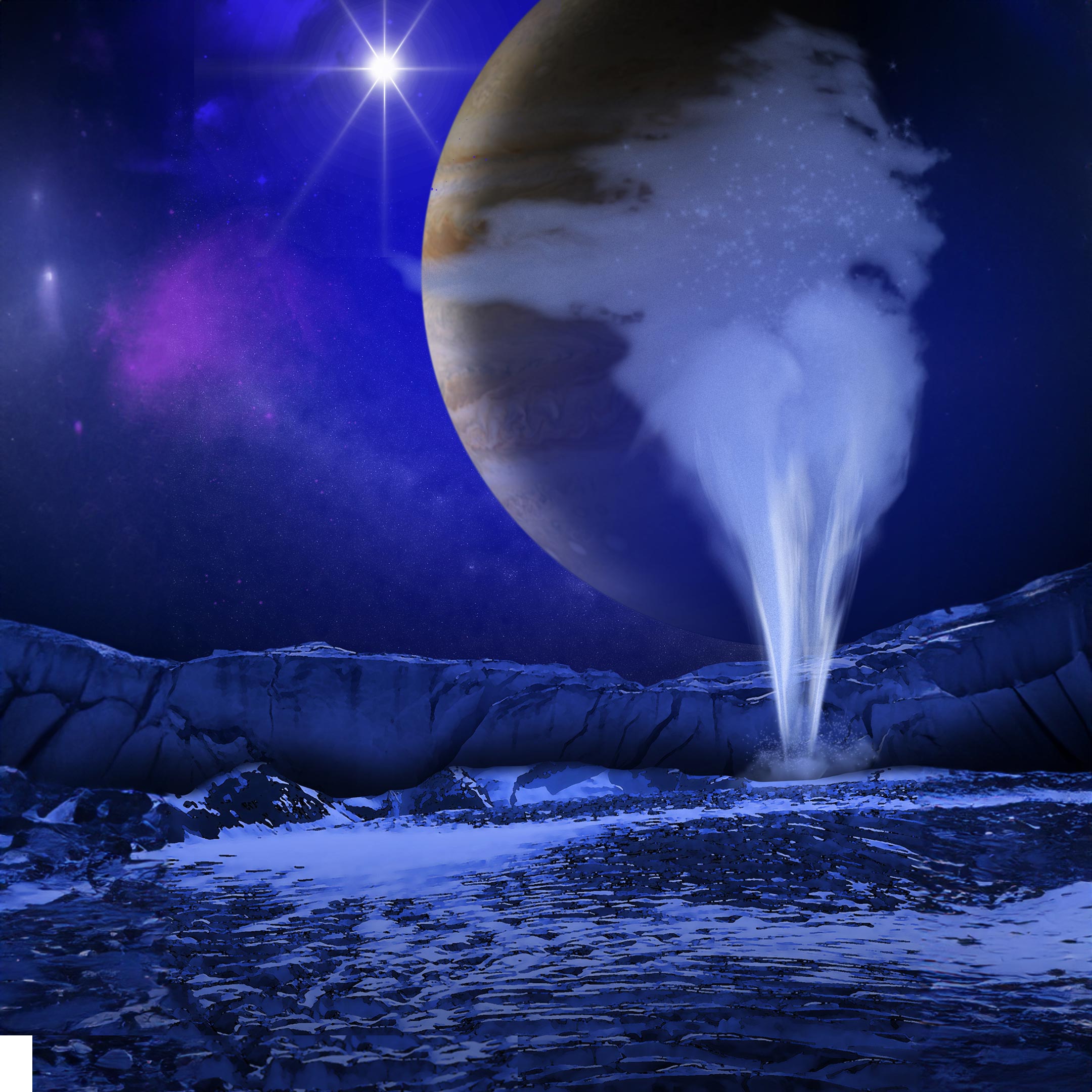
Webb telescope data, backed by lab experiments, reveal Europa’s icy shell is a dynamic landscape, with ice that crystallizes and reshapes under cosmic bombardment.
In chaos terrains like Tara Regio, the presence of strange chemicals—including table salt and carbon dioxide—suggests that materials from a deep subsurface ocean are leaking to the surface. This adds compelling new evidence that Europa hides a potentially habitable ocean beneath its fractured, ever-evolving crust.
A Constantly Changing Icy Surface
New laboratory experiments led by Dr. Ujjwal Raut at Southwest Research Institute are helping scientists unlock the secrets of Europa, Jupiter’s intriguing icy moon. The findings support recent observations from the James Webb Space Telescope (JWST), which detected surprising changes on Europa’s frozen surface. It turns out the moon’s surface ice isn’t static—it’s actively crystallizing in some places while remaining disordered in others. These variations may point to a fascinating combination of cosmic forces and internal activity reshaping the ice.
On Earth, water freezes into an orderly structure known as crystalline ice. But out in space, Europa’s surface is constantly bombarded by charged particles from Jupiter’s intense magnetic field. This radiation scrambles the ice’s structure, creating a more chaotic form called amorphous ice. Scientists now believe both forms are present on Europa, and that they shift over time.
Lab Experiments and Chaotic Terrains
To better understand this icy transformation, Raut’s team conducted detailed experiments simulating Europa-like conditions. These tests revealed how quickly the ice can shift between crystalline and amorphous forms, especially in rugged areas called chaos terrains—regions filled with tangled ridges, cracks, and shattered plains. When combined with JWST’s fresh data, the results strengthen the case for something extraordinary hiding beneath the surface: a vast liquid ocean.
For years, researchers believed Europa’s surface was topped with a very thin layer of amorphous ice, just enough to cover the crystalline ice beneath. But this new study discovered something surprising—crystalline ice appearing not just below the surface, but right on it, especially in an area known as Tara Regio.

Tara Regio’s Mysterious Chemistry
“We think that the surface is fairly porous and warm enough in some areas to allow the ice to recrystallize rapidly,” said Dr. Richard Cartwright, lead author of the paper and a spectroscopist at Johns Hopkins University’s Applied Physics Laboratory. “Also, in this same region, generally referred to as a chaos region, we see a lot of other unusual things, including the best evidence for sodium chloride, like table salt, probably originating from its interior ocean. We also see some of the strongest evidence for CO2 and hydrogen peroxide on Europa. The chemistry in this location is really strange and exciting.”
Evidence of an Interior Ocean
“Our data showed strong indications that what we are seeing must be sourced from the interior, perhaps from a subsurface ocean nearly 20 miles (30 kilometers) beneath Europa’s thick icy shell,” said Raut. “This region of fractured surface materials could point to geologic processes pushing subsurface materials up from below. When we see evidence of CO2 at the surface, we think it must have come from an ocean below the surface. The evidence for a liquid ocean underneath Europa’s icy shell is mounting, which makes this so exciting as we continue to learn more.”
For instance, CO2 found in this area includes the most common type of carbon, which has an atomic mass of 12 and contains six protons and six neutrons, as well as the rarer, heavier isotope that has an atomic mass of 13 with six protons and seven neutrons.
The Puzzle of Carbon Isotopes
“Where is this 13CO2 coming from? It is hard to explain, but every road leads back to an internal origin, which is in line with other hypotheses about the origin of 12CO2 detected in Tara Regio,” Cartwright said.
Reference: “JWST Reveals Spectral Tracers of Recent Surface Modification on Europa” by Richard J. Cartwright, Charles A. Hibbitts, Bryan J. Holler, Ujjwal Raut, Tom A. Nordheim, Marc Neveu, Silvia Protopapa, Christopher R. Glein, Erin J. Leonard, Lorenz Roth, Chloe B. Beddingfield and Geronimo L. Villanueva, 28 May 2025, The Planetary Science Journal.
DOI: 10.3847/PSJ/adcab9
Never miss a breakthrough: Join the SciTechDaily newsletter.
Follow us on Google and Google News.
2 Comments
I’m hoping we find blind, sonar equipped fish the size of whales. Pegs the cool-ometer.
Note 2506030447_Source1. Analyzing【
_[2, 2-1]Water is sensitive to temperature, so the water in Europa’s inner sea is constantly exposed to charged particles from Jupiter’s powerful magnetic field, showing how fast the surface of Europa, Jupiter’s moon, can travel between crystalline and amorphous forms, especially in a rugged area called Chaos Terrains, which is filled with tangled ridges, cracks, and shattered plains.
If we explain this in terms of qpeoms.mode, Jupiter’s radioactive radiation temperature, t.qpeoms.temper creates the qpeoms functional change of w.qpeoms.ho with considerable influence on the water of the Europa satellite. In any case, the association between Jupiter and Europa is expressed in terms of the qpeoms functional theory.
f(t)=wt.qpeoms
Due to Jupiter’s radiant heat (t), the value of the distribution of the qpeoms.ho topography of the satellite Europa’s water h2o().water changes.
Jupiter’s radiation, qpeoms.radiant_heat, is a particle beam in the form of energy emitted during the stabilization of atomic nuclei, with values of qpeoms expressed as alpha (α), beta (β), and gamma (γ) neutron lines.
They are also classified as electromagnetic waves, gamma rays, x-rays, and so on. These radiation qpeoms functions have the properties of related differentiation, such as ozer, qcell, mcell, nk, banc, etc., which pass through or ionize other qpeoms. Huh.
Therefore, when the effect of Jupiter’s radiant heat on the water oceans inside the Europa satellite is expressed in terms of collective theory inclusion, the interaction between the one.qpeoms.temper temperature and the physical property h2o state is expressed as a distribution function of parts.qpeoms.ho. Hmm.
1-2.
Webb telescope data, supported by laboratory experiments or qpeoms.t(ho2o), show that Europa’s ice shell is a dynamic topography where the ice crystallizes and changes shape from Jupiter’s radiation bombardment.
1-3.
It has been found that the ice on the Europa surface is non-fixed, actively crystallizing in some places, while remaining disordered in others. These changes may suggest an interesting combination of cosmic forces and internal activities that change the shape of the ice.
≈≈=========
Source 1.
https://scitechdaily.com/europas-fractured-ice-is-leaking-clues-from-a-hidden-ocean-below/
1.
Europa’s cracked ice spills clues from the sea hidden below
The ice on the Europa surface is constantly moving, and unusual compounds such as carbon dioxide and salt suggest activity is taking place in the deep sea below it.
1-1.
Webb telescope data, supported by laboratory experiments, show that Europa’s ice shell is a dynamic topography where the ice crystallizes and changes shape due to space bombardment.
The presence of strange chemicals, including table salts and carbon dioxide, in chaotic terrains such as Tara Reggio suggests that materials from deep underground oceans are leaking to the surface. This presents compelling new evidence that Europa is hiding a potentially life-sustaining ocean under its ever-evolving cracked crust.
1-2. The ever-changing ice surface
Experiments are helping scientists uncover the secrets of Europa, Jupiter’s interesting ice moon. The findings support recent observations by the James Webb Space Telescope (JWST), where surprising changes have been detected on the frozen surface of Europa.
1-3.
It has been found that the ice on the Europa surface is non-fixed, actively crystallizing in some places, while remaining disordered in others. These changes may suggest an interesting combination of cosmic forces and internal activities that change the shape of the ice.
2.
[Water freezes on Earth to form an orderly structure called crystal ice. However, in space, Europa’s surface is constantly exposed to charged particles from Jupiter’s powerful magnetic field.]
[This heat of radiation mixes the ice structure to create a more chaotic form called amorphous ice] Scientists think that both forms currently exist in Europa and change over time.
2-1. Lab experiments and confusing terrain
To better understand these ice changes, Raut’s team conducted detailed experiments simulating Europa-like environments. The experiment showed how fast ice can travel between crystalline and amorphous forms, especially in a rugged area called Chaos Terrains, which is filled with tangled ridges, cracks, and shattered plains. Combined with the latest data from JWST, this result further strengthens the evidence for something special beneath the surface: a vast ocean of liquid.
2-2.
For years, researchers thought Europa’s surface was covered with a very thin layer of amorphous ice, enough to cover the crystalline ice beneath it. However, this new study has discovered a surprising fact. It is that crystalline ice was found not just below the surface, but just above the surface, specifically in an area known as Tara Regio.
2-3.
The experiments presented evidence supporting spectral data recently collected by the James Webb Space Telescope (JWST). The data show that the ice surface of Jupiter’s moon Europa is constantly changing. JWST shows that Europa’s ice is being produced at different rates, like Tara Regio, at the surface and wherever there is crystalline ice (brighter color) below the surface.
3. The Mysterious Chemistry of Tara Reggio
The surface is quite porous, and some areas are thought to be warm enough for the ice to quickly recrystallize. In addition, many other unusual materials are found in this area, commonly referred to as the chaotic zone, with the strongest evidence of sodium chloride, which, like table salt, presumably originated in an internal ocean. In addition, the strongest evidence of carbon dioxide and hydrogen peroxide was found in Europa.