
Jupiter’s moons may have been born with the chemistry needed for life.
An international collaboration that included Southwest Research Institute has shown how complex organic molecules (COMs), widely considered essential precursors to life, may have been built into Jupiter’s Galilean moons as they formed. The findings are detailed in companion papers published in The Planetary Science Journal and Monthly Notices of the Royal Astronomical Society. Together, the studies provide new perspective on whether the Jovian system may have gained the ingredients needed for life at a very early stage.
COMs are carbon-based compounds that also contain elements such as oxygen and nitrogen, which are crucial for biology. Laboratory experiments have demonstrated that these molecules can form when icy dust grains containing methanol or mixtures of carbon dioxide and ammonia are exposed to ultraviolet light or moderate heating. Those conditions are typical of protoplanetary disks, the vast clouds of gas and dust that surround young stars and eventually give rise to planets.
Modeling the Early Solar System Environment
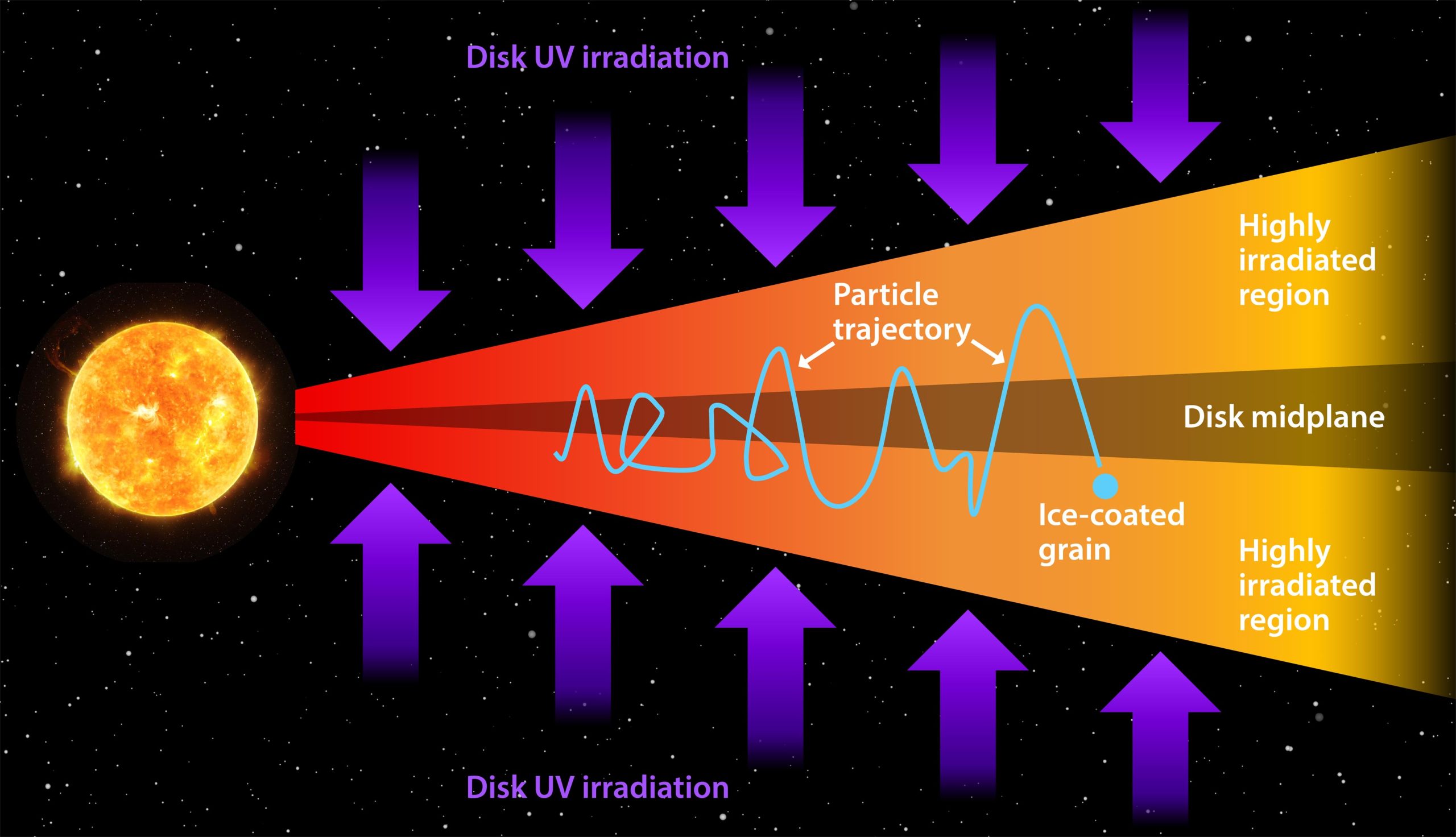
To investigate how these compounds could have formed and traveled, scientists combined simulations of disk evolution with models that track the movement of icy particles. This allowed them to estimate the temperatures and radiation levels those grains encountered over time.
“By combining disk evolution with particle transport models, we could precisely quantify the radiation and thermal conditions the icy grains experienced,” said Dr. Olivier Mousis of SwRI’s Solar System Science and Exploration Division, who is lead author of one of the two studies. “Then we directly compared our simulations with other laboratory experiments that produce COMs under realistic astrophysical conditions. The results showed that COM formation is possible in both the protosolar nebula environment and Jupiter’s circumplanetary disk.”
The research team brought together experts from SwRI, Aix-Marseille University (France), and the Institute for Advanced Studies (Ireland). They constructed detailed models of the protosolar nebula, the structure that formed the Sun and planets, as well as Jupiter’s circumplanetary disk, the material surrounding the young gas giant that later assembled into its moons. By integrating a grain transport component, they traced the paths of icy particles through both environments and reconstructed the chemical and physical history of the material that ultimately formed Europa, Ganymede, Callisto, and Io, Jupiter’s four largest and best-studied moons.
Transporting Life’s Building Blocks to the Galilean Moons
The simulations indicate that a substantial share of icy grains likely formed COMs and carried them into the region where Jupiter’s moons were taking shape. In some modeled cases, nearly half of the particles transported newly created organic molecules from the protosolar nebula into Jupiter’s circumplanetary disk, where they were incorporated into the growing moons with little chemical change.
The research also points to a second source. Certain areas within Jupiter’s circumplanetary disk appear to have been warm enough to drive the chemical reactions required to create COMs locally. This suggests that the Galilean moons may have inherited organic material both from the broader solar nebula and from chemical processes occurring within Jupiter’s own disk billions of years ago.
Ocean Worlds and the Potential for Life
Europa, Ganymede, and Callisto are thought to contain subsurface oceans beneath their icy crusts, environments that could support life. If COMs were present from the start, these moons would have had more than just water and internal energy. They may also have possessed the molecular ingredients necessary for prebiotic chemistry, including the formation of amino acids and nucleotides.
“Our findings suggest that Jupiter’s moons did not form as chemically pristine worlds,” Mousis said. “Instead, they may have accreted, or accumulated, a significant inventory of COMs at birth, providing a chemical foundation that could later interact with the liquid water in their interiors.”
NASA’s Europa Clipper mission and the European Space Agency’s Juice spacecraft are currently en route to the Jovian system to examine the structure, composition, and habitability of these moons.
“Establishing credible pathways for COMs formation and delivery provides scientists with a critical framework for interpreting upcoming measurements of Jupiter’s surface and subsurface chemistry,” Mousis said. “By linking laboratory chemistry, disk physics, and particle transport models, our work may highlight how habitable conditions are rooted in the earliest stages of planetary formation.”
References:
“Formation and Survival of Complex Organic Molecules in the Jovian Circumplanetary Disk” by Olivier Mousis, Clément Petetin, Tom Benest Couzinou, Antoine Schneeberger and Yannis Bennacer, 17 February 2026, The Planetary Science Journal.
DOI: 10.3847/PSJ/ae3559
“Delivery of complex organic molecules to the system of Jupiter” by Tom Benest Couzinou, Alizée Amsler Moulanier and Olivier Mousis, 28 November 2025, Monthly Notices of the Royal Astronomical Society.
DOI: 10.1093/mnras/staf2074
Never miss a breakthrough: Join the SciTechDaily newsletter.
Follow us on Google and Google News.