
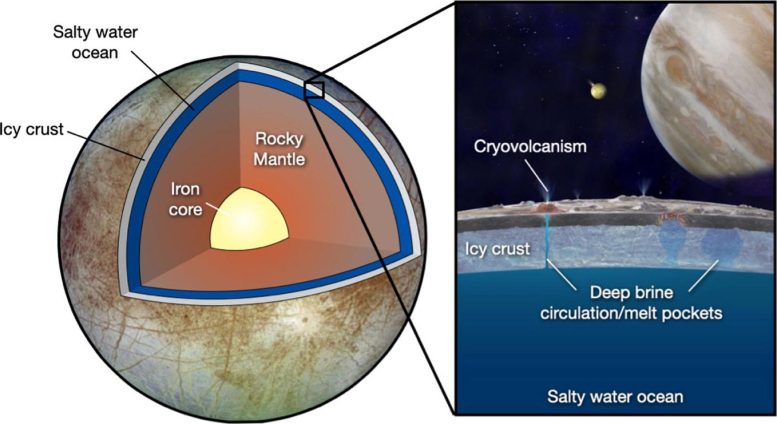
Research shows that high-pressure, salty water can remain liquid at colder temperatures on icy moons, expanding the potential for extraterrestrial life in their deep oceans.
University of Washington (UW) and University of California, Berkeley (UC Berkeley) researchers conducted experiments that measured the physical limits for the existence of liquid water in icy extraterrestrial worlds. This combination of geology and engineering was done to help in the hunt for alien life and the upcoming robotic exploration of oceans on other planets’ moons.
The results were recently published in the journal Cell Reports Physical Science.
“The more a liquid is stable, the more promising it is for habitability,” said co-corresponding author Baptiste Journaux, an acting assistant professor of Earth and space sciences at the UW. “Our results show that the cold, salty, high-pressure liquids found in the deep ocean of other planets’ moons can remain liquid to much cooler temperature than they would at lower pressures. This extends the range of possible habitats on icy moons, and will allow us to pinpoint where we should look for biosignatures, or signs of life.”
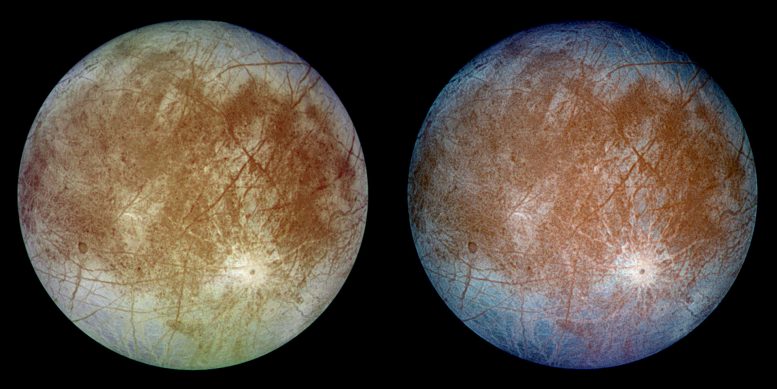
Potential Habitats on Jupiter and Saturn’s Icy Moons
Jupiter and Saturn’s icy moons — including Europa, Ganymede, and Titan — are leading candidates within our solar system for hosting extraterrestrial life. These ice-encrusted moons are thought to harbor enormous liquid oceans, up to several dozen times the volume of oceans on Earth.
“Despite its designation as the ‘blue marble,’ Earth is remarkably dry when compared to these worlds,“ Journaux said.
The oceans on these moons may contain various types of salts and are expected to range from about 100 miles (160 km) deep, on Europa, to more than 400 miles (640 km) deep, on Titan.
“We know that water supports life, but the major part of the oceans on these moons are likely below zero degrees Celsius and at pressures higher than anything experienced on Earth,” Journaux said. “We needed to know how cold an ocean can get before entirely freezing, including in its deepest abyss.”
Investigating Eutectics: Lowest Freezing Points of Salty Solutions
The study focused on eutectics, or the lowest temperature that a salty solution can remain liquid before entirely freezing. Salt and water are one example — salty water remains liquid below the freezing temperature of pure water, one of the reasons people sprinkle salt on roads in winter to avoid the formation of ice.
The experiments used UC Berkeley equipment originally designed for the future cryopreservation of organs for medical applications and for food storage. For this research, however, the authors used it to simulate the conditions thought to exist on other planets’ moons.
Journaux, a planetary scientist and expert on the physics of water and minerals, worked with UC Berkeley engineers to test solutions of five different salts at pressures up to 3,000 times atmospheric pressure, or 300 megapascals — about three times the pressure in Earth’s deepest ocean trench.
Implications for Extraterrestrial Life and Upcoming Missions
“Knowing the lowest temperature possible for salty water to remain a liquid at high pressures is integral to understanding how extraterrestrial life could exist and thrive in the deep oceans of these icy ocean worlds,” said co-corresponding author Matthew Powell-Palm, who did the work as a postdoctoral researcher at UC Berkeley, also co-founder and CEO of the cryopreservation company BioChoric, Inc.
Journaux recently started working with NASA’s Dragonfly mission team, which will send a rotorcraft in 2027 to Saturn’s largest moon, Titan. NASA also is leading the Europa Clipper mission in 2024 to explore Europa, one of the many moons orbiting Jupiter. Meanwhile, the European Space Agency in 2023 will send its JUICE spacecraft, or Jupiter Icy Moons Explorer, to explore three of Jupiter’s largest moons: Ganymede, Callisto and Europa.
“The new data obtained from this study may help further researchers’ understanding of the complex geological processes observed in these icy ocean worlds,” Journaux said.
Reference: “On the pressure dependence of salty aqueous eutectics” by Brooke Chang, Anthony N. Consiglio, Drew Lilley, Ravi Prasher, Boris Rubinsky, Baptiste Journaux and Matthew J.Powell-Palm, Cell Reports Physical Science.
DOI: 10.1016/j.xcrp.2022.100856
Other authors are Boris Rubinsky, Brooke Chang, Anthony Consiglio, Drew Lilley and Ravi Prasher, all at UC Berkeley. The study was funded by the National Science Foundation and NASA.
Never miss a breakthrough: Join the SciTechDaily newsletter.
Follow us on Google and Google News.