
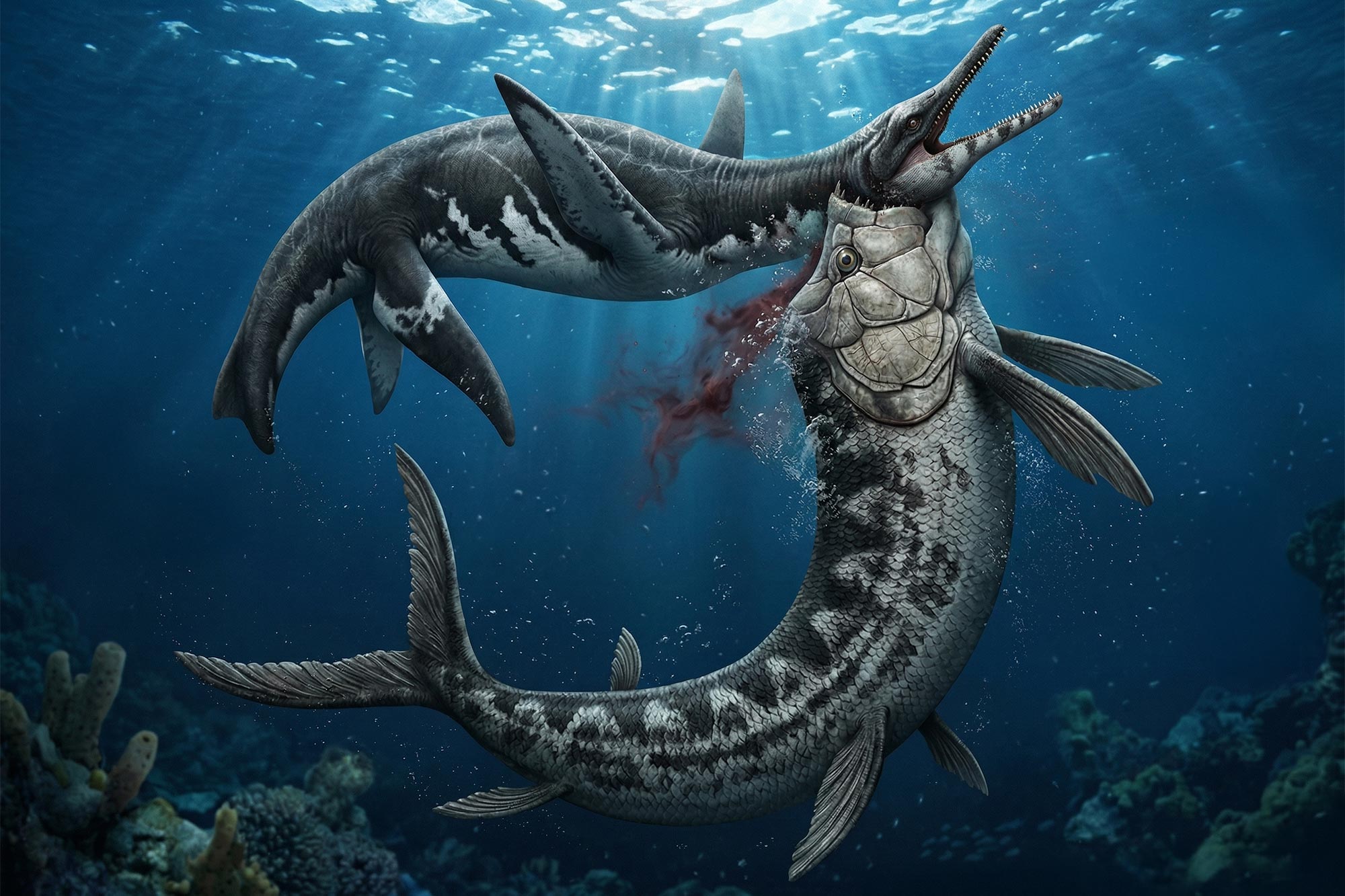
A fossil discovery from Alabama reveals a rare and dramatic glimpse into the dangers of Cretaceous oceans, where even top predators were vulnerable.
The oceans covering North America during the Cretaceous period were filled with life. Massive fish and large marine reptiles dominated the Western Interior Seaway. A newly described fossil now offers rare evidence of a direct encounter between two of these top predators.
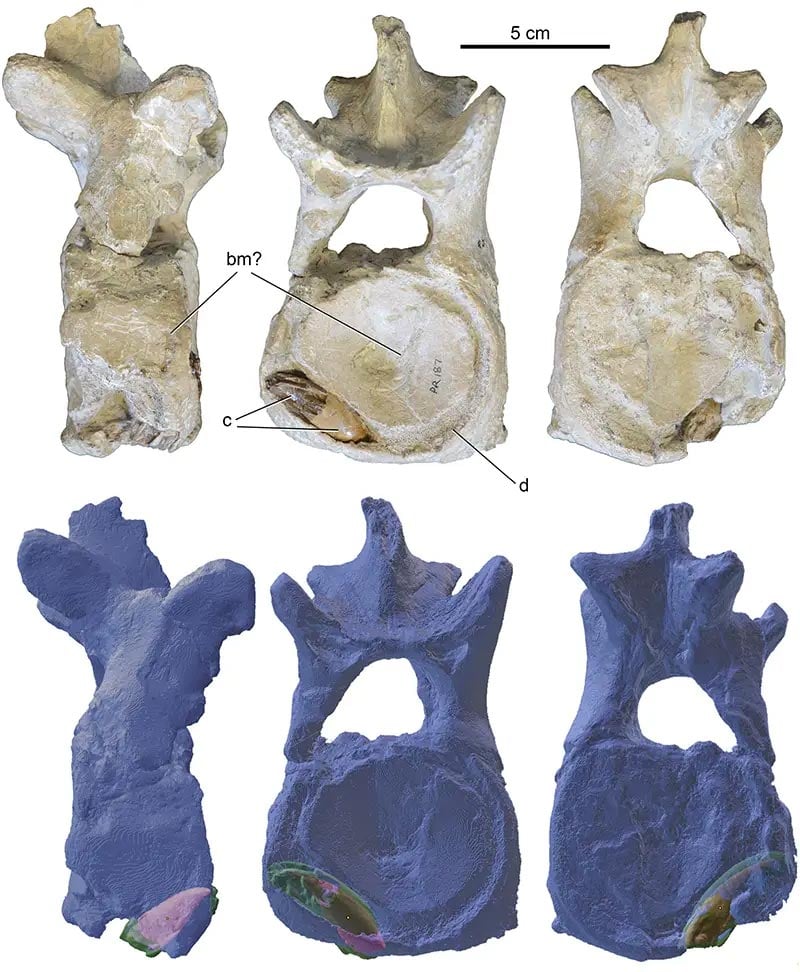
Researchers found this clue hidden in a specimen drawer at the Field Museum of Natural History in Chicago. The fossil, a four-meter (13-foot) long Polycotylus from Alabama’s Mooreville Chalk, contained an unexpected feature: a large tooth lodged in one of its neck vertebrae.
Professor Christopher Brochu from the University of Iowa’s Department of Earth and Environmental Sciences first spotted the specimen while taking a break from studying fossil crocodiles.
“I sometimes look at other material to see if there’s anything I can show in my classes, and that’s when I saw the bitten vertebra,” said Brochu.
A Hidden Clue Revealed by Technology
The force of the bite, along with millions of years of burial and fossilization, left the tooth shattered at both ends and stuck firmly inside the bone. To determine what animal left it behind, researchers turned to advanced imaging.
They used computed tomography (CT) scanning to examine the fossil’s internal structure without damaging it. Two undergraduate students at the University of Tennessee, Knoxville, Miles Mayhall and Emma Stalker, created a three-dimensional model of the tooth. Their work identified the attacker as Xiphactinus, a large predatory bony fish.
“We sometimes get these fixed ideas in our heads about who the top predator in any given environment is and who might rest a rung or two down on the food chain,” said lead author and paleontologist Stephanie Drumheller, a teaching associate professor from the Department of Earth, Environmental, and Planetary Sciences at UT. “This fossil is a good reminder that nature is rarely that cut and dry.”
Predator or Combatant?
Although Xiphactinus was enormous, it likely was not trying to eat the Polycotylus. Fossils showing “fish-within-a-fish” suggest this predator usually swallowed smaller prey whole. Instead, the embedded tooth may record a violent encounter rather than an attempted meal.
Regardless of the circumstances, the position and depth of the bite indicate it would have been fatal.
“Plesiosaurs are famous for their long necks, but those necks come at a price,” said coauthor Professor Robin O’Keefe, of the Department of Biological Sciences at Marshall University. “The trachea, esophagus, major arteries and veins, important nerves; all these organs lie vulnerable to attack. A bite to the neck by Xiphactinus would have certainly proved fatal to this animal, if the Polycotylus was not already dead.”
A Dangerous Ancient Ecosystem
This discovery adds to a growing body of evidence from the Mooreville Chalk that reveals a highly active and dangerous marine environment. Bite marks from fish, sharks, and marine reptiles are common in these rocks, showing that predators frequently attacked a wide range of prey.
These included other marine animals, dinosaurs that drifted out to sea, and even other predators. Altogether, the fossils suggest that survival in these ancient oceans was uncertain, even for the largest hunters.
Reference: “A bite to the throat: A probable Xiphactinus attack on a Polycotylus from the Cretaceous Mooreville Chalk of Alabama, U.S.A.” by Stephanie K. Drumheller, F. Robin O’keefe, Miles L. Mayhall, Emma Stalker and Christopher A. Brochu, 12 March 2026, Journal of Vertebrate Paleontology.
DOI: 10.1080/02724634.2026.2625732
Never miss a breakthrough: Join the SciTechDaily newsletter.
Follow us on Google and Google News.
1 Comment
nice topic