

USC researchers report that residents in neighborhoods with more high-heat days exhibit accelerated molecular aging compared to those in cooler areas.
A study from the USC Leonard Davis School of Gerontology finds that greater exposure to extreme heat may accelerate biological aging in older adults. The findings raise concerns about the long-term health effects of climate change and heat waves at the molecular level.
According to Jennifer Ailshire, senior author of the study and professor of gerontology and sociology at USC Leonard Davis, residents of neighborhoods experiencing more days of extreme heat tend to show greater biological aging than those living in cooler areas.
Biological age reflects how well the body functions at the molecular, cellular, and systemic levels, rather than simply the number of years since birth. A biological age higher than one’s chronological age is linked to an increased risk of disease and mortality. While extreme heat has long been associated with negative health effects, including a higher risk of death, its impact on biological aging has remained unclear—until now.
Measuring epigenetic changes
Ailshire and her coauthor Eunyoung Choi, USC Leonard Davis PhD in Gerontology alumna and postdoctoral scholar, examined how biological age changed in more than 3,600 Health and Retirement Study (HRS) participants aged 56 and older from throughout the U.S. Blood samples taken at various time points during the six-year study period were analyzed for epigenetic changes, or changes in the way individual genes are turned “off” or “on” by a process called DNA methylation.
The researchers used mathematical tools called epigenetic clocks to analyze methylation patterns and estimate biological ages at each time point. They then compared participants’ changes in biological age to their location’s heat index history and number of heat days reported by the National Weather Service from 2010 to 2016.
The National Weather Service Heat Index Chart categorizes heat index values into three levels based on the potential risk of adverse health effects. The “Caution” level includes heat index values ranging from 80°F to 90°F, the “Extreme Caution” level includes values between 90°F and 103°F, and the “Danger” level includes values between 103°F and 124°F. Days in all three levels were included as heat days in the study.
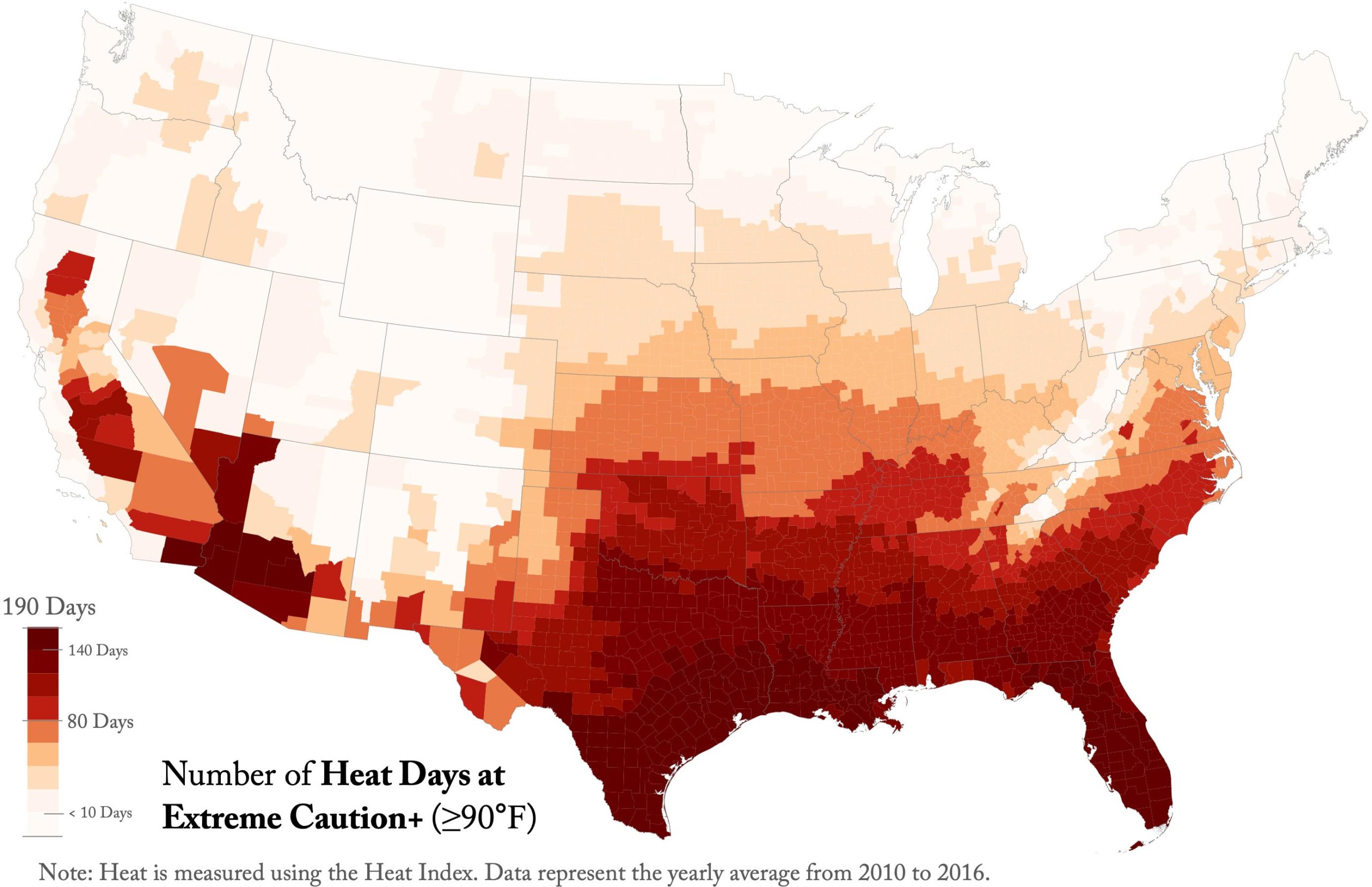
The analysis revealed a significant correlation between neighborhoods with more days of extreme heat and individuals experiencing greater increases in biological age, Choi said. This correlation persisted even after controlling for socioeconomic and other demographic differences, as well as lifestyle factors such as physical activity, alcohol consumption, and smoking, she added.
“Participants living in areas where heat days, as defined as Extreme Caution or higher levels (≥90°F), occur half the year, such as Phoenix, Arizona, experienced up to 14 months of additional biological aging compared to those living in areas with fewer than 10 heat days per year,” she said. “Even after controlling for several factors, we found this association. Just because you live in an area with more heat days, you’re aging faster biologically.”
All three epigenetic clocks employed in the study – PCPhenoAge, PCGrimAge, and DunedinPACE – revealed this association when analyzing epigenetic aging over a 1- to 6-year period. PCPhenoAge also showed the association after short (7 days) and medium (30-60 days) periods of time, indicating that heat-related epigenetic changes could happen relatively quickly, and some of them may accumulate over time.
Climate implications for communities
Older adults are particularly vulnerable to the effects of high heat, Ailshire said. She noted that the study used heat index, rather than just air temperature, to take relative humidity into account as they analyzed results.
“It’s really about the combination of heat and humidity, particularly for older adults, because older adults don’t sweat the same way. We start to lose our ability to have the skin-cooling effect that comes from that evaporation of sweat,” she explained. “If you’re in a high humidity place, you don’t get as much of that cooling effect. You have to look at your area’s temperature and your humidity to really understand what your risk might be.”
The next steps for the researchers will be to determine what other factors might make someone more vulnerable to heat-related biological aging and how it might connect to clinical outcomes. In the meantime, the study results could also prompt policymakers, architects, and others to keep heat mitigation and age-friendly features in mind as they update cities’ infrastructure, from placing sidewalks and building bus stops with shade in mind to planting more trees and increasing urban green space, Ailshire said.
“If everywhere is getting warmer and the population is aging, and these people are vulnerable, then we need to get really a lot smarter about these mitigation strategies,” she said.
Reference: “Ambient outdoor heat and accelerated epigenetic aging among older adults in the US” by Eun Young Choi and Jennifer A. Ailshire, 26 February 2025, Science Advances.
DOI: 10.1126/sciadv.adr0616
Funding for the study included the USC/UCLA Center on Biodemography and Population Health through a grant from the National Institute on Aging, National Institutes of Health (P30AG017265) and The Network on Life Course Health Dynamics and Disparities in 21st Century America funded by the National Institute on Aging, National Institutes of Health (R24AG045061).
Never miss a breakthrough: Join the SciTechDaily newsletter.
Follow us on Google and Google News.
2 Comments
From the actual study: “The interpretation of our results must be considered within the context of several limitations (see appendix S1 for an extended version)…our data did not have repeated measurements of epigenetic clocks, which did not allow us to observe and analyze longitudinal changes in response to ambient outdoor heat…this study cannot entirely rule out the influence of residual confounding or the impact of unmeasured variables such as amount of time respondents spend outdoors and use of temperature control within their home…the Health and Retirement Study (HRS) does not regularly collect information on respondents’ access to or use of air conditioning, so we were not able to directly account for its potential role in mitigating outdoor heat effects….the validity of epigenetic clocks across genetically and environmentally diverse populations has yet to be established…it is important to acknowledge that epigenetic modifications may represent adaptive responses to heat through acclimation or acclimatization rather than solely maladaptive changes associated with accelerated aging. The current study’s observational design does not allow us to definitively distinguish between these adaptive and maladaptive processes.”
In other words, bad study. But there is an agenda: “This provides strong (?) evidence critical for guiding public policy and advocacy initiatives aimed at developing mitigation strategies against climate change.”
There you have it. Climate change propaganda. The heat is killing us, even if the study you use to “prove” this is useless and hopelessly flawed.
DOGE, this type of research should be axed. NIH is funding this nonsensical propaganda.
“The findings raise concerns about the long-term health effects of climate change and heat waves at the molecular level.”
I’m still waiting for someone to claim that so-called climate change is responsible for the heart-break of psoriasis.
It is asserted that climate change is responsible for heat waves, while it is also acknowledged the there is more warming occurring at night and in the Winter than when heat waves occur. With a claimed annual Global Mean Temperature increase of <1.5 deg C in the last century, it will take a sensitive test to distinguish the influence of 'heat waves' over things like diet and exercise. While claiming that life style differences such as physical activity were taken into account as possible confounding factors, my lying eyes tell me that in the US, obesity is much more common than when I was a child and fewer people do hard physical labor. Therefore, I'm skeptical that such changes were adequately handled. Other changes, such as the widespread use today of recreational drugs and high-fructose corn syrup, were not considered.
As to the belief that global heat waves have become more common with a ~1 deg C global increase, I have done an analysis that calls that belief into question:
https://wattsupwiththat.com/2019/09/06/the-gestalt-of-heat-waves/
I concluded that there isn't strong empirical evidence to conclude that future global heat waves will be stronger or more frequent.