

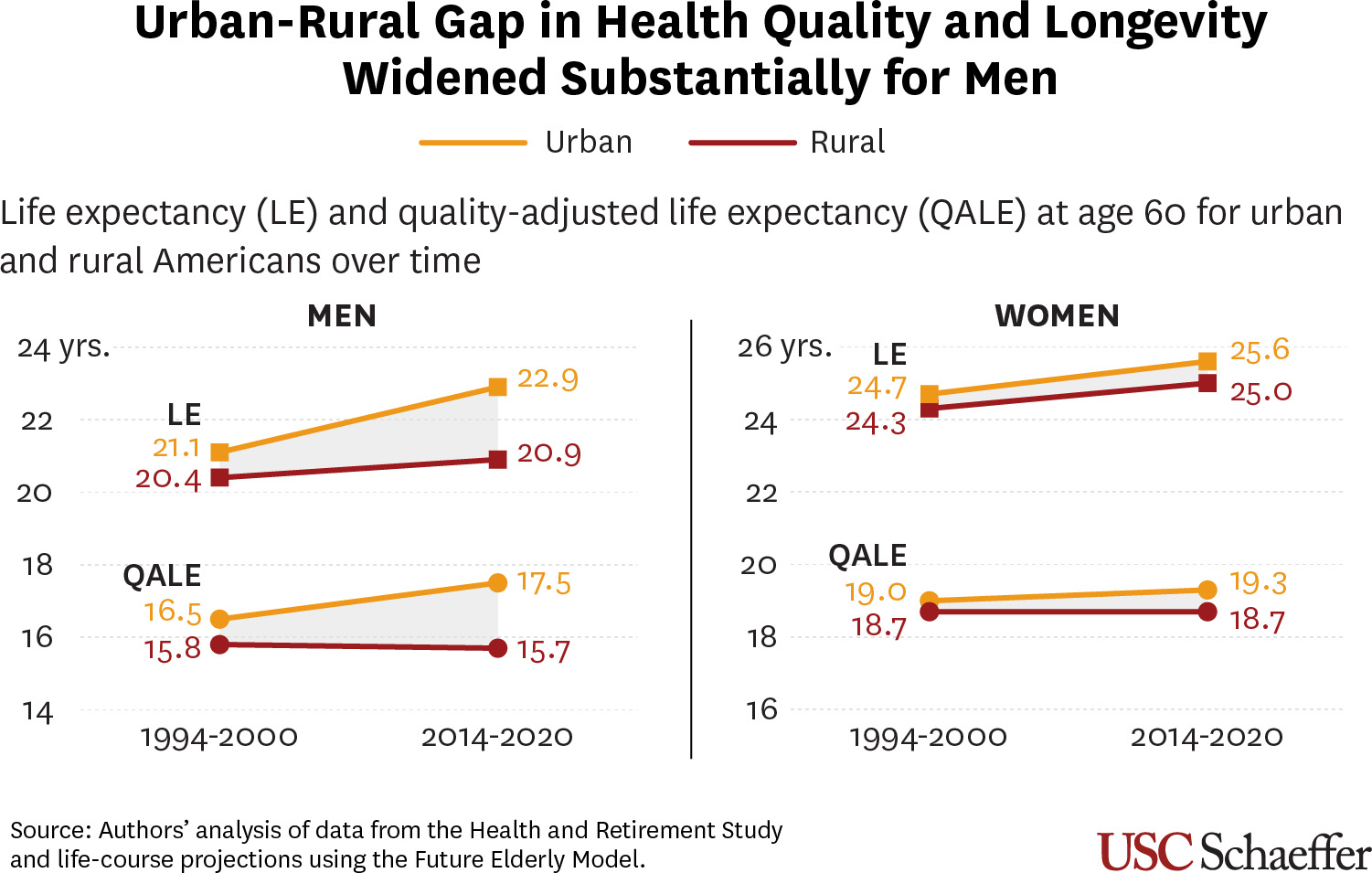
The disparity in life expectancy and health quality between urban and rural men approaching retirement has grown over the past twenty years.
New research from the USC Schaeffer Center for Health Policy & Economics reveals that rural men have a shorter life expectancy and fewer healthy years in later life compared to men living in urban areas.
Higher rates of smoking, obesity, and cardiovascular conditions among rural men are helping fuel a rural-urban divide in illness, and this gap has grown over time, according to the study published this week in the Journal of Rural Health. The findings suggest that by the time rural men reach age 60, there are limited opportunities to fully address this disparity, and earlier interventions may be needed to prevent it from widening further.
Rising Healthcare Challenges in Rural Areas
The findings also point to a rising demand for care in rural areas, which will particularly challenge these communities. Rural areas are more likely than urban ones to have shortages of healthcare providers and are aging faster as younger residents move to cities, which further shrinks the supply of potential caregivers.
“Rural populations face a higher prevalence of chronic diseases, which has serious implications for healthy aging,” said lead author Jack Chapel, a postdoctoral scholar at the Schaeffer Center. “With an aging population and fewer physicians available, the burden on rural communities is set to grow, leading to significant challenges in providing care for those who will face more health issues in the future.”
Study on Life Expectancy and Health Quality
Researchers used data from the Health and Retirement Survey and a microsimulation known as the Future Elderly Model to estimate future life expectancy for rural and urban Americans after age 60. They also assessed their likely quality of health in those years – a measure known as heath-quality-adjusted life expectancy (QALE). They estimated health trajectories for a cohort of Americans who were 60 years old between 2014-2020 and compared it with a similarly aged cohort from 1994-2000.
They found 60-year-old rural men can now expect to live two years less than their urban counterparts – a gap that’s nearly tripled from two decades ago. Rural men can also expect to live 1.8 fewer years in quality health than urban men, with this disparity more than doubling over the same period. For women, the urban-rural gap in life expectancy and health quality is much smaller and grew more slowly over time.
Nearly a decade after a landmark study found that people with lower levels of education are more likely to die from so-called “deaths of despair” – such as drug overdose or suicide – this new study finds that while education was an important factor in determining health quality, it cannot fully explain the gap between urban and rural populations. After adjusting rural education levels to match those of urban areas, the gap in healthy life expectancy was cut nearly in half. However, disparities existed even within each educational group, suggesting important geographic factors beyond education contribute to differences in healthy life expectancy.
Importance of Health Interventions
Researchers found that interventions to reduce smoking, manage obesity, and treat and control widespread heart disease would benefit older rural residents more than urban ones. However, most interventions researchers tested were not able to completely bridge the urban-rural divide in healthy life expectancy.
“While education matters, so does smoking, prevalent obesity, cardiovascular conditions – and simply living in a rural area – which leads not only to more deaths but more illness among rural American men,” said co-author Elizabeth Currid-Halkett, the James Irvine Chair in Urban and Regional Planning and a senior scholar at the USC Schaeffer Institute for Public Policy & Government Service.
“Closing the gap in healthy life expectancy between urban and rural areas for older adults would require encouraging health behavior changes earlier in life and making broader social and economic improvements in rural areas,” said co-author Bryan Tysinger, director of health policy simulation at the Schaeffer Center.
Reference: “The urban–rural gap in older Americans’ healthy life expectancy” by Jack M. Chapel, Elizabeth Currid-Halkett and Bryan Tysinger, 24 September 2024, The Journal of Rural Health.
DOI: 10.1111/jrh.12875
This work was supported by funding from the National Institute on Aging of the National Institutes of Health under award P30AG024968.
Never miss a breakthrough: Join the SciTechDaily newsletter.
Follow us on Google and Google News.
5 Comments
That doesn’t seem fair. People in cities are only alive thanks to farmers and cattlers.
Apparently more pollution is good…
I highly doubt those folks care in the slightest.
They’d probably even ask if you work for the gov and why you’re trying to convince them to give up their land and move to the city.
Hanna,
You are bigoted.
On the other hand, she may know a few farmers.