
Close Menu
    Facebook X (Twitter) Instagram
    SciTechDaily
    • Biology
    • Chemistry
    • Earth
    • Health
    • Physics
    • Science
    • Space
    • Technology
    Facebook X (Twitter) Pinterest YouTube RSS
    SciTechDaily
    Home»Biology»Falcons See Prey at Over 200 MPH – Speed of a Formula 1 Race Car
    Biology

    Falcons See Prey at Over 200 MPH – Speed of a Formula 1 Race Car

    By Lund UniversityDecember 20, 2019No Comments3 Mins Read
    Facebook Twitter Pinterest Telegram LinkedIn WhatsApp Email Reddit
    Share
    Facebook Twitter LinkedIn Pinterest Telegram Email Reddit
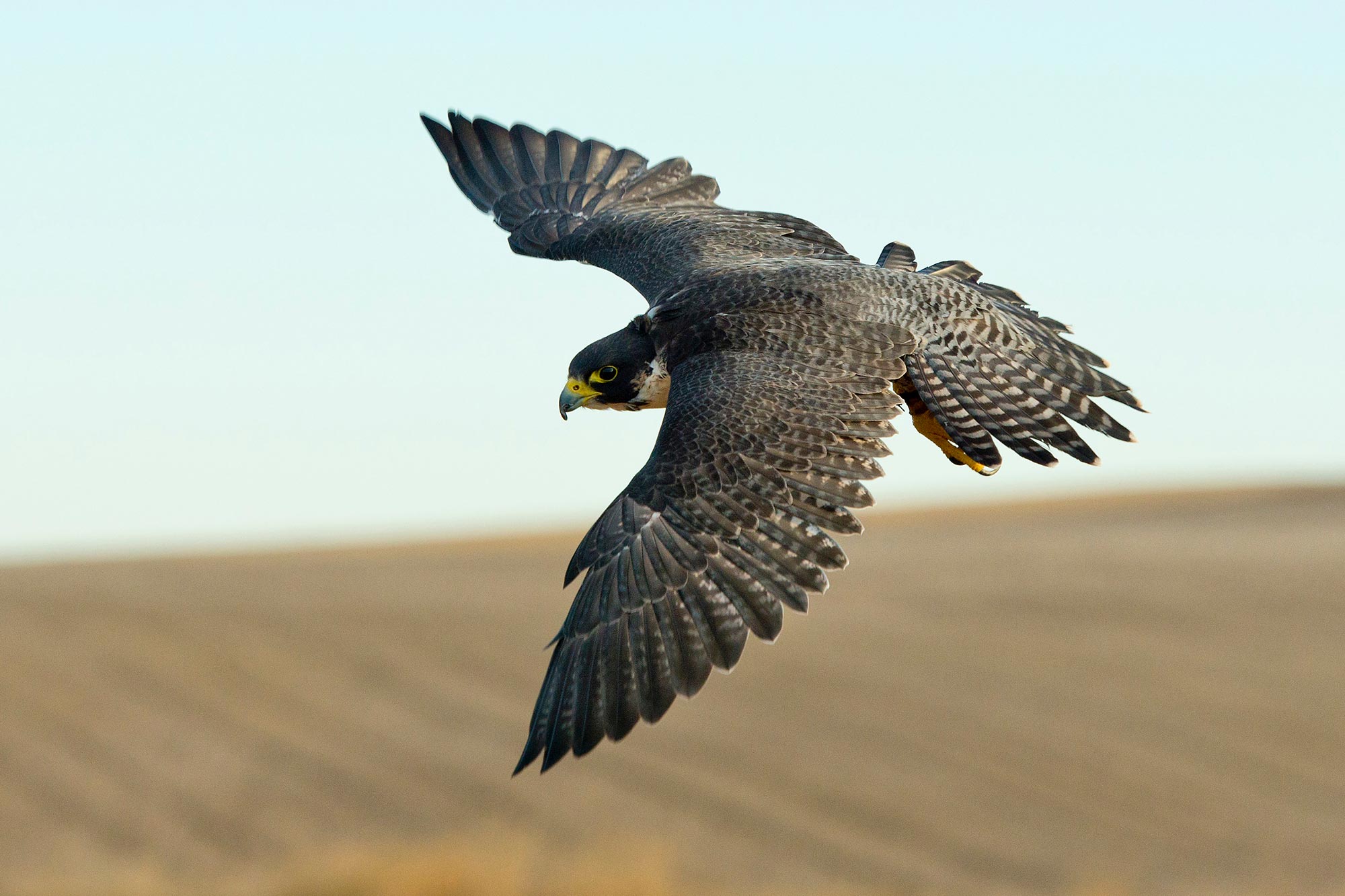
    Hunting Falcon
    The vision of some large eagles and vultures is twice as acute as that of humans.

    Extremely acute vision and the ability to rapidly process different visual impressions – these two factors are crucial when a peregrine falcon bears down on its prey at a speed that easily matches that of a Formula 1 racing car: over 350 kilometers per hour (~220 MPH).

    The visual acuity of birds of prey has been studied extensively and shows the vision of some large eagles and vultures is twice as acute as that of humans. On the other hand, up to now researchers have never studied the speed of vision among birds of prey, i.e. how fast they sense visual impressions.

    “This is the first time. My colleague Simon Potier and I have examined the peregrine falcon, saker falcon and Harris’s hawk and measured how fast light can blink for these species to still register the blinks,” says Almut Kelber, professor at the Department of Biology, Lund University.
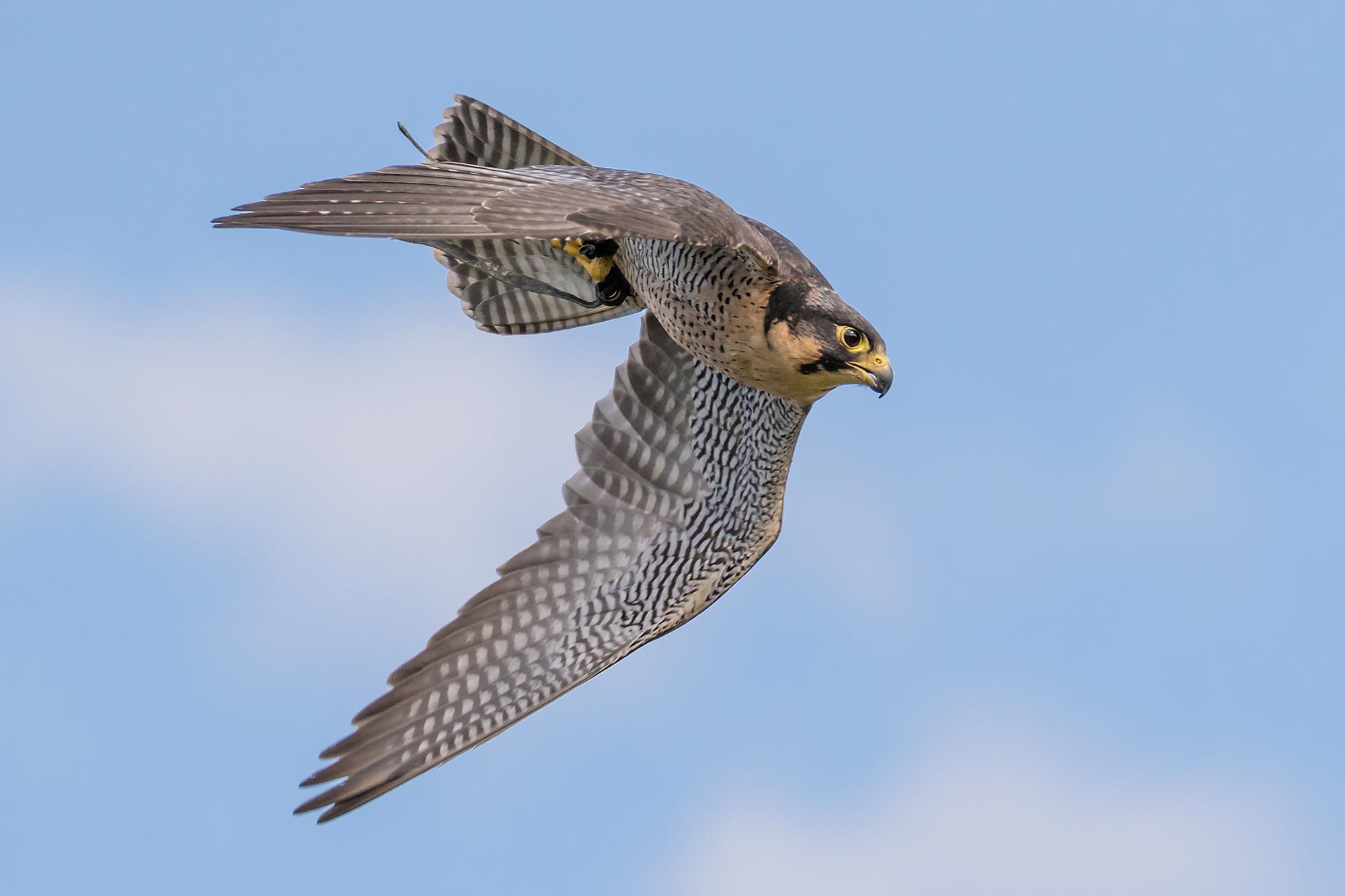
    Peregrine Falcon
    Peregrine falcon has the fastest vision and can register 129 Hz (blinks per second) provided the light intensity is high.

    The results show that the peregrine falcon has the fastest vision and can register 129 Hz (blinks per second) provided the light intensity is high. Under the same conditions, the saker falcon can see 102 Hz and the Harris’s hawk 77 Hz. By comparison, humans see a maximum of 50-60 Hz. At the cinema, a speed of 25 images per second is sufficient for us to perceive it as film, and not as a series of still images.

    The speed at which the different birds of prey process visual impressions corresponds with the needs they have when hunting: the peregrine falcon hunts fast-flying birds, whereas the Harris’s hawk hunts small, slower mammals on the ground.

    Even though the vision speed of birds of prey has never been measured before, there are studies about the speed at which small insect-eating birds such as flycatchers and blue tits can take in visual impressions.

    “They also have fast vision. Therefore, we draw the conclusion that bird species that hunt prey that flies fast have the fastest vision. Evolution has provided them with the ability because they need it,” says Almut Kelber.

    “It is something of a competition. A fly flies quite fast and has fast vision, therefore the flycatcher must see the fly quickly in order to catch it. The same applies to the falcon. To capture a flycatcher, the falcon must detect its prey sufficiently early in order to have time to react”, says Simon Potier.

    The new knowledge can hopefully contribute to better conditions for birds held in captivity.

    “Those who keep birds in cages must take care with the lighting and use cage lighting that does not shimmer, flicker or blink, because the birds will not feel well,” concludes Almut Kelber.

    Reference: “How fast can raptors see?” by Simon Potier, Margaux Lieuvin, Michael Pfaff and Almut Kelber, 10 December 2019, Journal of Experimental Biology.
    DOI: 10.1242/jeb.209031

    Never miss a breakthrough: Join the SciTechDaily newsletter.
    Follow us on Google and Google News.

    Birds Lund University
    Share. Facebook Twitter Pinterest LinkedIn Email Reddit

    Related Articles

    Bird Feeding Boosts Winter Survival of Small Birds by Helping Fight Infections

    Transgendered Bellbird Discovered in New Zealand

    Evidence Shows that Birds are Essentially Living Dinosaurs

    “Map of Life” to Illustrate All Living Things Geographically

    Pigeons Ability to Hear Magnetic Fields Finally Linked to the Lagena in Inner Ear

    Hummingbirds Notice Location, Not Flower Color

    Patterns of Flocks of Starlings Mathematically Behave How Magnets Would Move

    Hearing Loss Rapidly Changes Brain Motor Areas That Control Song

    “Area X” of Zebra Finch May Provide Insights to Human Speech Disorders

    Leave A Reply Cancel Reply

    • Facebook
    • Twitter
    • Pinterest
    • YouTube

    Don't Miss a Discovery

    Subscribe for the Latest in Science & Tech!

    Trending News

    Largest-Ever Study Finds Medicinal Cannabis Ineffective for Anxiety, Depression, PTSD

    250-Million-Year-Old Egg Solves One of Evolution’s Biggest Mysteries

    Living With Roommates Might Be Changing Your Gut Microbiome Without You Knowing

    Century-Old Cleaning Chemical Linked to 500% Increased Risk of Parkinson’s Disease

    What if Your Memories Never Happened? Physicists Take a New Look at the Boltzmann Brain Paradox

    One of the Universe’s Largest Stars May Be Getting Ready To Explode

    Scientists Discover Enzyme That Could Supercharge Ozempic-Like Weight Loss Drugs

    Popular Sweetener Linked to DNA Damage – “It’s Something You Should Not Be Eating”

    Follow SciTechDaily
    • Facebook
    • Twitter
    • YouTube
    • Pinterest
    • Newsletter
    • RSS
    SciTech News
    • Biology News
    • Chemistry News
    • Earth News
    • Health News
    • Physics News
    • Science News
    • Space News
    • Technology News
    Recent Posts
    • Black Hole Jets Pack Power of 10,000 Suns, Stunning New Study Reveals
    • A Cosmic Crash Turned This Nearby Galaxy Into Chaos
    • This Alien Solar System Doesn’t Follow the Rules – and Scientists Are Intrigued
    • What Did Prehistoric Europeans Eat? Scientists Uncover Surprising Answers
    • Scientists Say This Overlooked Organ Could Hold the Key to Longer Life
    Copyright © 1998 - 2026 SciTechDaily. All Rights Reserved.
    • Science News
    • About
    • Contact
    • Editorial Board
    • Privacy Policy
    • Terms of Use

    Type above and press Enter to search. Press Esc to cancel.