

A breakthrough in cloning hybrid rice could revolutionize sustainable agriculture.
An international group of researchers has achieved a 95% success rate in reproducing a commercial hybrid rice variety as a clone through seeds. This breakthrough has the potential to reduce the cost of hybrid rice seeds, making high-yielding and disease-resistant rice strains accessible to farmers with limited resources worldwide. The findings were recently published in the journal Nature Communications.
Crops produced from first-generation hybrids often display improved performance compared to their parent strains, which is referred to as “hybrid vigor”. However, this improvement does not continue when the hybrids are bred for a second generation. As a result, farmers who wish to use high-performing hybrid plant varieties must purchase new seeds each season.
The Potential of Apomixis in Crop Production
Rice, the staple crop for half the world’s population, is relatively costly to breed as a hybrid for a yield improvement of about 10 percent. This means that the benefits of rice hybrids have yet to reach many of the world’s farmers, said Gurdev Khush, adjunct professor emeritus in the Department of Plant Sciences at the University of California, Davis. Working at the International Rice Research Institute from 1967 until retiring to UC Davis in 2002, Khush led efforts to create new rice high-yield rice varieties, work for which he received the World Food Prize in 1996.
One solution to this would be to propagate hybrids as clones that would remain identical from generation to generation without further breeding. Many wild plants can produce seeds that are clones of themselves, a process called apomixis.
“Once you have the hybrid, if you can induce apomixis, then you can plant it every year,” Khush said.
However, transferring apomixis to a major crop plant has proved difficult to achieve.
One Step to Cloned Hybrid Seeds
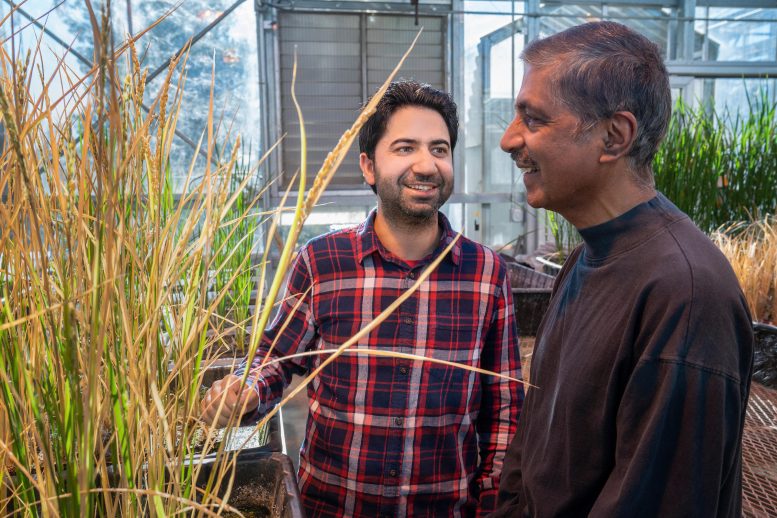
In 2019, a team led by Professor Venkatesan Sundaresan and Assistant Professor Imtiyaz Khanday at the UC Davis Departments of Plant Biology and Plant Sciences achieved apomixis in rice plants, with about 30 percent of seeds being clones.
Sundaresan, Khanday, and colleagues in France, Germany, and Ghana have now achieved a clonal efficiency of 95 percent, using a commercial hybrid rice strain, and shown that the process could be sustained for at least three generations.
A Genetic Breakthrough: The MiMe Modifications
The single-step process involves modifying three genes called MiMe which cause the plant to switch from meiosis, the process that plants use to form egg cells, to mitosis, in which a cell divides into two copies of itself. Another gene modification induces apomixis. The result is a seed that can grow into a plant genetically identical to its parent.
The method would allow seed companies to produce hybrid seeds more rapidly and at a larger scale, as well as provide seed that farmers could save and replant from season to season, Khush said.
“Apomixis in crop plants has been the target of worldwide research for over 30 years because it can make hybrid seed production can become accessible to everyone,” Sundaresan said. “The resulting increase in yields can help meet the global needs of an increasing population without having to increase the use of land, water, and fertilizers to unsustainable levels.”
The results could be applied to other food crops, Sundaresan said. In particular, rice is a genetic model for other cereal crops including maize and wheat, that together constitute major food staples for the world.
Khush recalled that he organized a 1994 conference on apomixis in rice breeding. When he returned to UC Davis in 2002, he gave a copy of the conference proceedings to Sundaresan.
“It’s been a long project,” he said.
Reference: “High-frequency synthetic apomixis in hybrid rice” by Aurore Vernet, Donaldo Meynard, Qichao Lian, Delphine Mieulet, Olivier Gibert, Matilda Bissah, Ronan Rivallan, Daphné Autran, Olivier Leblanc, Anne Cécile Meunier, Julien Frouin, James Taillebois, Kyle Shankle, Imtiyaz Khanday, Raphael Mercier, Venkatesan Sundaresan and Emmanuel Guiderdoni, 27 December 2022, Nature Communications.
DOI: 10.1038/s41467-022-35679-3
The study was funded by the Innovative Genomics Institute and the France-Berkeley Fund.
Never miss a breakthrough: Join the SciTechDaily newsletter.
Follow us on Google and Google News.
1 Comment
we need scientific breakthroughs on birth control