
Close Menu
    Facebook X (Twitter) Instagram
    SciTechDaily
    • Biology
    • Chemistry
    • Earth
    • Health
    • Physics
    • Science
    • Space
    • Technology
    Facebook X (Twitter) Pinterest YouTube RSS
    SciTechDaily
    Home»Health»Fewer Side Effects: A New Potential Cancer Treatment Target
    Health

    Fewer Side Effects: A New Potential Cancer Treatment Target

    By University of GothenburgSeptember 24, 2022No Comments3 Mins Read
    Facebook Twitter Pinterest Telegram LinkedIn WhatsApp Email Reddit
    Share
    Facebook Twitter LinkedIn Pinterest Telegram Email Reddit
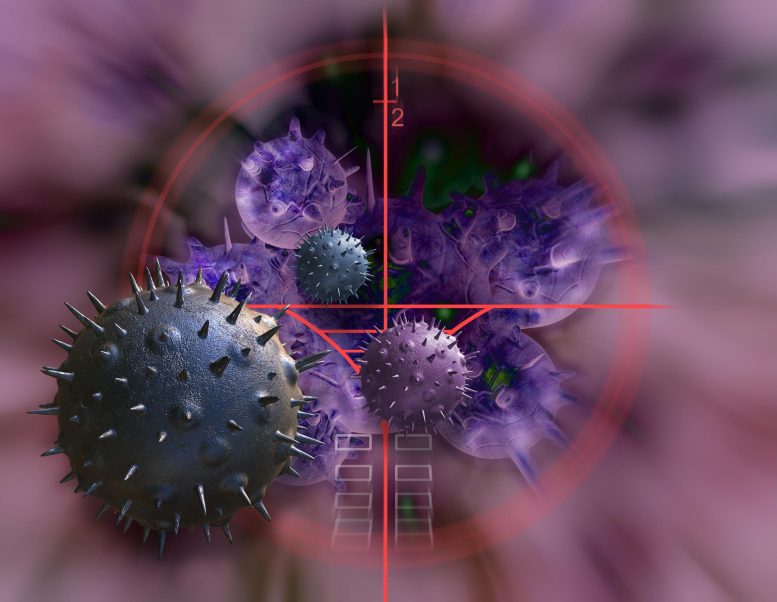
    Targeting Cancer Cells Illustration
    Future treatments that target the new mechanism could have fewer side effects than current treatments.

    Researchers Have Discovered a Potential New Cancer Treatment Target

    University of Gothenburg researchers have identified a previously undiscovered mechanism that regulates tumor development in mice and cultured cells. This finding could eventually pave the way for the creation of new drugs to treat a variety of cancer diseases.

    The researchers from Gothenburg detailed their findings in a study that was recently published in Nature Communications. It has to do with a protein that binds genetic material and, as the researchers have recently shown, is also in charge of characteristics that regulate tumor growth.

    The protein, known as HnRNPK, binds to messenger RNA (mRNA), which is encoded by the genes IER3 and IER3-AS1. These genes are highly active in several types of cancer. The HnRNPK prevents double-stranded RNA from developing between these genes by binding to their mRNA.

    Chandrasekhar Kanduri and Meena Kanduri
    Chandrasekhar Kanduri and Meena Kanduri, Sahlgrenska Academy at the University of Gothenburg. Credit: Elin Lindström, University of Gothenburg

    Changes in Tumor Growth

    “Keeping these two genes’ RNA separate promotes the growth of tumors that depend on growth factors. Without the HnRNPK protein, the properties that promote tumor growth are neutralized, paving the way for the development of drugs that block the HnRNPK,” says Chandrasekhar Kanduri, Professor of Medical Genetics at Sahlgrenska Academy, University of Gothenburg, who is one of the research leaders behind the study.

    The study also demonstrates that the HnRNPK protein binds to the mRNA of a number of other genes in a manner that prevents double-strand RNA from forming.

    The finding opens up the possibility of indirectly regulating the growth factor FGF-2, which is widely known to be essential for both the process by which stem cells mature into various cell types and early embryonic development.

    Fewer Side Effects

    Meena Kanduri, Associate Professor (Docent) of Molecular Medicine at Sahlgrenska Academy, is the corresponding author of the article.

    “Given the crucial role of FGF-2 in normal human development, using drugs that target the growth factor directly would have too many side effects. The mechanism we’ve now identified is part of the same signaling chain, but further downstream. So, the mechanism has the potential to become a more attractive cancer treatment option, with fewer side effects,” she says.

    More research is needed to verify the transferability of the finding from cell culture and mouse studies to humans. In the next stage, the group plans to conduct extended studies to examine in more detail how the pair of genes regulated by FGF-2 govern the growth environment of tumors.

    Reference: “HnRNPK maintains single strand RNA through controlling double-strand RNA in mammalian cells” by Sagar Mahale, Meenakshi Setia, Bharat Prajapati, Santhilal Subhash, Mukesh Pratap Yadav, Subazini Thankaswamy Kosalai, Ananya Deshpande, Jagannath Kuchlyan, Mirco Di Marco, Fredrik Westerlund, L. Marcus Wilhelmsson, Chandrasekhar Kanduri and Meena Kanduri, 29 August 2022, Nature Communications.
    DOI: 10.1038/s41467-022-32537-0

    Never miss a breakthrough: Join the SciTechDaily newsletter.
    Follow us on Google and Google News.

    Cancer Tumor University of Gothenburg
    Share. Facebook Twitter Pinterest LinkedIn Email Reddit

    Related Articles

    Scientists Uncover Aging Link That Could Change How Cancer Is Treated

    How Erectile Dysfunction Drugs Can Help Treat Cancer and Save Thousands of Lives

    New “Game Changing” Method Exposes Cancer Vulnerabilities

    New Molecular Target Could Result in Cancer Drugs With Fewer Side Effects

    The Double Advantage of Killer T-Cells To Prevent Cancer Metastases

    Surprisingly, Smokers Have a Lower Risk of Developing Prostate Cancer – But This Has a Hidden Cost

    A New Way To Stop Cancer: Researchers Combine Radiotherapy With Exosomes

    New Model Captures Shape and Speed of Tumor Growth for the First Time

    New Antibody Drug Boosts the Immune System’s Capacity to Fight Cancer

    Leave A Reply Cancel Reply

    • Facebook
    • Twitter
    • Pinterest
    • YouTube

    Don't Miss a Discovery

    Subscribe for the Latest in Science & Tech!

    Trending News

    Scientists Warn That This Common Pet Fish Can Wreck Entire Ecosystems

    Scientists Make Breakthrough in Turning Plastic Trash Into Clean Fuel Using Sunlight

    This Popular Supplement May Interfere With Cancer Treatment, Scientists Warn

    Scientists Finally Solved One of Water’s Biggest Mysteries

    Could This New Weight-Loss Pill Disrupt the Entire Market? Here’s What You Should Know About Orforglipron

    Earth’s Crust Is Tearing Open in Africa, and It Could Form a New Ocean

    Breakthrough Bowel Cancer Trial Leaves Patients Cancer-Free for Nearly 3 Years

    Natural Compound Shows Powerful Potential Against Rheumatoid Arthritis

    Follow SciTechDaily
    • Facebook
    • Twitter
    • YouTube
    • Pinterest
    • Newsletter
    • RSS
    SciTech News
    • Biology News
    • Chemistry News
    • Earth News
    • Health News
    • Physics News
    • Science News
    • Space News
    • Technology News
    Recent Posts
    • AI Detects “Invisible” Signs of Pancreatic Cancer Years Before Diagnosis
    • Kratom Use Explodes in the US, With Life-Changing Consequences
    • Scientists Uncover Fatal Weakness in “Zombie Cells” Linked to Cancer
    • World-First Study Reveals Human Hearts Can Regenerate After a Heart Attack
    • Why Your Dreams Feel So Real Sometimes and So Strange Other Times
    Copyright © 1998 - 2026 SciTechDaily. All Rights Reserved.
    • Science News
    • About
    • Contact
    • Editorial Board
    • Privacy Policy
    • Terms of Use

    Type above and press Enter to search. Press Esc to cancel.