
Close Menu
    Facebook X (Twitter) Instagram
    SciTechDaily
    • Biology
    • Chemistry
    • Earth
    • Health
    • Physics
    • Science
    • Space
    • Technology
    Facebook X (Twitter) Pinterest YouTube RSS
    SciTechDaily
    Home»Space»First Resolved Image of the Nucleus of a Long-Period Comet
    Space

    First Resolved Image of the Nucleus of a Long-Period Comet

    By Guy Webster, Jet Propulsion LaboratoryOctober 21, 2014No Comments3 Mins Read
    Facebook Twitter Pinterest Telegram LinkedIn WhatsApp Email Reddit
    Share
    Facebook Twitter LinkedIn Pinterest Telegram Email Reddit
    New MRO Images of Comet Siding Spring
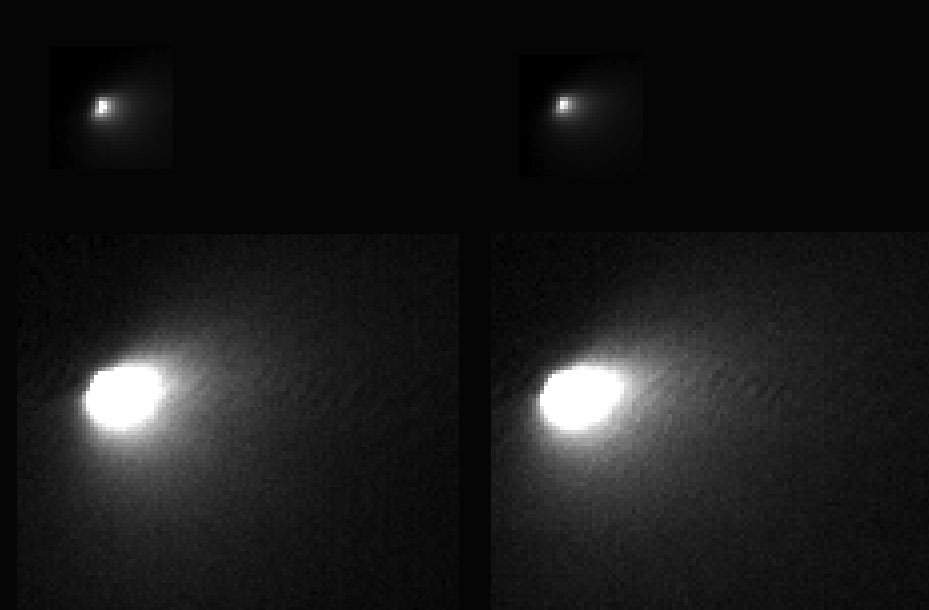
    These images were taken of comet C/2013 A1 Siding Spring by NASA’s Mars Reconnaissance Orbiter on October 19, 2014, during the comet’s close flyby of Mars and the spacecraft. Comet Siding Spring is on its first trip this close to the sun from the Oort Cloud at the outer fringe of the solar system. Credit: NASA/JPL-Caltech/University of Arizona

    NASA’s Mars Reconnaissance Orbiter has captured new images of comet C/2013 A1 Siding Spring, resulting in the first resolved image of the nucleus of a long-period comet.

    These images were taken of comet C/2013 A1 Siding Spring by NASA’s Mars Reconnaissance Orbiter on October 19, 2014, during the comet’s close flyby of Mars and the spacecraft. Comet Siding Spring is on its first trip this close to the sun from the Oort Cloud at the outer fringe of the solar system. This is the first resolved imaging of the nucleus of a long-period comet.

    The High Resolution Imaging Science Experiment (HiRISE) camera on Mars Reconnaissance Orbiter acquired images of this comet from a minimum distance of about 86,000 miles (138,000 kilometers), yielding a scale of about 150 yards (138 meters) per pixel. Telescopic observers had modeled the size of the nucleus as about half a mile, or one kilometer, wide. However, the best HiRISE images show only two to three pixels across the brightest feature, probably the nucleus, suggesting a size less than half that estimate.

    This composite image shows two versions of each of two of the best HiRISE images of the comet. Shown at the top are images with the full dynamic range, showing the nucleus and bright coma near the nucleus. Shown at the bottom are versions where the fainter outer coma is brightened, saturating the inner region. The images at left and right were taken about nine minutes apart.

    These closest-approach images were made possible due to very precise pointing and slewing of the Mars Reconnaissance Orbiter by engineers at Lockheed Martin in Denver, based on comet position calculations by engineers at NASA’s Jet Propulsion Laboratory, Pasadena, California. HiRISE acquired three images 12 days before the closest approach when the comet was barely detectable above the “noise level” of the images. These early images indicated the comet was not quite at its predicted location. This new viewing angle on the comet was used to update its predicted location and timing at the closest approach. Without this update, the comet may have been outside the HiRISE image area in the best images.

    HiRISE is one of six instruments on NASA’s Mars Reconnaissance Orbiter. The University of Arizona, Tucson, operates HiRISE, which was built by Ball Aerospace & Technologies Corp., Boulder, Colorado. NASA’s Jet Propulsion Laboratory, a division of the California Institute of Technology in Pasadena, manages the Mars Reconnaissance Orbiter Project for NASA’s Science Mission Directorate, Washington.

    Images of comet Siding Spring from HiRISE are online at: http://www.jpl.nasa.gov/spaceimages/details.php?id=PIA18618

    Never miss a breakthrough: Join the SciTechDaily newsletter.
    Follow us on Google and Google News.

    Astronomy Comet JPL
    Share. Facebook Twitter Pinterest LinkedIn Email Reddit

    Related Articles

    Cosmic Chameleons: Mysterious “Dark Comets” May Hold Clues to Life’s Origins on Earth

    Skywatching Magic: October’s Spectacular Comet Lights Up the Night Sky

    NASA Confirms Newly Discovered Comet Is Likely Interstellar Visitor

    View Passing Comet 46P/Wirtanen This Sunday

    NASA Comet Hitchhiker Would Take Tour of Small Asteroids and Comets

    New Rosetta Image of 67P/Churyumov-Gerasimenko

    NASA’s NEOWISE Spacecraft Views Its First Comet

    NASA’s Near-Earth Object Observations Program Discovers Ten Thousandth NEO

    Comet 2013 A1 to Make a Very Close Flyby of Mars

    Leave A Reply Cancel Reply

    • Facebook
    • Twitter
    • Pinterest
    • YouTube

    Don't Miss a Discovery

    Subscribe for the Latest in Science & Tech!

    Trending News

    Millions of People Have Osteopenia Without Realizing It – Here’s What You Need To Know

    Researchers Discover Boosting a Single Protein Helps the Brain Fight Alzheimer’s

    World-First Study Reveals Human Hearts Can Regenerate After a Heart Attack

    Why Your Dreams Feel So Real Sometimes and So Strange Other Times

    This Simple Home Device May Boost Brain Power in Adults Over 40

    Enormous Prehistoric Insects Puzzle Scientists

    Scientists Develop Bioengineered Chewing Gum That Could Help Fight Oral Cancer

    After 37 Years, the World’s Longest-Running Soil Warming Experiment Uncovers a Startling Climate Secret

    Follow SciTechDaily
    • Facebook
    • Twitter
    • YouTube
    • Pinterest
    • Newsletter
    • RSS
    SciTech News
    • Biology News
    • Chemistry News
    • Earth News
    • Health News
    • Physics News
    • Science News
    • Space News
    • Technology News
    Recent Posts
    • Scientists Discover Evolution’s 120-Million-Year-Old “Cheat Sheet”
    • This New “Sound Laser” Could Measure Gravity With Stunning Precision
    • Quantum Breakthrough: New Algorithm Solves “Impossible” Materials in Seconds
    • Could the Universe’s Hidden Shape Solve One of Physics’ Biggest Mysteries?
    • Rewriting Dinosaur Evolution: Scientists Unearth Remarkable 150-Million-Year-Old Stegosaur Skull
    Copyright © 1998 - 2026 SciTechDaily. All Rights Reserved.
    • Science News
    • About
    • Contact
    • Editorial Board
    • Privacy Policy
    • Terms of Use

    Type above and press Enter to search. Press Esc to cancel.