
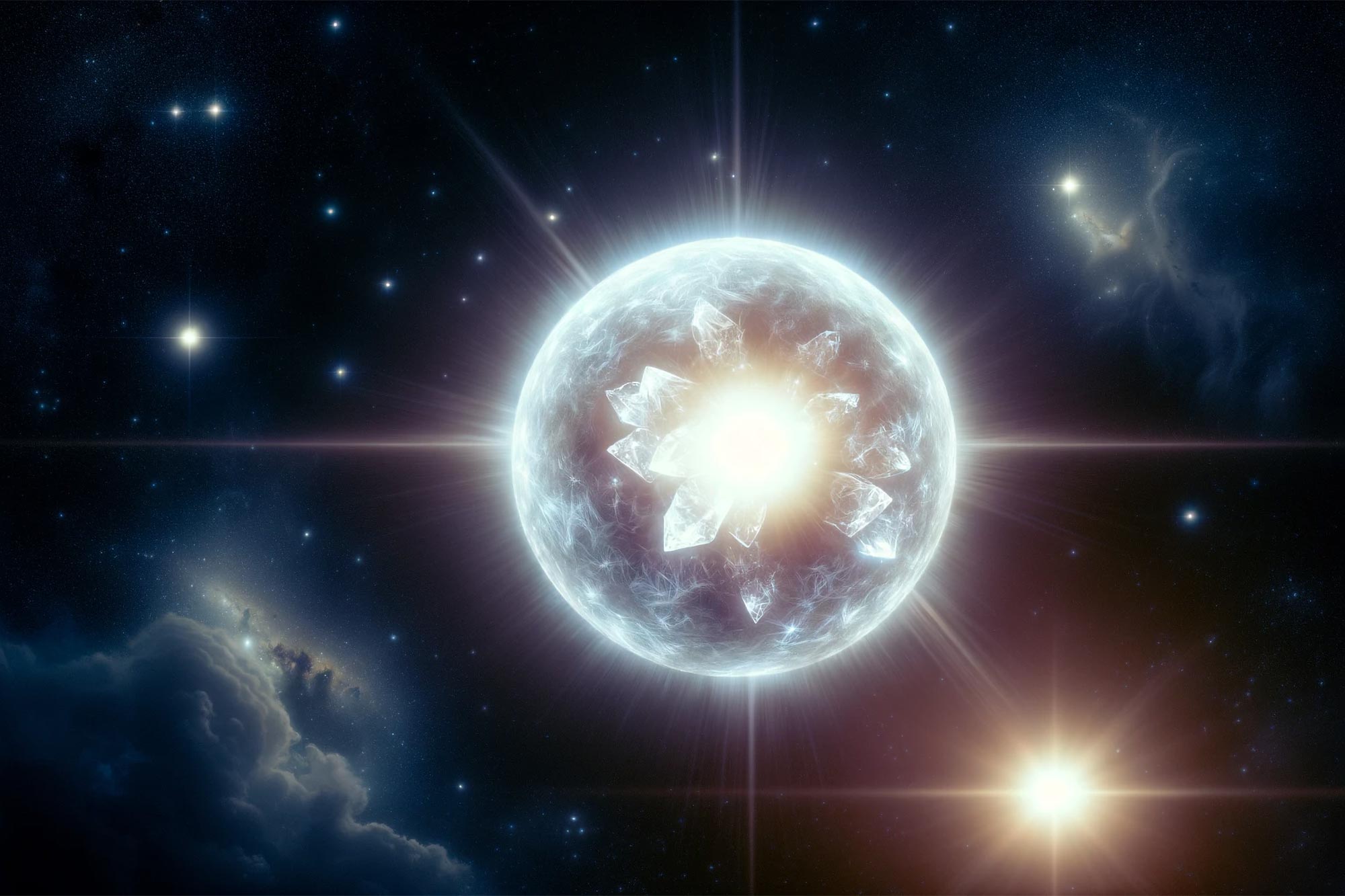
Scientists have discovered that some white dwarfs stop cooling due to internal crystal formation, challenging existing theories on star aging and affecting stellar age estimation methods.
Scientists have revealed why some white dwarfs mysteriously stop cooling – changing ideas on just how old stars really are, and what happens to them when they die.
White dwarf stars are universally believed to be ‘dead stars’ that continuously cool down over time. However, in 2019, data from the European Space Agency’s (ESA’s) Gaia satellite discovered a population of white dwarf stars that have stopped cooling for more than eight billion years. This suggested that some white dwarfs can generate significant extra energy, at odds with the classical ‘dead star’ picture, and astronomers initially were not sure how this could happen.
Groundbreaking Discovery in Stellar Physics
New research published in Nature, led by Dr. Antoine Bédard from the University of Warwick and Dr. Simon Blouin from the University of Victoria (Canada), unveils the mechanism behind this baffling observation.
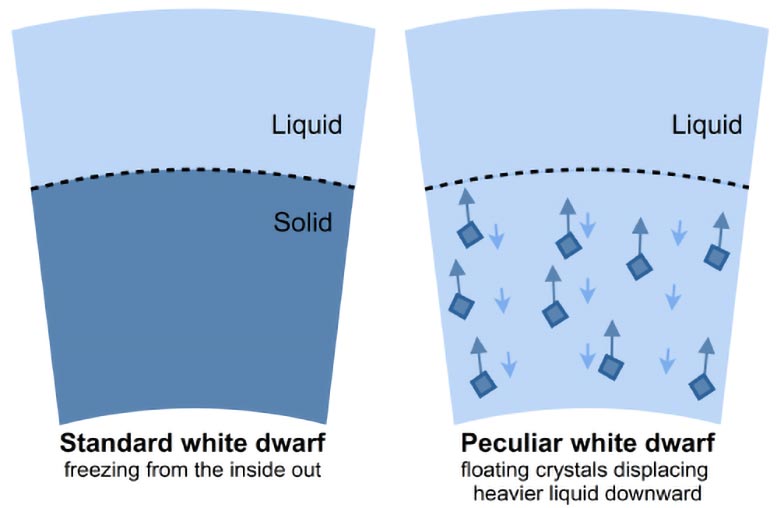
Over 97% of stars in the Milky Way will eventually become white dwarfs. Scientists have long considered these stars to be at the end of their lives. Having depleted their nuclear energy source, they stop producing heat and cool down until the dense plasma in their interiors freezes into a solid state, and the star solidifies from the inside out. This cooling process can take billions of years.
According to the new research, in some white dwarfs, the dense plasma in the interior does not simply freeze from the inside out. Instead, the solid crystals that are formed upon freezing are less dense than the liquid, and therefore want to float. As the crystals float upward, they displace the heavier liquid downward. The transport of heavier material toward the center of the star releases gravitational energy, and this energy is enough to interrupt the star’s cooling process for billions of years.
Antione Bédard, a research fellow at The University of Warwick, said: “This explanation matches all the observational properties of the unusual white dwarf population. This is the first time this transport mechanism has been observed in any type of star, which is exciting: it’s not every day we uncover a whole new astrophysical phenomenon!”
The researchers have a hypothesis about why this happens in some stars but not others. Simon Blouin, a Canadian Institute of Theoretical Astrophysics National Fellow at the University of Victoria, explained: “The difference is likely due to the composition of the star. Some white dwarf stars are formed by the merger of two different stars. When these stars collide to form the white dwarf, it changes the composition of the star in a way that can allow the formation of floating crystals.”
Implications for Stellar Age Assessment
This new discovery will not only require that astronomy textbooks be revised but also that astronomers revisit the process they use to determine the age of stellar populations. Currently, white dwarfs are routinely used as age indicators: the cooler a white dwarf is, the older it is assumed to be. However, due to the extra delay in cooling found in some white dwarfs, some stars of a given temperature may be billions of years older than previously thought.
Bédard added: “The transport mechanism we have uncovered means that some white dwarfs are shining as bright as ‘normal’ stars for billions of years. This complicates age-dating and our use of white dwarfs to reconstruct the formation of our Galaxy.”
Reference: “Buoyant crystals halt the cooling of white dwarf stars” by Antoine Bédard, Simon Blouin and Sihao Cheng, 6 March 2024, Nature.
DOI: 10.1038/s41586-024-07102-y
This research was supported by the National Sciences and Engineering Research Council of Canada (NSERC), the Banting Postdoctoral Fellowship program, the European Research Council, and the Canadian Institute for Theoretical Astrophysics (CITA).
The third author of the study, Dr. Sihao Cheng, is a postdoctoral member at the Institute for Advanced Study in Princeton, New Jersey, USA.
Never miss a breakthrough: Join the SciTechDaily newsletter.
Follow us on Google and Google News.
7 Comments
Celestial crystalline spheres? The more things change, the more they stay the same.
What kind of matter would that be? And can we store things in it . It’s gotta be heavyaf also mabey we can put it at the front of ship and make another to ride gravity waves.
Bugger mining that
I’m assuming frfr it’s energy dense.
I’m thinking that it is probably crystallized hydrogen, helium, or a combination of both since metallic hydrogens already been proven.
Since it’s believed that these peculiar Stars were created by two stars slamming together then wouldn’t it mean that the crystallize Cores shattered on impact?
If the are created by two stars slamming together then how can shatter crystal that hasn’t formed yet
Who needs sci fi ,truth is so much stranger than fiction.
( To be honest though,I really do love sci fi )