

Teleportation isn’t just science fiction anymore — scientists have found a way to send information more clearly and efficiently than ever before.
Using an incredibly tiny material called a nanophotonic platform, researchers dramatically improved how well quantum information can travel, even with just single particles of light. This breakthrough means teleportation could one day be part of real-world communication networks, opening the door to a future where information zips through space in ways once thought impossible.
Nonlinear Optics: The Key to Quantum Communication
For years, researchers have known that using nonlinear optical processes could make quantum communication systems more reliable and resistant to certain types of errors. But earlier attempts struggled because these systems couldn’t operate at the extremely low light levels needed for true quantum communication.
Now, a team at the University of Illinois Urbana-Champaign has made a major breakthrough. They built their nonlinear system using an indium-gallium-phosphide nanophotonic platform, significantly boosting efficiency. Their approach works with much less light, even down to single photons, the smallest units of light, offering the first real path to practical quantum communication with nonlinear optics.
Dramatic Gains in Quantum Fidelity and Efficiency
“Our nonlinear system transmits quantum information with 94% fidelity, compared to the theoretical limit of 33% on systems using linear optical components,” said Kejie Fang, an Illinois professor of electrical and computer engineering and the project lead. “This alone demonstrates the power of quantum communication with nonlinear optics. The big problem to solve is efficiency. By using a nanophotonic platform, we saw the efficiency increase by enough to show that the technology is promising.”
The research was recently published in Physical Review Letters.
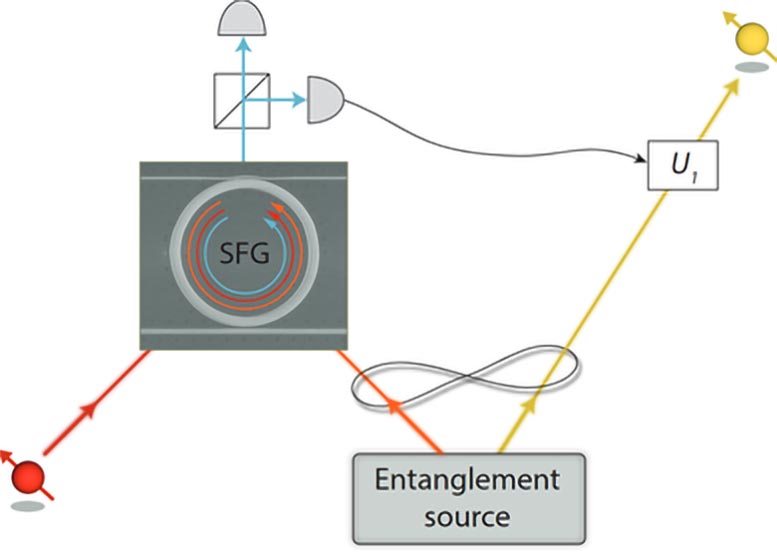
How Quantum Teleportation Leverages Entanglement
Transmission of quantum information over networks is facilitated by the quantum teleportation protocol. In it, the phenomenon of quantum entanglement – in which two quantum objects, typically single photons, influence each other even when there is no apparent physical connection between them – is exploited to transfer quantum information between a sender and a receiver without transmitting it through a communication channel. The advantage of this procedure is that the influences of external noise and channel imperfections are greatly mitigated.
There are two factors that limit the performance of quantum teleportation. First, the use of standard, linear optical components introduces inherent ambiguities in the transmission. Second, the entangled photons are made with an imperfect process subject to errors and excess noise. In particular, it is common for entanglement sources to produce more than a single pair of photons at once, making it unclear whether the two used in teleportation are truly entangled.
Nonlinear Optics: A Solution for Multiphoton Noise
“Multiphoton noise occurs in all realistic entanglement sources, and it’s a serious problem for quantum networks,” said Elizabeth Goldschmidt, an Illinois professor of physics and a co-author of the study. “The appeal of nonlinear optics is that it can mitigate the effect of multiphoton noise by virtue of the underlying physics, making it possible to work with imperfect entanglement sources.”
Nonlinear optical components cause photons of different frequencies to combine and create new photons at new frequencies. For quantum teleportation, the nonlinear process used is “sum frequency generation” (SFG), in which the frequencies of two photons add to form a new photon. However, the original two photons must have specific starting frequencies for the process to occur.
Improving Efficiency With Sum Frequency Generation
When SFG is used in quantum teleportation, the protocol does not proceed if two photons of the same frequency are detected. This filters out the primary type of noise in most entangled photon sources and allows for much higher teleportation fidelities than would be possible otherwise. The main drawback is that an SFG conversion occurs with very low probability, making the teleportation process highly inefficient.
“Researchers have known about this for a long time, but it was not fully explored due to the low probability of successful SFG,” Fang said. “In the past, the best that was achieved is 1 in 100 million. Our achievement is realizing a factor of 10,000 increase in conversion efficiency to 1 in 10,000 with a nanophotonic platform.”
Looking Ahead: Future Quantum Communications Applications
The researchers are optimistic that, with further development, quantum teleportation with nonlinear optical components can be made even more efficient. They believe that it will find use in other quantum communications protocols, including entanglement swapping.
Reference: “Faithful Quantum Teleportation via a Nanophotonic Nonlinear Bell State Analyzer” by Joshua Akin, Yunlei Zhao, Paul G. Kwiat, Elizabeth A. Goldschmidt and Kejie Fang, 22 April 2025, Physical Review Letters.
DOI: 10.1103/PhysRevLett.134.160802
Joshua Akin, Yunlei Zhao, and Paul Kwiat also contributed to this work.
Kejie Fang is an Illinois Grainger Engineering associate professor of electrical and computer engineering in the Department of Electrical and Computer Engineering and the Department of Physics. He is affiliated with the Holonyak Micro and Nanotechnology Laboratory and the Illinois Quantum Information Science and Technology Center. He is a Yuen T. Lo Faculty Fellow.
Elizabeth Goldschmidt is an Illinois Grainger Engineering assistant professor of physics in the Department of Physics and the Department of Electrical and Computer Engineering. She is affiliated with the Materials Research Laboratory and the Illinois Quantum Information Science and Technology Center.
Never miss a breakthrough: Join the SciTechDaily newsletter.
Follow us on Google and Google News.
14 Comments
According to the Topological Vortex Theory (TVT), both photons and quantum are different manifestations of topological materials
Read The Book Of Mormon. The only way you can avoid being sent to hell!
Who’s Marry?
Very interesting n éxcíting to know people r working ón quantum experiments
Stop the horse crap, your supposed prophet was a pedophile that conned people into believing his lies…
You are the one perverting the written word making YHWH less than the only eternal God to ever exist. You are the one risking hell adding to the completed work of God
[I do not mean to be harsh, but…] Maybe a physics professor should know what “quantum teleportation” means. I should not have to explain it, but apparently I do. “Quantum teleportation” means, not mirroring at a distance, but actually moving the pertinent (mediating) particle instantaneously across the same distance. (This is known to be impossible.) Your article appears to be about physically transporting/transmitting particles, which certainly is not *any* sort of “teleportation” — erroneous nor correct.
Shock Therapy is old science compared to Quatum Physics, but it could help you. Good Luck !
There is lot to know n due for humanity to exist within quantum world
Note 2504300357_Source1. Analyzing【
My quantum entanglement shift originally occurred in qpeoms.susqer and was set in domain (*). It is so extensive that it moves on its own permanently without being affected by the system. My first discovery of this was a few years ago on a walk along the perimeter road of Bulgwang-dong, Seoul.
However, quantum entanglement has a very important property in the concept of quantum computing. Various approaches have emerged to define this.
_[2] Quantum entanglement is reminiscent of qvixer.a having a radius and having the same radius qvixer.b of a sphere. The two radii are zz’, the magicsum of xy? Well, I’ve never thought of this before.
A sphere produces an infinite number of identical radii r.b with the designation of one radius r.a. a sphere with the same radius occurring n.V.qvixer.b=V in its specified radius r=1. Here the proportional constant of entanglement in qvixer.ab is π. Huh.
The formula for finding the volume (volume) of a sphere is V = (4/3) * π * r ³, where V is the volume of the sphere, π is the circumference (about 3.14159), and r is the radius of the sphere.
By the way, is example 2. qms.2qvixer.ab really a sphere volume with r? It has different themes. r,V is an entanglement with a domain of magicsum synchronization (*) and 2qvix.ab is an entanglement with a domain of unitization (*). Huh.
_【3】Seeing how two photons have specific frequencies is an example of 2. Both photons are two qvixers. Originally, quasi.vixers are unstable and are complex units of msbase represented by two or more sums. These two qvixers teleport? Well, that’s the first domain (*new) I’ve ever thought of. Huh.
_[3-1] View 2. qms is not easily found. The type is estimated to be infinite, but it is hard to find SFG transform strands at msbase frequencies easily. Hmm.
≈≈≈≈==========
Source 1.
https://scitechdaily.com/from-sci-fi-to-reality-single-photon-teleportation-breakthrough/
1.
From sci-fi to reality: a breakthrough in single-photon teleportation.
By using a nanopotonic platform to enhance nonlinear optics, the researchers achieved 94% fidelity in quantum teleportation and solved the main noise and efficiency problems.
1-1.
Teleportation is no longer a story in science fiction. Scientists have found a clearer and more efficient way to transmit information than ever before.
Using an extremely small material called the nanopotonic platform, the researchers have dramatically improved how well quantum information can be transmitted with just a single particle of light. This groundbreaking technology means that teleportation can one day be applied to communication networks in the real world, opening the door to a future where information quickly crosses space in a way that was once thought impossible.
1-2. Non-linear optics: Key to quantum communication
For many years, researchers have known that using nonlinear optical processes can increase the reliability of quantum communication systems and increase the resistance to certain types of errors. However, early attempts were challenged by the inability to operate at extremely low volumes of light required for true quantum communication.
1-3.
A team from the University of Illinois Urbana-Champaign campus has made a significant breakthrough. They built nonlinear systems using an indium-gallium-phosphoryl nanophotonic platform, greatly improving their efficiency. This approach works with much less light, up to a single photon, the smallest unit of light, and presents the first practical path for practical quantum communication using nonlinear optics.
1-4. Dramatic improvements in quantum fidelity and efficiency
Nonlinear systems transmit quantum information with 94 percent fidelity, which is much higher than the theoretical limit of 33 percent for systems using linear optical components. This alone demonstrates the power of quantum communication using nonlinear optics.
Efficiency is an important issue that must now be addressed. By using the nanophotonics platform, efficiency has been sufficiently improved, proving that this technology is promising.
The study was recently published in Physical Review Letters.
Quantum teleportation with nonlinear sum frequency generation (SFG). This nonlinear nanophotonic platform significantly mitigates multiphoton noise and provides high teleportation fidelity.
2.How quantum teleportation leverages entanglement
The transfer of quantum information over the network is facilitated through quantum teleportation protocols. In this protocol, we leverage [quantum entanglement phenomenon] (a phenomenon in which two quantum objects, usually single photons, influence each other even if they are not physically connected) to transmit quantum information between the sender and the receiver rather than over a communication channel. The advantage of this procedure is that it greatly mitigates the effects of external noise and channel defects.
2-1.
There are two factors that limit the performance of quantum teleportation. First, the use of standard linear optical components creates ambiguity in the transmission. Second, entangled photons are produced in an incomplete process where errors and excessive noise occur. In particular, it is unclear whether the two photons used for teleportation are actually entangled, as more than one pair of photons are often generated simultaneously from the entangled light source.
2-2. Non-linear optics: solutions for multi-photon noise
Multi-photon noise arises from all realistic entanglement sources, which is a serious problem for quantum networks. The attraction of nonlinear optics is that the effects of multi-photon noise can be alleviated through fundamental physical principles. This enables work on incomplete entanglement sources.
3.
Nonlinear optical components combine photons of different frequencies to produce photons of new frequencies. [For quantum teleportation, a nonlinear process called “sum frequency generation (SFG)” is used in which the frequencies of two photons merge to form a new photon.
Your comments appear to be more incitefull than the Original articles that you comment on; your recent comment on red sprites; however, unfortunately seems to have been taken down; I wanted to read it over again, in particular the green glow underneath the red sprite. But, oh well, as they say, I will though save your comment this time. Since last time; negative time appears to have been observed, and two recent observations concerning time within space may have more than one coordinate might make the methodology of which this article deves into obsolete before it ever reaches mass distribution.
A massless photon travels at the speed of light, all other particles do not. Not very hopeful for positive mass moving much slower than speed of light.
The article should note that classical communication channels are required for certain quantum teleportation protocols to complete a transfer. The cited PRL paper even states this.
Beam me up.
Could you elaborate on the specific types of errors in quantum communication that this new nonlinear optical approach aims to mitigate?