
Research in Mice Holds Implications for Childhood Cancer Survivors
Male testis tissue that is cryopreserved can be reimplanted after more than two decades and will go on to make viable sperm, according to a new study in rodents. The research, by Eoin Whelan of the School of Veterinary Medicine, University of Pennsylvania and colleagues will be published publishing today (May 10th, 2022) in the open-access journal PLOS Biology. But the long delay comes with a cost of reduced fertility compared to tissue that is only briefly frozen. The findings could have far-reaching implications for the treatment of young male cancer patients, for whom chemotherapy could be preceded by the harvesting and freezing of testicular tissue for eventual reimplantation.
Childhood cancer survival rates have increased dramatically in recent decades, but a serious side effect of treatment is decreased fertility later in life. A potential treatment would be to harvest, freeze, and reimplant testicular tissue, which contains stem cells, a procedure that has recently been shown to restore fertility in a macaque model, at least after short-term freezing.
Long-Term Freezing of SSCs
But for pre-pubertal boys with cancer, reimplantation may not be feasible for a decade or more after harvesting, raising the question of how long frozen spermatogenic stem cells (SSCs) can remain viable. To explore this question, the authors thawed rat SSCs that had been cryopreserved in their laboratory for more than 23 years, and implanted them in so-called nude mice, which lack an immune response that would otherwise reject the foreign tissue. They compared the ability of the long-frozen SSCs to generate viable sperm to SSCs frozen for only a few months, and to freshly harvested SSCs, all from a single rat colony maintained over several decades.
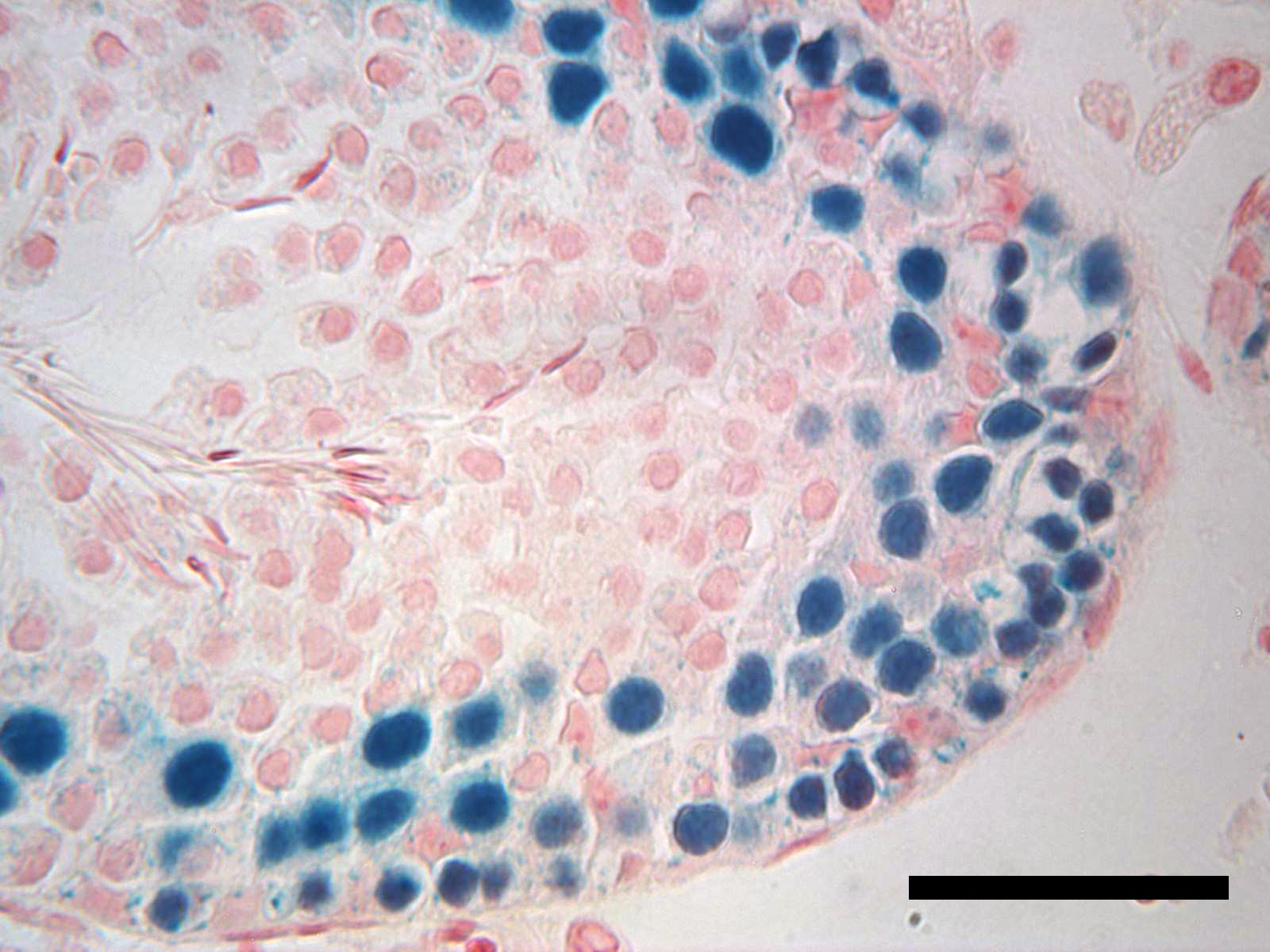
The researchers found that the long-frozen SSCs were able to colonize the mouse testis and generate all of the necessary cell types for successful sperm production, but not as robustly as SSCs from either of the more recently harvested tissue samples. While the long-frozen SSCs had similar profiles of gene expression changes compared to the other samples, they made fewer elongating spermatids, which go on to form swimming sperm.
These results have several important implications. First, they point out the importance of in situ testing of SSC viability, rather than relying on biochemical or cellular biomarkers, in determining the potential of cryopreserved cells, which may not reflect the actual loss of stem cell potential over time. Second, while there currently are no protocols that can expand human SSCs for reimplantation—a requirement for clinical development of this treatment—such protocols may need to consider time-dependent degradation of viability, assuming human SSCs mimic those of rats. Finally, and this is the good news, viability is by no means lost during long-term cryopreservation, suggesting that it may be possible to identify and mitigate the key drivers of loss of viability, in order to improve the reproductive options of boys whose childhood cancers are successfully treated.
Long-Term Viability of Cryopreserved Cells
Whelan adds, “Our study showed that rat spermatogonial stem cells can be successfully frozen for over 20 years, transplanted into an infertile recipient animal and regenerate the ability to produce sperm, albeit at a reduced rate. This could provide a method to recover the loss of fertility in prepubertal boys treated for cancer.”
Reference: “Reestablishment of spermatogenesis after more than 20 years of cryopreservation of rat spermatogonial stem cells reveals an important impact in differentiation capacity” by Whelan EC, Yang F, Avarbock MR, Sullivan MC, Beiting DP, Brinster RL, 10 May 2022, PLOS Biology.
DOI: 10.1371/journal.pbio.3001618
Funding: This work was funded by Robert J. Kleberg, Jr and Helen C. Kleberg Foundation (RLB). The funders had no role in study design, data collection and analysis, decision to publish, or preparation of the manuscript.
Never miss a breakthrough: Join the SciTechDaily newsletter.
Follow us on Google and Google News.