
Close Menu
    Facebook X (Twitter) Instagram
    SciTechDaily
    • Biology
    • Chemistry
    • Earth
    • Health
    • Physics
    • Science
    • Space
    • Technology
    Facebook X (Twitter) Pinterest YouTube RSS
    SciTechDaily
    Home»Biology»Fundamentally Altering Previous Thinking – Two Bee Species Have Become One
    Biology

    Fundamentally Altering Previous Thinking – Two Bee Species Have Become One

    By Curtin UniversityNovember 1, 2023No Comments3 Mins Read
    Facebook Twitter Pinterest Telegram LinkedIn WhatsApp Email Reddit
    Share
    Facebook Twitter LinkedIn Pinterest Telegram Email Reddit
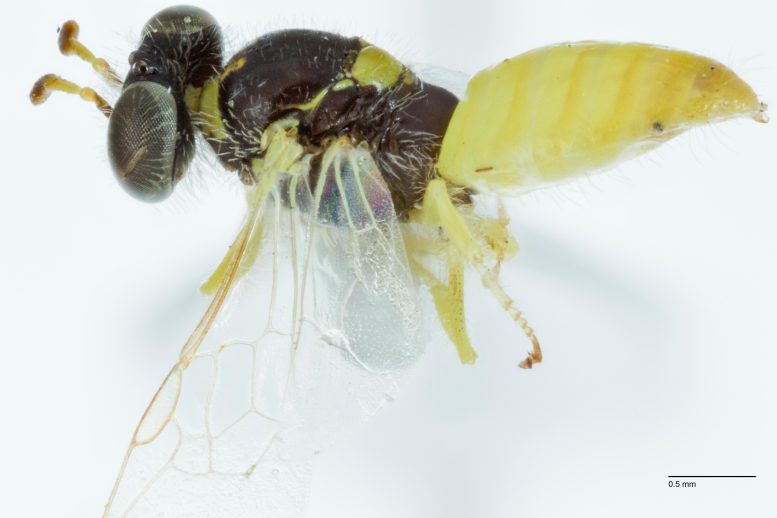
    Male Xanthesma brachycera
    New research has found that two previously distinct bee species are actually male and female of the same species, underscoring the importance of DNA barcoding in species identification. Male Xanthesma (Xenohesma) brachycera. Credit: Curtin University

    A recent study conducted by researchers from Curtin and Flinders Universities reveals that what were previously believed to be two distinct species of native Australian bee are, in actuality, one species.

    Lead researcher Dr. Kit Prendergast from the Curtin School of Molecular and Life Sciences said the study, based on native bee surveys at Perth locations of Wireless Hill, Shenton Park, and Russo Reserve, fundamentally alters previous thinking.

    Research Methodology and Discovery

    “Essentially the research team used DNA sequencing to show that what we used to think of as two different species of bees are actually just the males and females of one, single species,” Dr Prendergast said.

    “For many native bee species in Australia, their descriptions were based on only one sex. Identifying males and females as belonging to the same species solely through observation can be challenging, as both sexes of the same species often display noticeable differences.

    “In this study, I collected what appeared to be the female of a bee species that has been described only from the male – a species at the time called Xanthesma (Xenohesma) perpulchra. The team then used DNA analysis to confirm these female bees were in fact the same species as the male.

    “Surprisingly, their DNA also matched another species, that had only ever been described from the female – the Xanthesma (Xanthesma) brachycera, so we were able to prove that the two were in fact the same species.

    “It appears both sexes had never been collected in the same place at the same time, and both were described in the early 1900s, well before the advent of DNA analysis.”

    The Value of DNA Barcoding

    Dr Prendergast said the findings showed the value of DNA barcoding in accurately identifying males and females that belong to the same species. This is particularly crucial because males and females of the same species may have distinct appearances, while different species of the same sex can appear quite similar.

    “Our findings are significant because being able to correctly identify species is fundamentally important to virtually every aspect of biological sciences,” Dr Prendergast said.

    “Accurate species identification enables us to determine how many species are present in an area, helps us understand the evolution of life on earth, and how species are related. It also allows us to assess conservation needs.

    “We hope this research is just the tip of the iceberg when it comes to the taxonomy of Australian native bees, and that it inspires agencies and government to invest in more taxonomic work, especially on the Euryglossinae, which is an important, yet understudied group of bees native to Australia.”

    Reference: “Xanthesma (Xenohesma) perpulchra and Xanthesma (Xanthesma) brachycera are conspecific based on DNA barcodes” by Kit S. Prendergast and James B. Dorey, 26 October 2023, Australian Journal of Taxonomy.
    DOI: 10.54102/ajt

    Never miss a breakthrough: Join the SciTechDaily newsletter.
    Follow us on Google and Google News.

    Bees Curtin University DNA Evolution Flinders University Species
    Share. Facebook Twitter Pinterest LinkedIn Email Reddit

    Related Articles

    Australian Night Bees Recorded Foraging in Darkness for the First Time

    DNA Study Reveals Clues about Primate Evolution

    Prolific Changes in the Human Genome in the Past 5,000 Years

    DNA Could Predate Existence of Life As We Know It

    Improved Estimates of DNA’s Mutation Rate Paint Clearer Picture of Human Prehistory

    Honeybees Switch Roles within the Hive

    Behavior in Curious Honeybees Similar to Humans

    New Frog Species Discovered Living in New York and New Jersey

    Human Y-Chromosome Has Enough Genes to Stay for Millions of Years

    Leave A Reply Cancel Reply

    • Facebook
    • Twitter
    • Pinterest
    • YouTube

    Don't Miss a Discovery

    Subscribe for the Latest in Science & Tech!

    Trending News

    Bone-Strengthening Discovery Could Reverse Osteoporosis

    Scientists Uncover Hidden Trigger Behind Stem Cell Aging

    Scientists Find Way to Reverse Fatty Liver Disease Without Changing Diet

    Could Humans Regrow Limbs? New Study Reveals Promising Genetic Pathway

    Scientists Reveal Eating Fruits and Vegetables May Increase Your Risk of Lung Cancer

    Scientists Reverse Brain Aging With Simple Nasal Spray

    Scientists Uncover Potential Brain Risks of Popular Fish Oil Supplements

    Scientists Discover a Surprising Way To Make Bread Healthier and More Nutritious

    Follow SciTechDaily
    • Facebook
    • Twitter
    • YouTube
    • Pinterest
    • Newsletter
    • RSS
    SciTech News
    • Biology News
    • Chemistry News
    • Earth News
    • Health News
    • Physics News
    • Science News
    • Space News
    • Technology News
    Recent Posts
    • Europe’s Most Active Volcano Just Got Stranger – Here’s Why Scientists Are Rethinking It
    • Why Are Giant Ants Letting Tiny Ants Crawl All Over Them?
    • Revolutionary Technique Sends Healthy Mitochondria Exactly Where They’re Needed
    • This Student Recreated the Universe in a Bottle. What She Discovered Could Help Reveal How Life Started on Earth
    • Alzheimer’s Symptoms May Start Outside the Brain, Study Finds
    Copyright © 1998 - 2026 SciTechDaily. All Rights Reserved.
    • Science News
    • About
    • Contact
    • Editorial Board
    • Privacy Policy
    • Terms of Use

    Type above and press Enter to search. Press Esc to cancel.