

Advances in inertial confinement fusion and innovative modeling have brought nuclear fusion closer to reality, offering insights into high-energy-density physics and the early universe.
The pursuit of controlled nuclear fusion as a source of clean, abundant energy is moving closer to realization, thanks to advancements in inertial confinement fusion (ICF). This method involves igniting deuterium-tritium (DT) fuel by subjecting it to extreme temperatures and pressures during a precisely engineered implosion process.
In DT fusion, most of the released energy is carried by neutrons, which can be harnessed for electricity generation. Simultaneously, alpha particles remain trapped within the fuel, where they drive further fusion reactions. When the energy deposited by these alpha particles surpasses the energy input from the implosion, the plasma enters a self-sustaining “burning” phase. This significantly boosts energy output and density.
A breakthrough occurred in February 2021 at the National Ignition Facility (NIF), where scientists successfully achieved a burning plasma state in an ICF experiment. This achievement represents a critical step forward in the development of fusion energy and offers insights into the extreme conditions that existed in the early universe.
Discovery of Novel Phenomena in Burning Plasma
However, within this extreme state, Hartouni and his colleagues observed novel physical phenomena in experiments conducted at the NIF: the neutron spectrum data deviated significantly from hydrodynamic predictions, indicating the emergence of supra-thermal DT ions. These observations challenge existing models that rely on Maxwell distributions and underscore the importance of previously overlooked kinetic effects and non-equilibrium mechanisms.
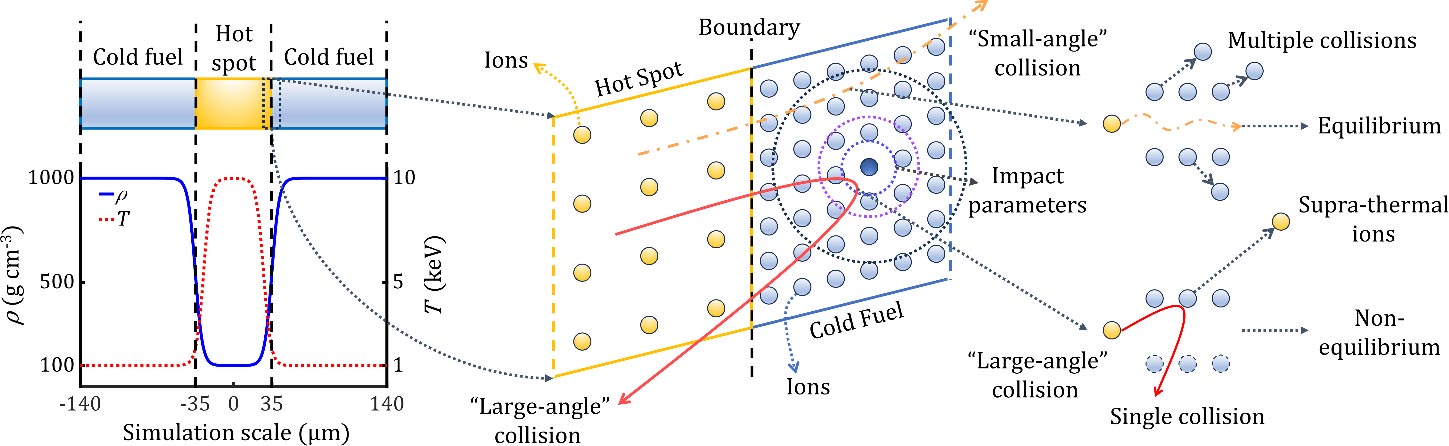
Accurately modeling these kinetic effects, particularly large-angle collisions that involve substantial energy exchanges, poses a considerable challenge. These collisions generate supra-thermal ions during the deposition of alpha particles, causing deviations from the equilibrium state and falling outside the scope of hydrodynamic descriptions.
A Breakthrough in Modeling Ion Kinetics
To address this challenge, a joint research team led by Prof. Jie Zhang from the Institute of Physics of Chinese Academy of Sciences and Shanghai Jiao Tong University has innovatively proposed a large-angle collision model that integrates the screened potentials of the background ions with the relative motion of ions during binary collisions, which can comprehensively capture ion kinetics.
The hybrid-particle-in-cell LAPINS code newly developed by the team, incorporating with this model, achieves high-precision simulation of ICF burning plasmas. Extensive and kinetic investigations into the implications of large-angle collisions have yielded several key findings, including an ignition moment promotion by ~10 ps, the presence of supra-thermal D ions below an energy threshold of ~34 keV, approximately twice the expected deposition of peak alpha particles densities and enhancement of alpha particles densities at the hotspot center by ~24%.
The rationality of their findings is confirmed through the congruency between the neutron spectral moment analyses conducted by the NIF and their kinetic simulations, both highlighting disparities between neutron spectral moment analyses and hydrodynamics predictions, which becomes more pronounced as the yield increases.
This work not only provide novel insights for experiment interpretation but also open new research opportunities to guide the design and improvement of ignition schemes and to explore the nuclear burning plasmas, which are distinguished by their exceptionally high energy densities and hold immense potential for illuminating the intricate physics that underpins the evolution of the early universe.
Reference: “Mechanisms behind the surprising observation of supra-thermal ions in NIF’s fusion burning plasmas” by Yuhan Xue, Dong Wu and Jie Zhang, 4 December 2024, Science Bulletin.
DOI: 10.1016/j.scib.2024.11.050
The study was funded by the Strategic Priority Research Program of Chinese Academy of Sciences.
Never miss a breakthrough: Join the SciTechDaily newsletter.
Follow us on Google and Google News.
10 Comments
According to the Topological Vortex Theory (TVT), spins creates everything and shape the world, nuclear fusion is not the preferred option, topological intelligent batteries can truly enable humans to achieve energy independence and freedom.
I think you took the Midjourney/DALL-E cIickbait ‘illustration’ at the top too seriously. Its only purpose is to attract web traffic.
I already did all this stuff in my garage it isn’t difficult provided you have the right logic and no institutions murdering your ideas..
Uh huh.
It may be a journey without an end.
Over 50 years of fusion delusion just to get a smidge over local energy breakeven. That is breaching the first order of difficulty magnitude. Breaching it, not finishing it; they’ve stepped on the first rung or two. There are 98 rungs on the ladder after that.
Will it be 2100 and a hundred trillion dollars to get to whole-system breakeven and a realization that they have nothing to show for it than a system that cannot compete with wind, solar, and conventional nuclear?
And space flight is impossible, too.
FTL space flight? Yes.
When will African countries join the research, or are they going to be perpetually consumers, that have no achievement to offer on the earth? Do we hope to only escorts others in this journey to make the world smarter and better?
I’m there are brilliant minds in the world who just do not have the resources to bring to light their innovative ideas.