
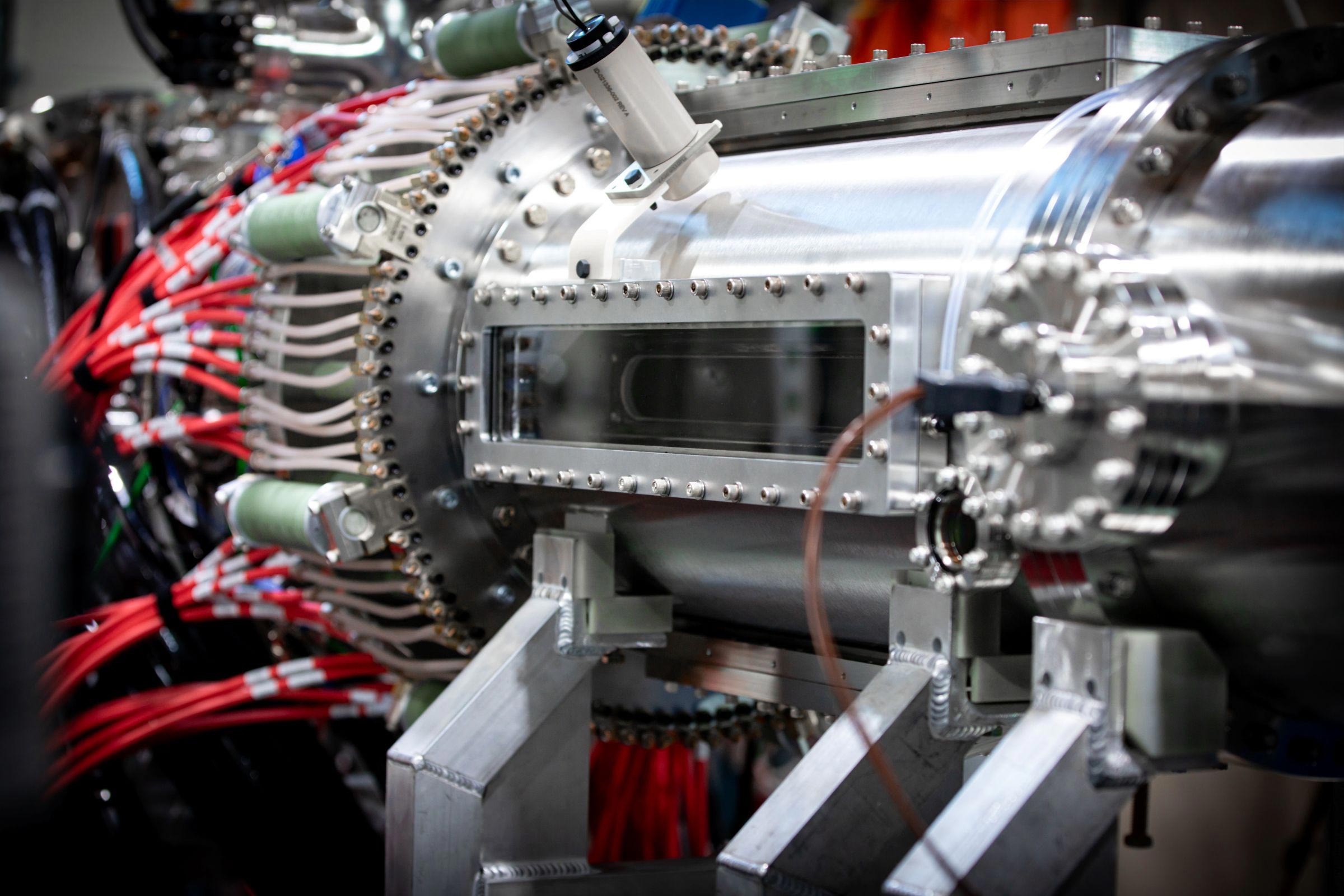
Zap Energy’s FuZE-3 device has reached giga-pascal-level plasma pressures thanks to a novel design that independently tunes acceleration and compression.
These early results suggest rapid progress toward fusion conditions once thought achievable only with massive, expensive systems.
Record-Breaking Plasma Pressures in FuZE-3
Operating the Fusion Z-pinch Experiment 3, known as FuZE-3, Zap Energy has produced plasmas with electron pressures reaching 830 megapascals (MPa), or 1.6 gigapascals (GPa) in total. These pressures are similar to those found far beneath Earth’s crust. This achievement marks the highest pressure ever recorded in a sheared-flow-stabilized Z pinch and represents a meaningful step toward reaching scientific energy gain, or Q>1.
FuZE-3 is the company’s first system to use a third electrode that allows the processes responsible for accelerating the plasma and compressing it to be managed independently. Early findings were shared today at the American Physical Society’s Division of Plasma Physics meeting in Long Beach, California.
“There are some big changes in FuZE-3 compared to Zap’s previous systems and it’s great to see it perform this well so quickly out of the gate,” says Colin Adams, Head of Experimental Physics.
The Challenge of Reaching Fusion-Ready Pressures
Fusion energy requires extremely hot, dense plasma. High pressure, which reflects both the temperature and density of the plasma, is a crucial ingredient because greater pressure increases the number of fusion reactions that can occur. Some fusion approaches push for the highest pressures they can reach, while others focus on holding the plasma for longer periods to compensate for lower pressure. Zap’s sheared-flow-stabilized Z pinch approach is designed to find a balance between strong compression and effective confinement.
The highest single-shot electron pressure Zap has measured so far is 830 MPa. Since plasma contains both electrons and the much heavier ions, and their temperatures are expected to be nearly the same, the total plasma pressure (electrons and ions) is estimated to be about twice that value, or 1.6 GPa. For perspective, one gigapascal is roughly 10,000 times atmospheric pressure at sea level, or nearly 10 times the pressure at the bottom of the Mariana Trench.
A high-speed camera captures a sheared-flow-stabilized Z pinch inside the FuZE-3 device. The camera is pointed straight toward the column of fusion plasma and the compression wave is visible as it collapses inward. The process takes only around a microsecond. Credit: Zap Energy
Validating Results With High-Precision Diagnostics
These extreme pressures were maintained for around a microsecond (one millionth of a second) and were measured using optical Thomson scattering, a technique widely considered the most reliable method for determining plasma conditions.
Recent experiments with FuZE-3 involved many repeatable shots, each producing electron densities between 3-5×1024 m-3 and electron temperatures above 1 keV (equal to 21,000,000 degrees Fahrenheit).
“This was a major effort by the team that was successful because of a tightly coupled cycle of theoretical predictions, computational modeling, rapid build and test engineering, experimental validation, and measurement expertise,” remarks Ben Levitt, Vice President of R&D. “With a smaller system we have the benefit of being able to move quickly, and achieving these results in systems that are a fraction of the size and cost of fusion devices of comparable performance is a big part of what makes this such a significant accomplishment.”
Designing FuZE-3 to Push Triple-Product Boundaries
FuZE-3 is the third generation of FuZE devices, and the fifth sheared-flow-stabilized Z-pinch device. Zap’s initial device FuZE was the first to exceed 1 keV temperatures and has now been decommissioned. FuZE-Q, Zap’s highest performing device by power and fusion neutron yield, remains in regular operation alongside FuZE-3.
FuZE-3 was designed to climb to new levels of triple product, an important metric in fusion that is the mix of three measurements: density, temperature and confinement time. Critically, it includes three electrodes and two capacitor banks.
Decoupling Acceleration and Compression for Better Control
Tests at Zap to date have relied on systems with a single pulse of electrical current conducting between two electrodes. This means that the power driven into the device must accelerate the plasma to provide stabilizing flow as well as compress the plasma into a Z pinch.
“The capability to independently control plasma acceleration and compression gives us a new dial to tune the physics and increase the plasma density,” explains Adams. “The two-electrode systems have been effective at heating, but lacked the compression targeted in our theoretical models.”
Though the new measurements demonstrate very high pressures, Zap’s physics is a form of quasi-steady-state magnetic confinement, not the inertial fusion physics targeted by systems that compress a target in nanoseconds using huge arrays of powerful lasers (or also in some cases Z pinches). For Zap’s approach, controlling plasma acceleration to generate and sustain stabilizing flow is as important as controlling compression.
Early Results and Ambitious Performance Goals Ahead
Zap’s newest findings are still considered early results, as the team is actively running additional experiments on FuZE-3. More information is being shared this week at the APS DPP meeting, and the researchers expect to release full FuZE-3 data in upcoming scientific publications.
“We’re really just getting started with FuZE-3,” says Levitt. “It was built and commissioned just recently, we’re generating lots of high-quality shots with high repeatability, and we have plenty of headroom to continue making rapid progress in fusion performance. We’ll be integrating lessons from FuZE-3 into our next generation systems as we continue advancing toward commercial fusion.”
As testing on FuZE-3 continues, Zap is also preparing to launch another next generation FuZE system, which is planned to begin operation this winter. Work on future power plant technology is moving forward at the same time, supported by the Century demonstration platform.
Never miss a breakthrough: Join the SciTechDaily newsletter.
Follow us on Google and Google News.
6 Comments
Fusion energy requires extremely hot, dense plasma. High pressure, which reflects both the temperature and density of the plasma, is a crucial ingredient because greater pressure increases the number of fusion reactions that can occur. Some fusion approaches push for the highest pressures they can reach, while others focus on holding the plasma for longer periods to compensate for lower pressure.
WHY?
Please ask researchers to think deeply:
1. Where does your theory come from?
2. Is your theory scientific, rational, and economical?
Stars and radioactive elements are one of the most active topological nodes in nature, and utilizing them may be more valuable than synthesizing them. Based on topological vortex theory (TVT), extreme high pressure and high temperature may not necessarily be the optimal options. Understanding the interactions between different materials for autonomous, controllable, and convenient utilization may be the best choice for scientific research.
When we pursue the ultimate truth of all things, the space in which our bodies and all things exist may itself be the final and deepest puzzle we need to explore. This is not only the pursuit of physics, but also the most magnificent exploration of the origin of the universe by human reason.
Based on the Topological Vortex Theory (TVT), space is an uniformly incompressible physical entity. Space-time vortices are the products of topological phase transitions of the tipping points in space, are the point defects in spacetime. Point defects do not only impact the thermodynamic properties, but are also central to kinetic processes. They create all things and shape the world through spin and self-organization.
In today’s physics, some so-called peer-reviewed journals—including Physical Review Letters, Nature, Science, and others—stubbornly insist on and promote the following:
1. Even though θ and τ particles exhibit differences in experiments, physics can claim they are the same particle. This is science.
2. Even though topological vortices and antivortices have identical structures and opposite rotational directions, physics can define their structures and directions as entirely different. This is science.
3. Even though two sets of cobalt-60 rotate in opposite directions and experiments reveal asymmetry, physics can still define them as mirror images of each other. This is science.
4. Even though vortex structures are ubiquitous—from cosmic accretion disks to particle spins—physics must insist that vortex structures do not exist and require verification. Only the particles that like God, Demonic, or Angelic are the most fundamental structures of the universe. This is science.
5. Even though everything occupies space and maintains its existence in time, physics must still debate and insist on whether space exists and whether time is a figment of the human mind. This is science.
6. Even though space, with its non-stick, incompressible, and isotropic characteristics, provides a solid foundation for the development of physics, physics must still insist that the ideal fluid properties of space do not exist. This is science.
and go on.
Is this the counterintuitive science they widely promote? Compromising with pseudo academic publications and peer review by pseudo scholars is an insult to science and public intelligence. Some so-called scholars no longer understand what shame is. The study of Topological Vortex Theory (TVT) reminds us that the most profound problems in physics often lie at the intersection of different theories. By exploring these border regions, we can not only resolve contradictions in existing theories but also discover new physical phenomena and application possibilities.
Under the topological vortex architecture, it is highly challenging for even two hydrogen atoms or two quarks to be perfectly symmetrical, let alone counter-rotating two sets of cobalt-60. Contemporary physics and so-called peer-reviewed publications (including Physical Review Letters, Science, Nature, etc.) stubbornly believe that two sets of counter rotating cobalt-60 are two mirror images of each other, constructing a more shocking pseudoscientific theoretical framework in the history of science than the “geocentric model”. This pseudo scientific framework and system have seriously hindered scientific progress and social development.
For nearly a century, physics has been manipulated by this pseudo scientific theoretical system and the interest groups behind it, wasting a lot of manpower, funds, and time. A large amount of pseudo scientific research has been conducted, and countless pseudo scientific papers have been published, causing serious negative impacts on scientific and social progress, as well as humanistic development.
Complexity does not necessarily mean that there is no logical and architectural framework to follow. Mathematics is the language and tool that reveals the motion of spacetime, rather than the motion itself. Although the physical form of spacetime vortices is extremely simple, their interaction patterns are highly complex, and we must develop more and richer mathematical languages to describe and understand them.
The development of the Topological Vortex Theory (TVT) reflects a progression from concrete physical phenomena to abstract mathematical modeling and, ultimately, to interdisciplinary unification. Its core innovation lies in forging the continuous spacetime geometry of general relativity with the discrete interactions of quantum field theory within the same topological dynamical system.
——Excerpted from https://scitechdaily.com/microscope-spacecrafts-most-precise-test-of-key-component-of-the-theory-of-general-relativity/#comment-909171.
Understanding the hierarchical structure of matter is crucial for scientific thinking in physics research.
——Excerpted from https://scitechdaily.com/microscope-spacecrafts-most-precise-test-of-key-component-of-the-theory-of-general-relativity/#comment-909385.
The Topological Vortex Theory (TVT) predicts the existence of spacetime vortices in the universe, and has been validated and applied in multiple fields:
Climate Change Research: Studies based on TVT have analyzed paleoclimate data and fluid dynamics simulations, verifying the influence of the axial tilt coupling effect of cosmic-scale vortex networks on Earth’s energy redistribution. This provides a new explanation for climate phenomena that cannot be explained by traditional Earth-Sun distance theories.
Antimatter Research: The theory offers a new perspective on understanding antimatter, suggesting that the distinction between matter and antimatter has strict topological origins. It also questions whether the “antiparticles” observed in existing experiments are the strict antimatter counterparts of their corresponding particles.
Artificial Intelligence (AI): TVT has been applied to simulate the abrupt, leap-like characteristics of human thought. By abstracting the activation patterns of neuronal clusters as a topological phase transition process in a spacetime vortex network, it provides a theoretical framework for developing AI systems with human-like cognitive abilities.
The key difference between TVT and traditional physics (e.g., Newtonian mechanics, relativity, quantum mechanics) lies in its perspective on describing the universe. TVT emphasizes the ideal fluid properties and topological structure of space, rather than focusing solely on the direct interactions of particles and forces. This perspective offers a new paradigm for understanding the structure of the universe.
Its core predictions (e.g., cosmic-scale vortex networks) have been confirmed across multiple disciplines. For example:
Topological vortices are prevalent in nature and science across a wide range of length scales, ranging from macroscopic cosmic strings (1), mesoscale liquid crystals (2, 3) and ferromagnets (4), nanoscale ferroelectrics and superconductor/superfluid Bose-Einstein condensate states (5, 6), down to the atomic nucleus (7).
——Excerpted from https://www.science.org/doi/10.1126/sciadv.adu6223.
thanks
Back to the future.