
Fresh Look at Old Data Reveals Novel Details About Galactic Formation
Astronomers have found that eRosita bubbles, high-energy gas structures in the Milky Way, are more complex and not hotter than surrounding areas, contrary to previous assumptions. Their analysis of Suzaku satellite data suggests the bubbles originate from nuclear star-forming activity rather than a supermassive black hole.
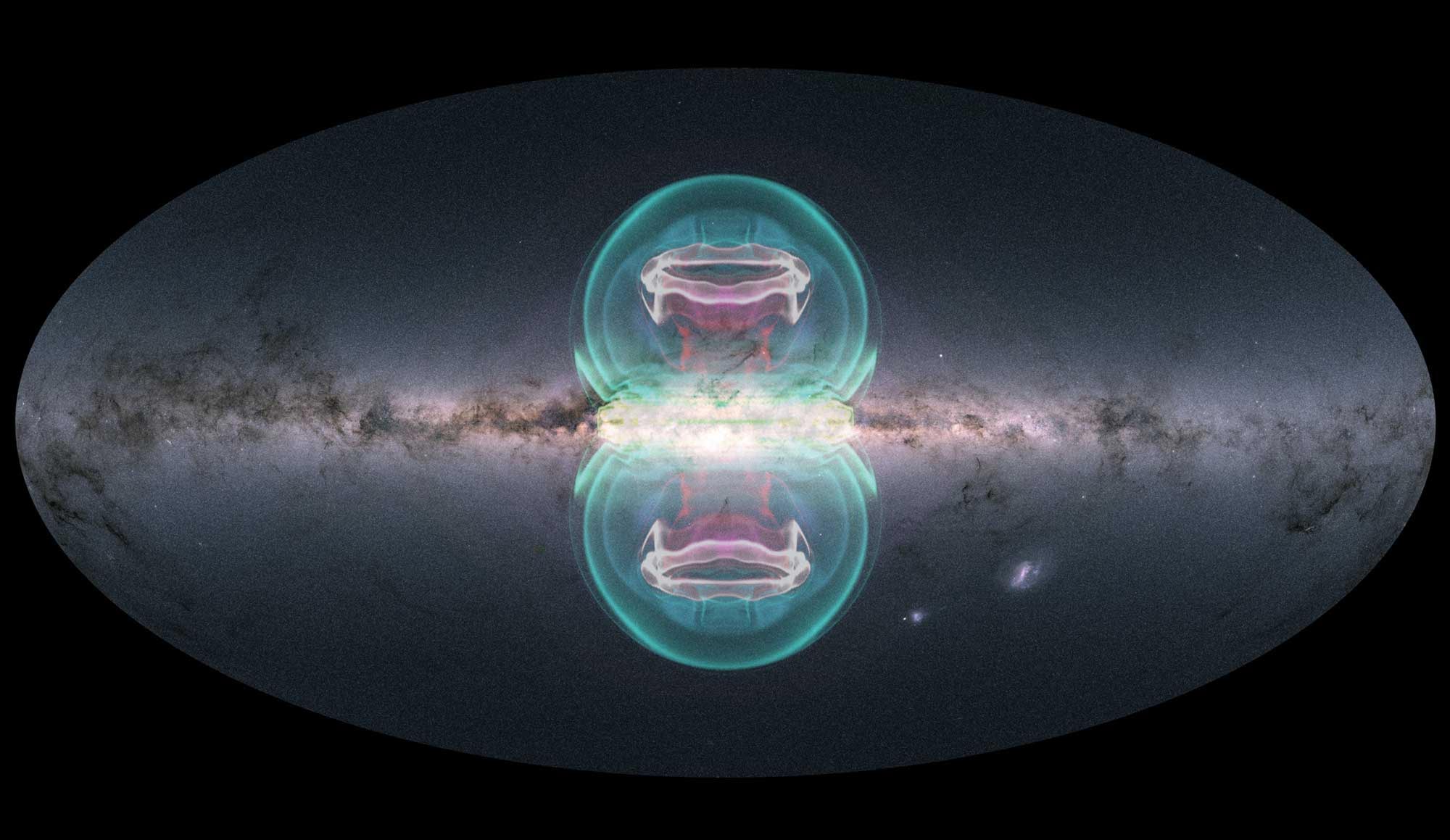
Astronomers have revealed new evidence about the properties of the giant bubbles of high-energy gas that extend far above and below the Milky Way galaxy’s center.
In a study recently published in Nature Astronomy, a team led by scientists at The Ohio State University was able to show that the shells of these structures – dubbed “eRosita bubbles” after being found by the eRosita X-ray telescope – are more complex than previously thought.
Although they bear a striking similarity in shape to Fermi bubbles, eRosita bubbles are larger and more energetic than their counterparts. Known together as the “galactic bubbles” due to their size and location, they provide an exciting opportunity to study star formation history as well as reveal new clues about how the Milky Way came to be, said Anjali Gupta, lead author of the study and a former postdoctoral researcher at Ohio State who is now a professor of astronomy at Columbus State Community College.
The Role of the Circumgalactic Medium
These bubbles exist in the gas that surrounds galaxies, an area that is called the circumgalactic medium.
“Our goal was really to learn more about the circumgalactic medium, a place very important in understanding how our galaxy formed and evolved,” Gupta said. “A lot of the regions that we were studying happened to be in the region of the bubbles, so we wanted to see how different the bubbles are when compared to the regions which are away from the bubble.”
Previous studies had assumed that these bubbles were heated by the shock of gas as it blows outward from the galaxy, but this paper’s main findings suggest the temperature of the gas within the bubbles isn’t significantly different from the area outside of it.
“We were surprised to find that the temperature of the bubble region and out of the bubble region were the same,” said Gupta. Additionally, the study demonstrates that these bubbles are so bright because they’re filled with extremely dense gas, not because they are at hotter temperatures than the surrounding environment.
Gupta and Smita Mathur, co-author of the study and a professor of astronomy at Ohio State, did their analysis using observations made by the Suzaku satellite, a collaborative mission between NASA and the Japanese Aerospace Exploration Agency (JAXA).
By analyzing 230 archival observations made between 2005 and 2014, researchers were able to characterize the diffuse emission – the electromagnetic radiation from very low-density gas – of the galactic bubbles, as well as the other hot gases that surround them.
Star Formation as the Bubble’s Origin
Although the origin of these bubbles has been debated in scientific literature, this study is the first that begins to settle it, said Mathur. As the team found an abundance of non-solar neon-oxygen and magnesium-oxygen ratios in the shells, their results strongly suggest that galactic bubbles were originally formed by nuclear star-forming activity, or the injection of energy by massive stars and other kinds of astrophysical phenomena, rather than through the activities of a supermassive black hole.
“Our data supports the theory that these bubbles are most likely formed due to intense star formation activity at the galactic center, as opposed to black hole activity occurring at the galactic center,” Mathur said. To further investigate the implications their discovery may have for other aspects of astronomy, the team hopes to use new data from other upcoming space missions to continue characterizing the properties of these bubbles, as well as work on novel ways to analyze the data they already have.
“Scientists really do need to understand the formation of the bubble structure, so by using different techniques to better our models, we’ll be able to better constrain the temperature and the emission measures that we are looking for,” said Gupta.
Reference: “Thermal and chemical properties of the eROSITA bubbles from Suzaku observations” by Anjali Gupta, Smita Mathur, Joshua Kingsbury, Sanskriti Das and Yair Krongold,1 May 2023, Nature Astronomy.
DOI: 10.1038/s41550-023-01963-5
Other co-authors were Joshua Kingsbury and Sanskriti Das of Ohio State and Yair Krongold of the National Autonomous University of Mexico. This work was supported by NASA.
Never miss a breakthrough: Join the SciTechDaily newsletter.
Follow us on Google and Google News.