
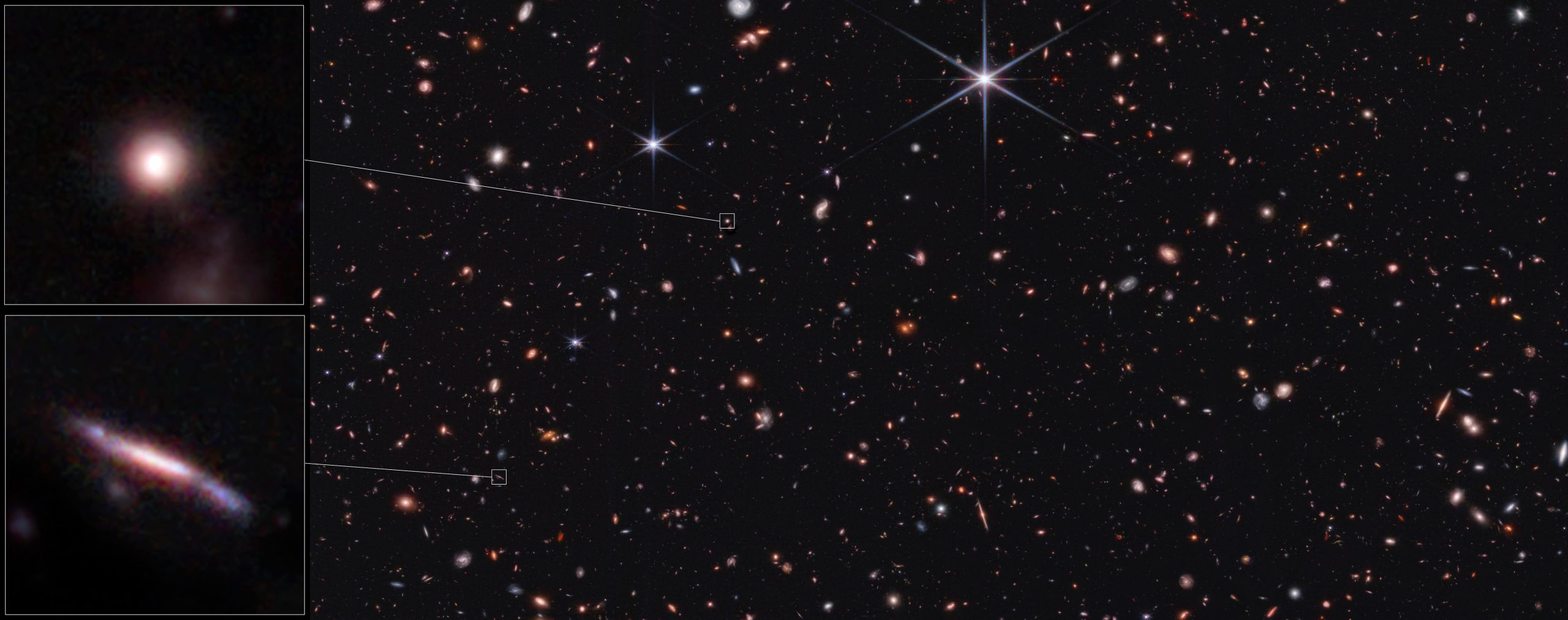
Data from NASA’s James Webb Space Telescope suggests that many early galaxies were long and thin, not disk-like or spherical.
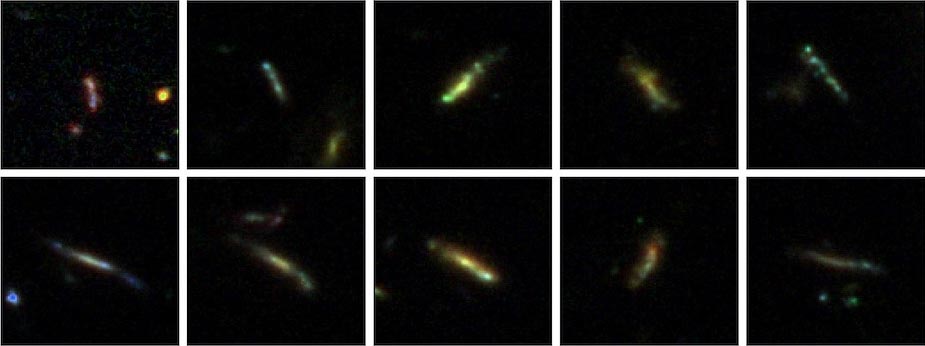
Columbia researchers analyzing images from NASA’s James Webb Space Telescope have found that galaxies in the early universe are often flat and elongated, like breadsticks—and are rarely round, like balls of pizza dough.
“Roughly 50 to 80% of the galaxies we studied appear to be flattened in two dimensions,” explained Viraj Pandya, a NASA Hubble Fellow at Columbia University, and the lead author of a new paper slated to appear in The Astrophysical Journal that outlines the findings. “Galaxies that look like long, thin breadsticks seem to be very common in the early universe, which is surprising, since they are uncommon among galaxies in the present-day universe.”
Webb Telescope’s Insights into Cosmic Evolution
The team focused on a vast field of near-infrared images delivered by Webb, known as the Cosmic Evolution Early Release Science (CEERS) Survey, plucking out galaxies that are estimated to have existed when the universe was 600 million to 6 billion years old.
While most distant galaxies look like breadsticks, others are shaped like pizza pies and balls of pizza dough. The “balls of pizza dough,” or sphere-shaped galaxies, appear to be the smallest type of galaxy and were also the least frequently identified. The pizza pie-shaped galaxies were found to be as large as breadstick-shaped galaxies along their longest axis. “They are more common in the nearby universe which, due to the universe’s ongoing expansion, is made up of older, more mature galaxies.”
The Milky Way’s Past Form and the Evolution of Galaxies
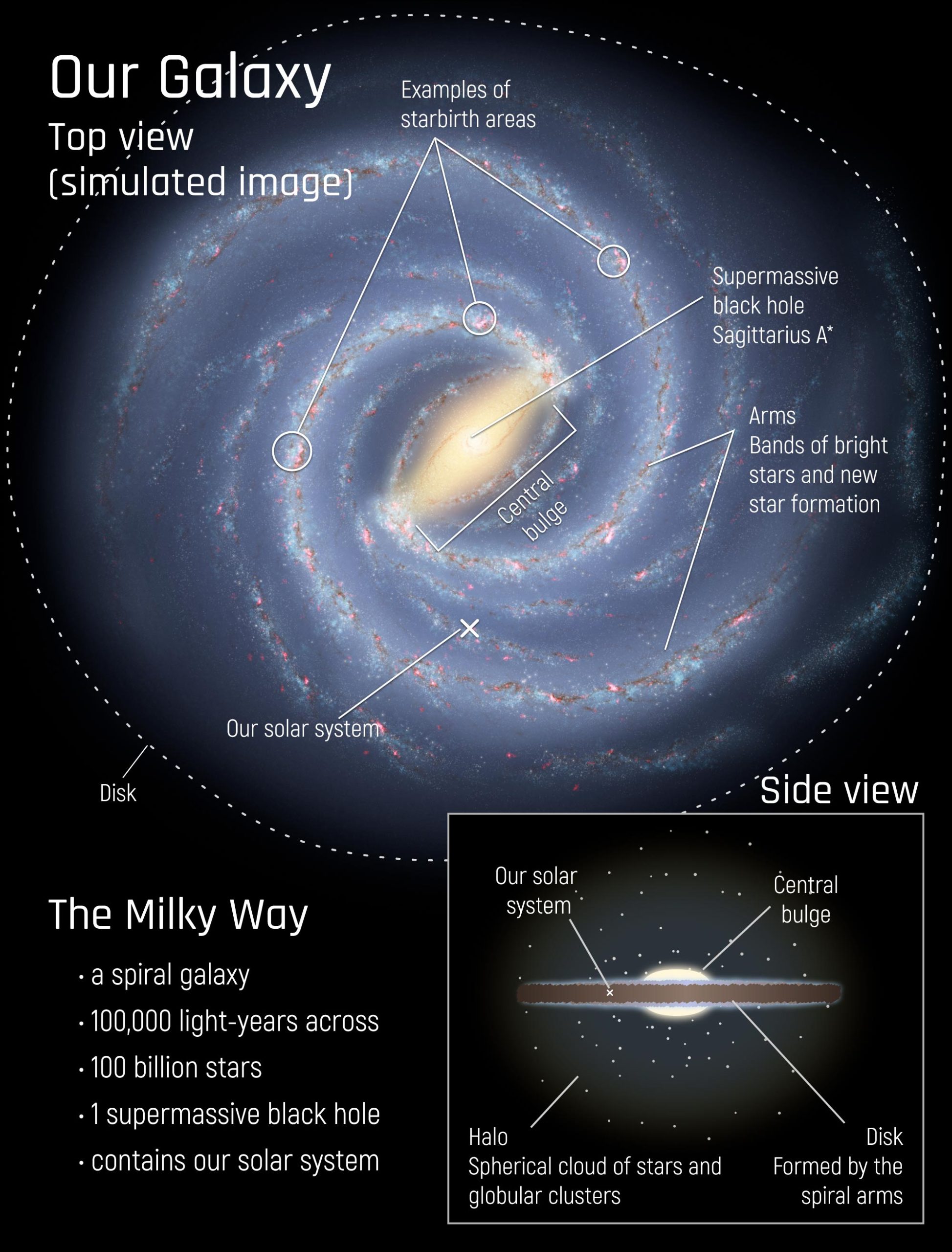
Which category would our Milky Way galaxy fall into if we were able to wind the clock back by billions of years? “Our best guess is that it might have appeared more like a breadstick,” said co-author Haowen Zhang, a PhD candidate at the University of Arizona in Tucson. This hypothesis is based partly on new evidence from Webb—theorists have “wound back the clock” to estimate the Milky Way’s mass billions of years ago, which suggests its likely breadstick shape in the distant past.
These distant galaxies are also far less massive than nearby spirals and ellipticals—they are precursors to more massive galaxies like our own. “In the early universe, galaxies had had far less time to grow,” said Kartheik Iyer, a co-author and NASA Hubble Fellow also at Columbia University. “Identifying additional categories for early galaxies is exciting—there’s a lot more to analyze now. We can now study how galaxies’ shapes relate to how they look and better project how they formed in much more detail.”
Hubble and Webb: A Collaborative View of the Cosmos
Hubble, the space telescope that launched in 1990 and collects data to this day, “has long showed an excess of elongated galaxies,” explained co-author Marc Huertas-Company, a faculty research scientist at the Institute of Astrophysics on the Canary Islands. But researchers still wondered: Would additional detail show up better with the sensitivity to infrared light that the Webb telescope, which launched in 2021, has? “Webb confirmed that Hubble didn’t miss any additional features in the galaxies they both observed. Plus, Webb showed us many more distant galaxies with similar shapes, all in great detail,” Huertas-Company said.
Understanding the Shapes of Early Galaxies
One question, of course, is why early galaxies tended to be so flattened and elongated. One hypothesis, Pandya explained, is that the early universe may have been filled with filaments of dark matter that formed a kind of “skeletal background,” or “cosmic highway,” that ushered gas and stars along it. These filaments still exist, but they have grown much more diffuse as the universe has expanded, so they may be less likely to promote the formation of breadstick-shaped galaxies.
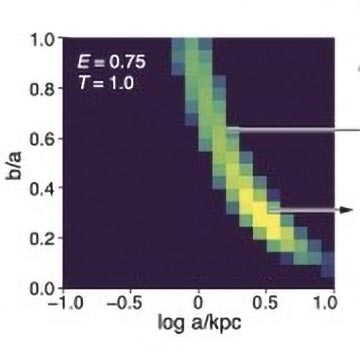
When researchers plotted galaxies’ aspect ratios against their longest axis length, they found the diagrams looked distinctly like bananas. Credit: Pandya et al.
“Galaxies Going Bananas” and Future Research
The paper is called “Galaxies Going Bananas,” yet another food analogy that sprang into the authors’ minds as they looked at their data. When the authors plotted galaxies’ aspect ratios against their longest axis length, they found that the diagrams that emerged looked distinctly like bananas, a shape that reflects their elongated, ellipsoid (i.e. breadstick) shape. “The bananas are another way of saying that these intrinsically elongated galaxies seem to be the dominant ones in the first 4 billion years of the universe,” Pandya said.
There are still gaps in our knowledge. Researchers not only need an even larger sample size from Webb to further refine the properties and precise locations of distant galaxies, they will also need to spend ample time tweaking and updating their models to better reflect the precise geometries of distant galaxies. “These are early results,” said co-author Elizabeth McGrath, an associate professor at Colby College in Waterville, Maine. “We need to delve more deeply into the data to figure out what’s going on, but we’re very excited about these early trends.”
For more on this study, see Webb Telescope Reveals Many Early Galaxies Looked Like Pool Noodles and Surfboards.
Reference: “Galaxies Going Bananas: Inferring the 3D Geometry of High-Redshift Galaxies with JWST-CEERS” by Viraj Pandya, Haowen Zhang, Marc Huertas-Company, Kartheik G. Iyer, Elizabeth McGrath, Guillermo Barro, Steven L. Finkelstein, Martin Kuemmel, William G. Hartley, Henry C. Ferguson, Jeyhan S. Kartaltepe, Joel Primack, Avishai Dekel, Sandra M. Faber, David C. Koo, Greg L. Bryan, Rachel S. Somerville, Ricardo O. Amorin, Pablo Arrabal Haro, Micaela B. Bagley, Eric F. Bell, Emmanuel Bertin, Luca Costantin, Romeel Dave, Mark Dickinson, Robert Feldmann, Adriano Fontana, Raphael Gavazzi, Mauro Giavalisco, Andrea Grazian, Norman A. Grogin, Yuchen Guo, ChangHoon Hahn, Benne W. Holwerda, Lisa J. Kewley, Allison Kirkpatrick, Anton M. Koekemoer, Jennifer M. Lotz, Ray A. Lucas, Laura Pentericci, Pablo G. Perez-Gonzalez, Nor Pirzkal, Dale D. Kocevski, Casey Papovich, Swara Ravindranath, Caitlin Rose, Marc Schefer, Raymond C. Simons, Amber N. Straughn, Sandro Tacchella, Jonathan R. Trump, Alexander de la Vega, Stephen M. Wilkins, Stijn Wuyts, Guang Yang and L. Y. Aaron Yung, Accepted, The Astrophysical Journal.
arXiv:2310.15232
Never miss a breakthrough: Join the SciTechDaily newsletter.
Follow us on Google and Google News.
1 Comment
“The word “believe” reflects the fact that some of the galaxies may be disk (i.e. pizza pie) shaped galaxies seen from the side.”
I guess one is supposed to imagine there is no spin evident, with complementary redshift end blueshift ends, or else (seems more believable) there is no data on that and no one involved in the story wants to just come out and resolve that question.