
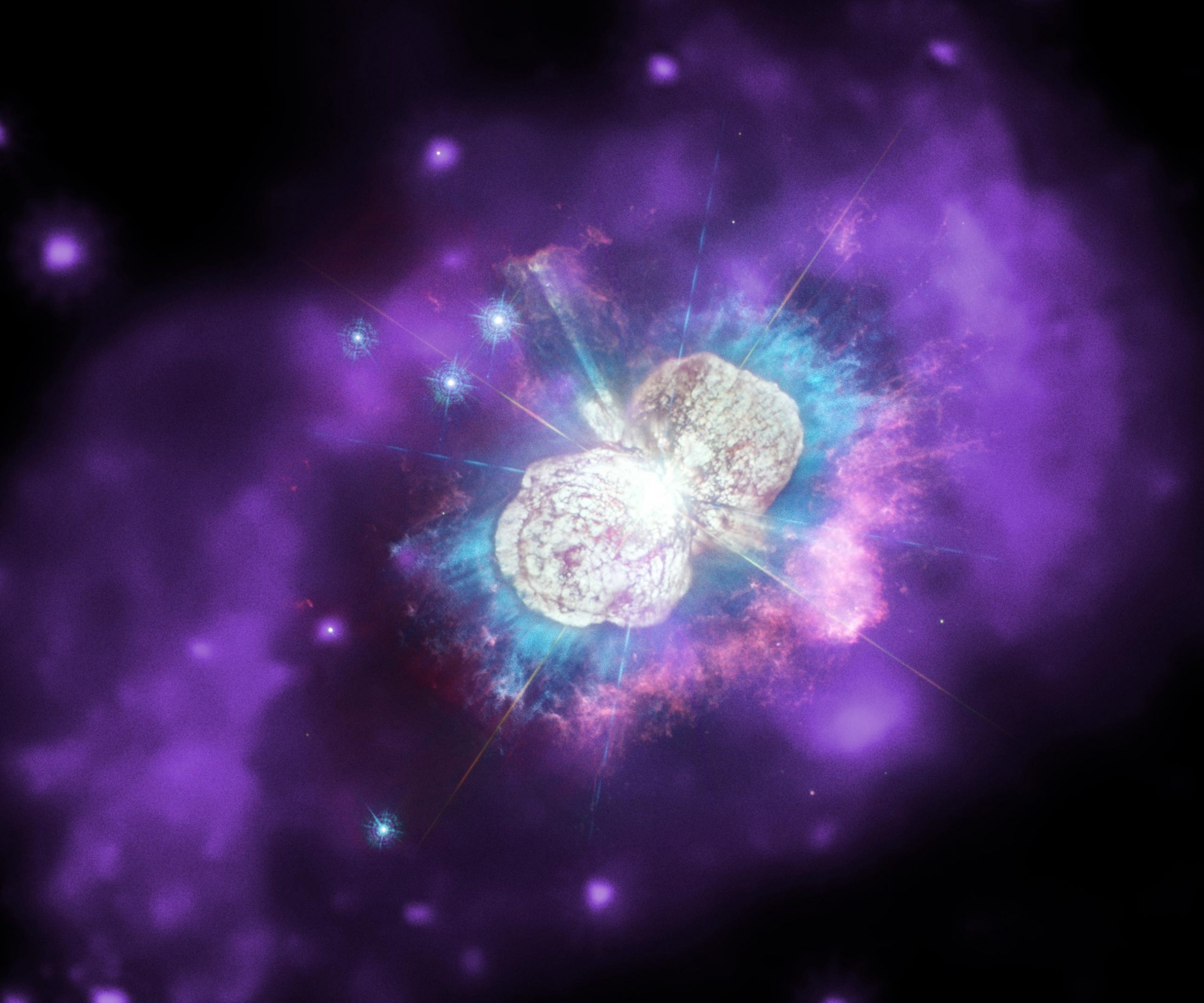
Gamma-ray burst GRB 160203A unexpectedly brightened hours after its explosion, suggesting it collided with dense matter, prompting scientists to rethink how these powerful events unfold.
Gamma-ray bursts are enormous cosmic explosions and are one of the brightest and most energetic events in the Universe. Their brightness changes over time, illuminating deep space like a flashlight shining into a dark room. Intense radiation emitted from most observed gamma-ray bursts is predicted to be released during a supernova as a star implodes to form a neutron star or a black hole.
In the recently observed gamma-ray burst event called GRB 160203A, remains of the explosion started glowing much brighter than expected, according to standard scientific models, even several hours after the initial flash. We now believe that this “rebrightening” was caused by the main body of the burst crashing through shells of material ejected by the source star, or interstellar “knots.” Both theories suggest that the standard gamma-ray burst model needs to be re-examined, and perhaps the surrounding space isn’t as smooth and uniform as originally predicted.
In our study, we began collecting reports from all over the world that observed the gamma-ray burst event, including the archives of the Zadko research telescope. By carefully calibrating the data from different sources and comparing the different brightness over time, we unpacked the surrounding galaxy and defined key characteristics of the burst: the temporal index (how quickly it fades over time), the spectral index (the overall color of the burst), and the extinction (how much light is absorbed by the matter between here, on Earth, and the burst). One surprising finding was that the density of the burst’s host galaxy is unusually dense – about the same as our own galaxy, the Milky Way.
Deviations from the Standard Model
The next step was to see how and when the data moved away from the model. With further calculations, we identified three interesting time periods that indicated significant brightness differences compared to the model’s prediction. Although the third period was probably a coincidence, the first and second periods were too large to ignore. Normally, rebrightening is caused by something happening to the host galaxy(?), such as suddenly collapsing into a black hole; however, these kinds of events normally happen within the first few minutes of a gamma-ray burst – in this event, the first rebrightening didn’t start until three hours after the initial explosion.
As a result, we decided to expand the conventional model of gamma-ray bursts to explain this unusual event. One of the properties of such events is the relationship between the density of the medium and the intensity of radiation emitted from the explosion. What’s particularly convincing about this explanation is its applicability to many contexts. As stars prepare to explode into supernovas and gamma-ray bursts, they eject their outer shells into the surrounding space. For bursts that don’t come from supernovas, these changes in brightness could be the result of turbulence in the interstellar medium. In either case, the change in brightness gives us a new tool to probe the structure of distant space, and we are now eagerly anticipating another burst with similar features to put our new model to the test.
Written by OzGrav PhD student Hayden Crisp, University of Western Australia
Reference: “GRB160203A: an exploration of lumpy space” by H Crisp, B Gendre, E J Howell and D Coward, 8 April 2021, Monthly Notices of the Royal Astronomical Society.
DOI: 10.1093/mnras/stab916
arXiv:2103.15431
Never miss a breakthrough: Join the SciTechDaily newsletter.
Follow us on Google and Google News.