

Researchers have unveiled a new DNA-based therapy that silences the PCSK9 gene to lower cholesterol without statin side effects.
Early results show dramatic reductions in cholesterol levels, offering a fresh route to combat heart disease.
When cholesterol levels in the blood rise too high, a condition known as hypercholesterolemia can develop, damaging arteries and threatening heart health. Researchers from the University of Barcelona and the University of Oregon have now unveiled a promising new therapy that helps control cholesterol levels and offers fresh possibilities for combating atherosclerosis, a disease linked to the buildup of fatty plaques in artery walls.
The team developed a method to block the activity of PCSK9, a protein that plays a crucial role in regulating the amount of low-density lipoprotein cholesterol (LDL-C) in the bloodstream. Using specially designed molecules called polypurine hairpins (PPRH), the technique boosts the removal of cholesterol by cells and prevents it from accumulating in arteries, without the unwanted side effects often associated with statin medications.
The findings, published in the journal Biochemical Pharmacology, were led by Carles J. Ciudad and Verònica Noé, professors at the UB’s Faculty of Pharmacy and Food Sciences and the Institute of Nanoscience and Nanotechnology (IN2UB), working with Nathalie Pamir from the University of Oregon in Portland (United States). The research received support from the Spanish Ministry of Science, Innovation and Universities (MICINN) and the National Institutes of Health (NIH) of the United States.

Polypurine hairpins for PCSK9 expression inhibition
PCSK9 (protein convertase subtilisin/kexin type 9) is an enzyme that has emerged over the last decade as a therapeutic target for reducing cardiovascular disease and improving lipid metabolism. This protein binds selectively and competitively to the cellular receptor itself. Thus, PCSK9 reduces the number of available LDL receptors on cells, which increases the level of LDL-bound cholesterol circulating in the blood plasma and ultimately causes hypercholesterolemia.
The new methodology is based on the ability of polypurine hairpins (PPRHs) to specifically stop gene transcription.
In this case, PPRHs can inhibit the expression of the PCSK9 gene, thereby increasing LDLR receptor levels and promoting cholesterol uptake inside cells. As a result, circulating cholesterol levels and the risk of atherosclerosis decrease.
PPRHs are oligonucleotides, simple single-stranded DNA molecules that have a high affinity for specific DNA and also RNA sequences. The study reveals for the first time how polypurine hairpins — HpE9 and HpE12 — decrease PCSK9 RNA and protein, and increase LDLR levels.
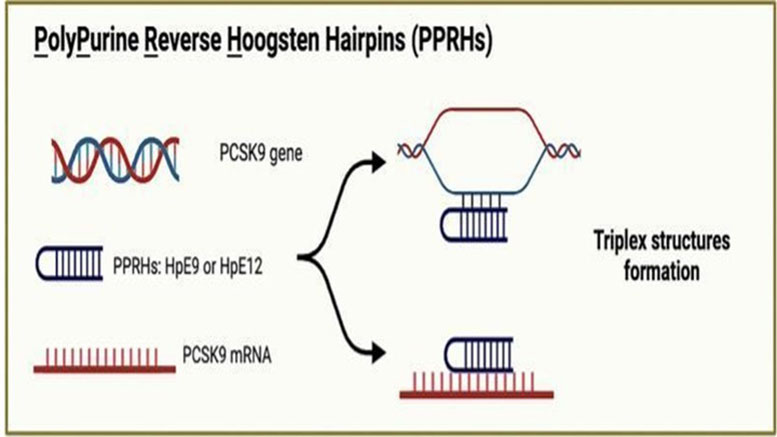
“Specifically, one of the arms of each chain of the HpE9 and HpE12 polypurines binds specifically to polypyrimidine sequences of exons 9 and 12 of PCSK9, respectively, via Watson-Crick bonds,” notes Professor Carles J. Ciudad, from the Department of Biochemistry and Physiology. This binding inhibits gene transcription and the action of RNA polymerase or the binding of transcription factors.
The new therapeutic technique has been validated in vivo in transgenic mice expressing the human PCSK9 gene. “The results show that both HpE9 and HpE12 are highly effective in HepG2 cells. HpE12 decreases PCSK9 RNA levels by 74% and protein levels by 87%. In the case of transgenic mice, a single injection of HpE12 reduces plasma PCSK9 levels by 50% and cholesterol levels by 47% on the third day,” says Professor Verònica Noé.
Therapeutic oligonucleotides as an alternative to statins
Since PCSK9 was defined as a significant target in plasma cholesterol-lowering therapy, several therapeutic approaches have been designed to lower or block its action. For example, gene silencing with siRNAs, antisense oligonucleotides, or the CRISPR technique. In particular, Inclisiran, an siRNA agent against PCSK9, and the monoclonal antibodies such as evolocumab and alirocumab stand out.
“PPRHs, especially HpE12, are therapeutic oligonucleotides with many advantages, including low cost of synthesis, stability, and lack of immunogenicity. In addition, such a PPRH-based approach against PCSK9 would not lead to side effects such as the myopathies associated with statin therapy,” the experts conclude.
Reference: “Inhibition of PCSK9 with polypurine reverse hoogsteen hairpins: A novel gene therapy approach” by Ester López-Aguilar, Silvia Cecilia Pacheco-Velázquez, M-Antonia Busquets, Joshua Hay, Paul A. Mueller, Sergio Fazio, Carlos J Ciudad, Véronique Noé and Nathalie Pamir, 11 May 2025, Biochemical Pharmacology.
DOI: 10.1016/j.bcp.2025.116976
Never miss a breakthrough: Join the SciTechDaily newsletter.
Follow us on Google and Google News.
10 Comments
Let’s rebuild the genome!
How sad. How arrogant. We need cholesterol. Why are we wasting money on this? Oh yeh the pharmaceutical industry! How they sleep at night I don’t know.
What are you talking about? 1 in 5 people have genetic cholesterol that is way too high that their liver makes. 80% of the population can control cholesterol through eating habits. I have 50% blockage due to this condition in a couple arteries.
What is truly arrogant is that comment, obviously no one in your family has hypercholesterolemia or you wouldn’t be saying such dribble. I’ve had multiple family members with this illness and its the root cause of a host of other deadly horrifying illnesses.
Does it lower your testosterone levels?
When is this therapy available to humans?
Yes I am totally done with Pharma
Awful yes….No Statins( pharma yes)
No Statins ….this in a ground breaking, No Pharma. I am not sure of your understanding or maybe mine for that matter, NO STATINS
3rd stand in the DNA. Low carbohydrates diet is the only thing I have found to lower. Mother’s side of the family. 4 stints.
What is truly arrogant and equally ignorant is the comment left by Lesley Wilkinson who obviously has no family members afflicted by hypercholesterolemia or Lesley wouldn’t be saying such nonsense about this study. I’ve had multiple family members with this illness and its the root cause of a host of other deadly horrifying illnesses.
There are already multiple PCSK9 inhibitors on the market (Repatha, Praluent, Leqvio) and they have side effects, so I don’t see how this gene therapy would be any better. At least with the prescriptions, you can stop taking them if you have bad side effects. With the gene therapy, I’m thinking the effects are permanent whether you do OK with them or not.
Also, lowering your cholesterol by 50% is dangerous. The brain needs cholesterol to function properly. Low cholesterol can cause rage. I had it happen to me once when I changed my diet drastically and my cholesterol dropped to a low level. The littlest things would fill me with rage and I had violent thoughts. It was scary.