
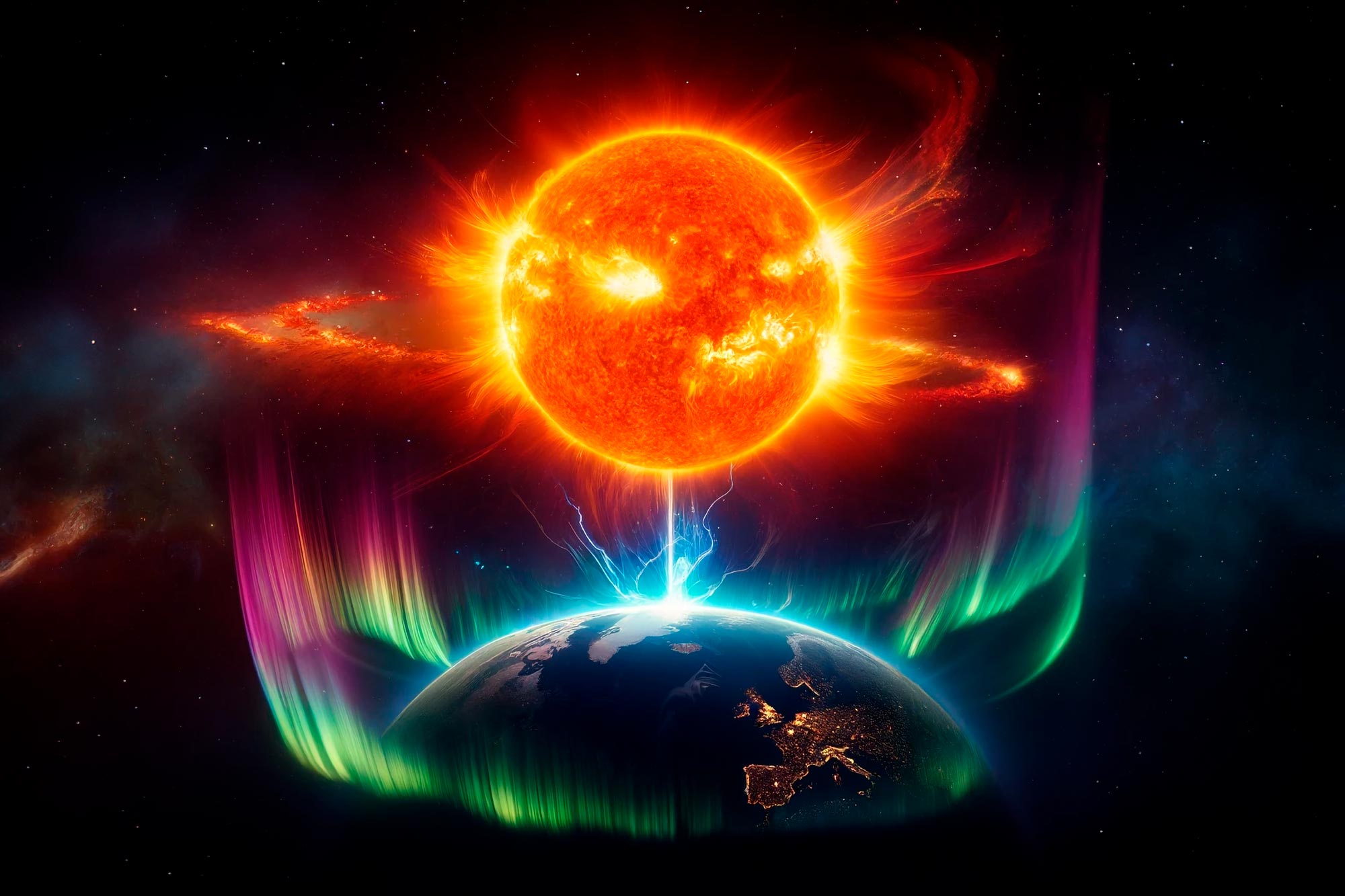
NOAA’s GOES satellites observed significant solar activity, including a severe geomagnetic storm, marking the peak phase of Solar Cycle 25. Advanced tools like the GOES-U satellite’s CCOR-1 are key to monitoring and understanding these powerful solar phenomena.
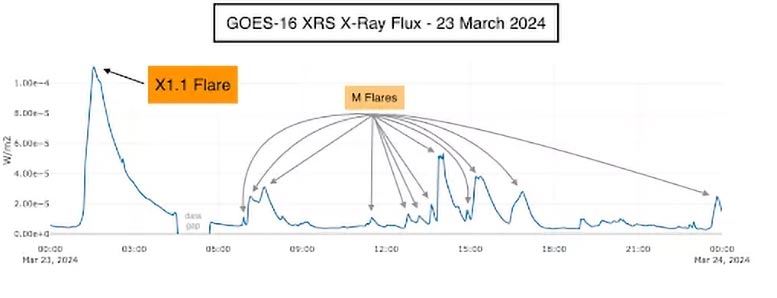
From March 23–24, 2024, NOAA’s GOES satellites, and others operated by international partners, observed numerous flares erupt from the sun, including a powerful X-class solar flare. Additionally, a surge of extremely hot plasma, known as a coronal mass ejection (CME), raced toward Earth resulting in geomagnetic storms and auroras.
The Impact of Geomagnetic Storms
This CME reached our planet at 10:37 a.m. EDT (1437 GMT) on Sunday, March 24, triggering a severe G4-class geomagnetic storm, marking the most potent solar storm since 2017. However, according to a Geomagnetic Storm Watch from NOAA’s Space Weather Prediction Center, there was no reason for the public to be alarmed.
Geomagnetic storms, also referred to as solar storms, disrupt Earth’s magnetic field and can potentially affect power grids on Earth as well as radio signals and communications systems. They can also affect our satellite operations and GPS navigation capabilities. Additionally, astronauts in space have to be extra careful during these events, particularly if they are doing a spacewalk. Outside of the Earth’s protective atmosphere, the extra associated radiation they are exposed to may cause radiation poisoning or other harmful health effects.
NOAA categorizes geomagnetic storms on a scale ranging from G1 to G5. A G5 storm, the most extreme level, can result in complete high frequency radio blackouts across the sunlit side of Earth, lasting for several hours.
On March 24, NOAA issued a Geomagnetic Storm Alert that stated how geomagnetic storm levels G1 through G4 had been reached and that aurora might be seen as far south as Alabama to northern California. As a result of this storm, power grid irregularities were reported in Canada.
Current Solar Cycle and Predictions
We are currently in Solar Cycle 25. The solar cycle is a nearly periodic change in the Sun’s activity moving from solar minimum (least number of sunspots and low solar activity) through solar maximum (most sunspots and high solar activity) and back to solar minimum, which generally takes about 11 years. Sometimes the surface of the Sun is very active with lots of sunspots, while other times it is quieter with only a few or even none.
Near solar maximum, geomagnetic storms of the type that arrived Sunday can hit Earth a few times a year. We are currently close to the predicted maximum of Solar Cycle 25, and in December, the biggest solar flare in years disrupted radio communications. During solar minimum, a few years may pass between storms.
According to NOAA’s Space Weather Prediction Center (SWPC), a revised prediction concludes that solar activity during Solar Cycle 25 will increase more quickly and peak at a higher level than that predicted by an expert panel in December 2019. The updated prediction now calls for Solar Cycle 25 to peak between January and October of 2024, with a maximum sunspot number between 137 and 173.
Technological Advances in Solar Monitoring
NOAA satellites help monitor the activity of the sun and when solar flares, or coronal mass ejections occur. Since these events can happen unpredictably and some can reach Earth within minutes, NOAA’s Space Weather Prediction Center uses this information to monitor the activity on the sun and makes forecasts, predictions, and alerts.
To help with this, the GOES satellites also house the Extreme Ultraviolet and X-ray Irradiance Sensors (EXIS), which monitor the Sun’s electromagnetic radiation and serve as a critical first warning system for the onset of flares, the Space Environmental In-Situ Suite (SEISS), which helps assess the electrostatic discharge risk and radiation hazards to astronauts and satellites, and a Magnetometer, which measures the Earth’s magnetic field.
Did you know that NOAA’s newest satellite, GOES-U, will be carrying a new instrument to study the corona, called a compact coronagraph (CCOR-1)? This instrument will study the solar corona by blocking out the light from the sun. This is similar to a total solar eclipse, when the moon moves in front of the sun. CCOR-1 will help detect and characterize CMEs and serve as a primary source for information about impending geomagnetic storms.
And speaking of solar eclipses, don’t miss the one that will be visible over parts of Mexico, the U.S., and Canada on April 8, 2024!
Never miss a breakthrough: Join the SciTechDaily newsletter.
Follow us on Google and Google News.