
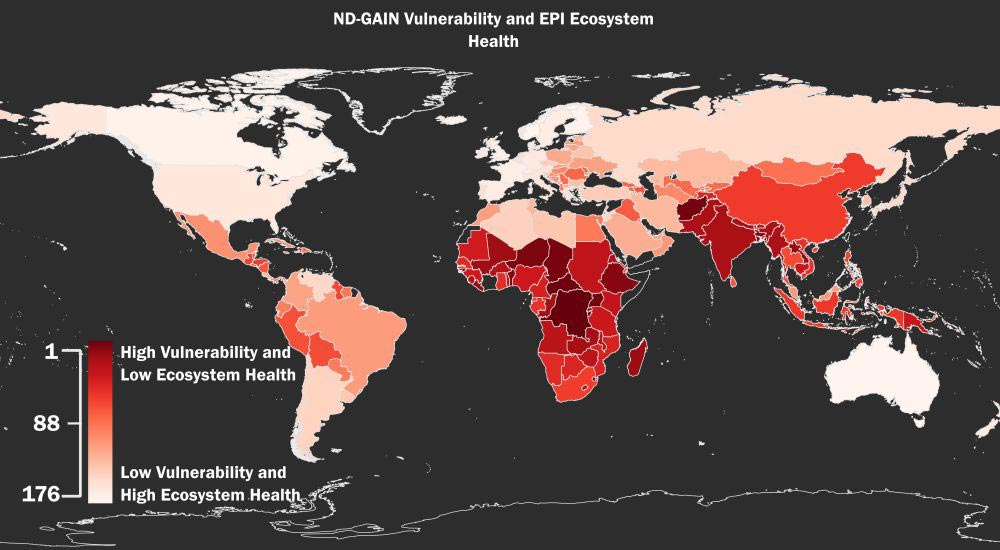
A new analysis of global datasets shows low-income countries are significantly more likely to be impacted by both toxic pollution and climate change.
A new analysis of global datasets shows low-income countries are significantly more likely to be impacted by both toxic pollution and climate change–and provides a list of at-risk countries most (and least) able to immediately begin direct efforts toward pollution risk reduction, according to a study published July 7, 2021, in the open-access journal PLOS ONE by Richard Marcantonio from the University of Notre Dame, Indiana, USA, and colleagues.
In this age of the Anthropocene, it’s clear that human activities are destabilizing our planet across multiple systems. Previous research has shown that low-income countries face higher risks than high-income countries from toxic pollution and climate change; however, few studies have explored the relationship between these two risks.
To test the relationship between toxic pollution and climate change, the authors collated and analyzed three frequently used public datasets, ND-GAIN (Notre Dame Global Adaptation Index), EPI (Yale Environmental Performance Index), and GAHP (Global Alliance on Health and Pollution), using data for 176 countries from 2018.
A Strong Link Between Climate Risk and Toxic Pollution
They found a strong (rs = -0.798; 95% CI -0.852, -0.727) and statistically significant (p<0.0001) relationship between the spatial distribution of global climate risk and toxic pollution–in other words, countries most at risk for impacts of climate change were most often also the countries facing highest risks of toxic pollution. (And as other studies show, climate change and toxic pollution interact to create compounding issues: e.g. warming temperatures increase rates of heat-related illness/death as well as enhance the toxicity of environmental contaminants.) The top one-third of countries most at-risk represented over two-thirds of the world’s population, geographically concentrated in low-income countries across Africa and Southeast Asia. The authors note that the demographic, ecological, and social factors at work are interconnected and demonstrate broader patterns of inequality, and also emphasize that physical geography, local structural conditions (such as a relatively low capacity for environmental policy and enforcement), and external factors (such as foreign firms taking advantage of reduced environmental regulation) all play a role in exacerbating risks in these countries. Based on their analysis, the authors went on to create a “Target” list of top-ten countries that could provide maximum returns on any investment for risk reduction based on their risk as well as their structural capacity to enact changes (respectively: Singapore, Rwanda, China, India, Solomon Islands, Bhutan, Botswana, Georgia, the Republic of Korea, and Thailand).
The data used in this study do not capture all forms of harm or potential risk from toxic pollution and climate change–only those measured in the initial datasets. Additionally, the authors note that addressing impacts may require a finer intra-country assessment, since risks can vary widely within countries. However, the immediate findings clearly point to a need to jointly address the effects of pollution and climate change globally, while also suggesting an approach for policymakers worldwide.
The authors add: “Vast work has been done to understand the magnitude and distribution of risk from climate change and toxic pollution, separately. We wanted to know if the spatial distribution of these two types of environmental risks are similar and, unfortunately, our results say that in general they are.”
Reference: “Global distribution and coincidence of pollution, climate impacts, and health risk in the Anthropocene” by Richard Marcantonio, Debra Javeline, Sean Field and Agustin Fuentes, 21 July 2021, PLOS ONE.
DOI: 10.1371/journal.pone.0254060
Never miss a breakthrough: Join the SciTechDaily newsletter.
Follow us on Google and Google News.
1 Comment
Is “rs” supposed to stand for the Spearman rank correlation coefficient or the Pearson correlation coefficient squared? Even the original article doesn’t define how it is being used.
“Anthopocene” is being promoted by some climatologists to denote an interval of recent time. However, there is no professional group representing geologists, paleontologists, or archaeologists that have endorsed or sanctioned the term. One has to question the objectivity of researchers that choose to use a term that has no official recognition by those with responsibility for doing so. At the very least, it is irresponsible science because if the term is never approved, it may well fall into disuse, and subsequent researchers reading the literature may not have any certainty as to what period of time it refers to. This appears to be yet another attempt to foist an undefined vocabulary, such as “ocean acidification” or “tipping point,” onto scientists in other disciplines who use different vocabularies. It smacks of hubris.