
German researchers have developed a sustainable method to produce protein and vitamin B9 from microbes using renewable energy. This yeast-based altenative could help address global food challenges by providing a nutrient-rich option that requires no farmland.
Researchers in Germany have developed a method to harvest protein and vitamin B9 from microbes by providing them with little more than hydrogen, oxygen, and CO2. The technology, recently published in the Cell Press journal Trends in Biotechnology, runs on renewable energy to produce a sustainable, micronutrient-enriched protein alternative that may one day make it to our plates.
“This is a fermentation process similar to how you make beer, but instead of giving the microbes sugar, we gave them gas and acetate,” says corresponding author Largus Angenent of the University of Tübingen, Germany. “We knew that yeast could produce vitamin B9 on their own with sugar, however, we didn’t know if they could do the same with acetate.”
A Solution for Growing Food Challenges
“We are approaching 10 billion people in the world, and with climate change and limited land resources, producing enough food will become harder and harder,” says Angenent. “One alternative is growing proteins in bioreactors through biotechnology rather than growing crops to feed animals. It makes agriculture much more efficient.”
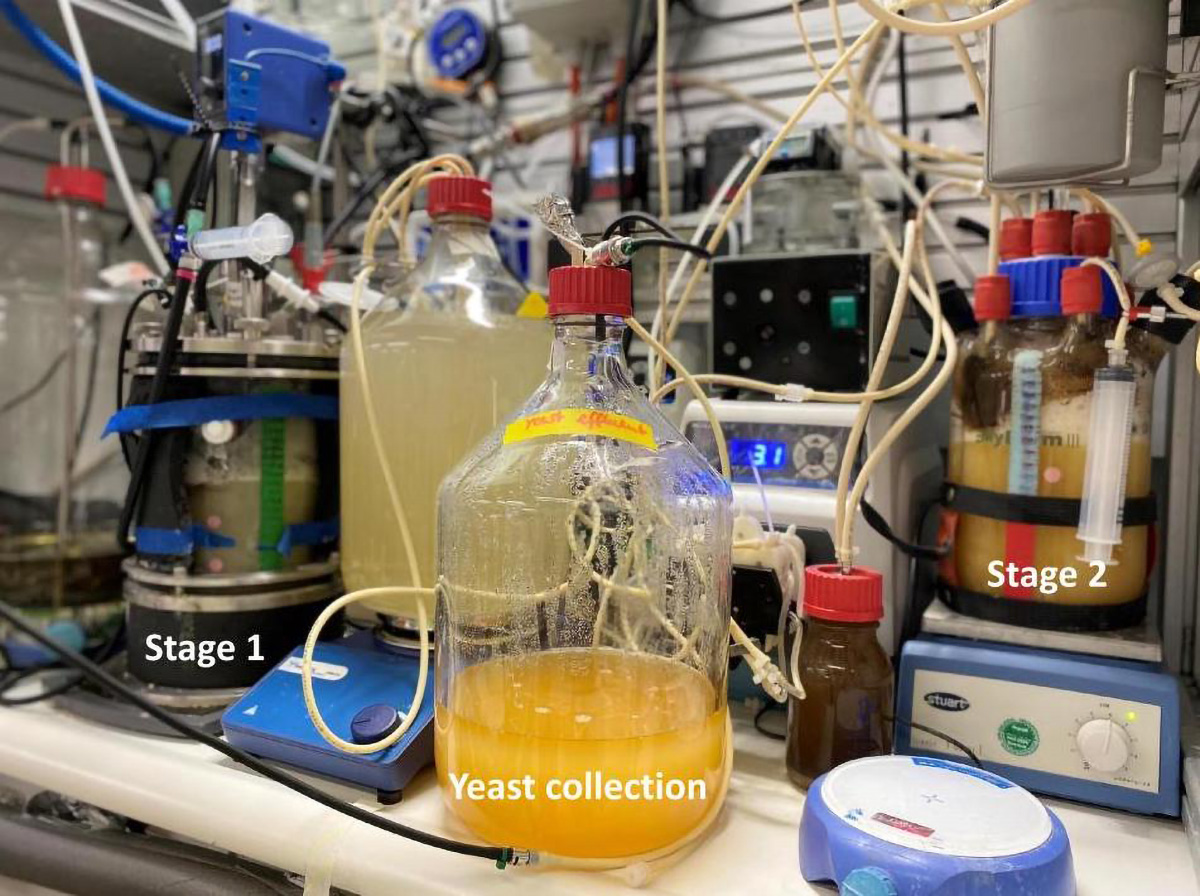
The team designed a two-stage bioreactor system that produces yeast rich in protein and vitamin B9. This vitamin is also known as folate and is essential for bodily functions like cell growth and metabolism. In the first stage, the bacterium Thermoanaerobacter kivui converts hydrogen and CO2 into acetate, which is found in vinegar. In the second stage, Saccharomyces cerevisiae, more commonly known as baker’s yeast, feeds on acetate and oxygen to make protein and vitamin B9. The hydrogen and oxygen can be produced by zapping water with electricity produced by clean energy sources like windmills, for example.
Comparable Nutritional Value to Conventional Foods
It turns out acetate-fed yeast produces about the same amount of vitamin B9 as those that eat sugar. Just 6 grams, or 0.4 tablespoon, of the harvested dried yeast meets the daily vitamin B9 requirement. The vitamin levels were measured by a team led by co-author Michael Rychlik at the Technical University of Munich, Germany.
For protein, the researchers found that the levels in their yeast exceed those of beef, pork, fish, and lentils. Eighty-five grams, or 6 tablespoons, of yeast provides 61% of daily protein needs, while beef, pork, fish, and lentils meet 34%, 25%, 38%, and 38% of the need, respectively. However, the yeast should be treated to rid compounds that can increase the risk of gout if consumed excessively. Even so, treated yeast still meets 41% of the daily protein requirement, comparable to traditional protein sources.
Addressing Environmental and Food Security Challenges
This technology aims to address several global challenges: environmental conservation, food security, and public health. Running on clean energy and CO2, the system reduces carbon emissions in food production. It uncouples land use from farming, freeing up space for conservation. Angenent also stresses that it will not outcompete farmers. Instead, the technology will help concentrate farmers to produce vegetables and crops sustainably. The team’s yeast may also help developing nations overcome food scarcity and nutritional deficiencies by delivering protein and vitamin B9.
But before picking up the research team’s yeast at a grocery aisle as a protein alternative, Angenent says there’s much more to do. They plan to optimize and scale up production, investigate food safety, conduct technical and economic analyses, and gauge market interest.
“The fact that we can make vitamins and protein at the same time at a pretty high production rate without using any land is exciting,” says Angenent. “The end product is vegetarian/vegan, non-GMO, and sustainable, which could appeal to consumers.”
Reference: “Power-to-vitamins: producing folate (vitamin B9) from renewable electric power and CO2 with a microbial protein system” by Lisa Marie Schmitz, Nicolai Kreitli, Lisa Obermaier, Nadine Weber, Michael Rychlik and Largus T. Angenent, 12 September 2024, Trends in Biotechnology.
DOI: 10.1016/j.tibtech.2024.06.014
This work was supported by the Alexander von Humboldt Foundation, the Federal Ministry of Education and Research in Germany, the Novo Nordisk Foundation CO2 Research Center (CORC), SPRIND GmbH, and the Federal Ministry of Education and Research.
Never miss a breakthrough: Join the SciTechDaily newsletter.
Follow us on Google and Google News.
1 Comment
When the wind you’re breaking is smelling like sauerkraut, it’s time to harvest some sweet, sweet proteins from it.