
Researchers propose using arid lands combined with specific plants and soils to create effective carbon-capture systems, offering a solution that doesn’t compete with agricultural land use.
Reducing CO2 levels in the atmosphere will take more than cutting emissions—we will also need to capture and store the excessive volumes of already-emitted carbon. In an opinion paper published in the journal Trends in Plant Science on September 21, a team of plant scientists argued that arid lands such as deserts could be one answer to the carbon-capture problem.
The authors argue that we could transform arid ecosystems into efficient carbon-capture systems with improved soil health, enhanced photosynthetic efficiency, and larger root biomass by engineering ideal combinations of plants, soil microbes, and soil type to facilitate a naturally occurring biogeochemical process called the oxalate-carbonate pathway to create below-ground carbon sinks.
“Re-greening deserts by restoration of ecosystem functions, including carbon sequestration, should be the preferential approach,” writes the research team, led by senior author and plant scientist Heribert Hirt of King Abdullah University of Science and Technology. “The advantage of reclaiming arid regions for re-greening and carbon sequestration is that they do not compete with lands used in agriculture and food production.”
The Role of Oxalates in Carbon Sequestration
The method takes advantage of arid-adapted plants that produce oxalates—ions containing carbon and oxygen that might ring a bell if you’re unlucky enough to suffer from kidney stones or gout. Some soil microbes use oxalates as their sole carbon source, and in doing so, they excrete carbonate molecules into the soil. Carbonate usually breaks down quickly, but if these plant-microbe systems are grown in alkaline- and calcium-rich soils, the carbonate reacts with calcium to form stable deposits of calcium carbonate.
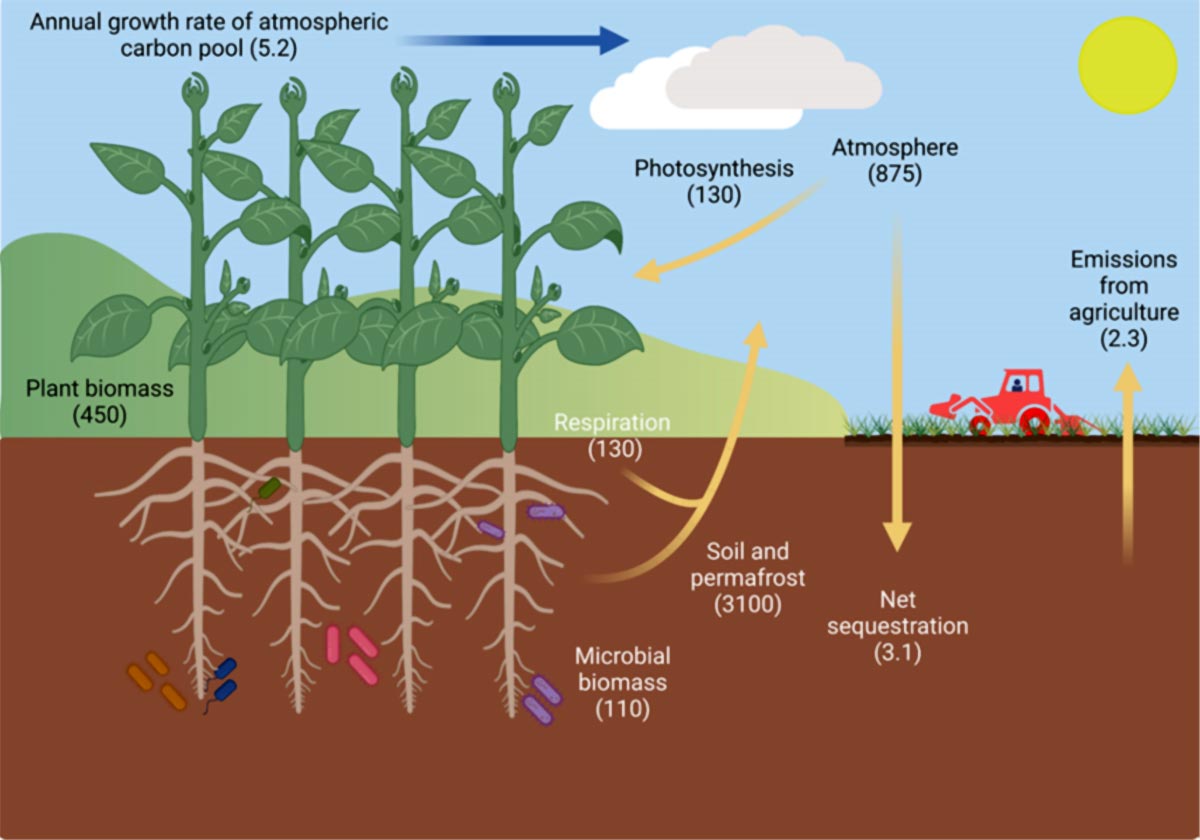
Carbon naturally cycles between the atmosphere, oceans, and terrestrial ecosystems, but human actions have resulted in the accumulation of excess CO2 in the atmosphere. Even if we can reduce CO2 emissions, the researchers write that the “…climate effects of elevated CO2 will remain irreversible for at least 1,000 years unless CO2 can be sequestered from the atmosphere.”
Arid Lands vs. Trees for Carbon Capture
Trees are considered an ideal system for carbon capture, but reforestation competes directly with agriculture for arable land. In contrast, arid lands, which constitute approximately one-third of terrestrial surfaces, are not utilized for agriculture.
Currently, arid ecosystems support very little plant life, with the lack of water being the biggest limiting factor. However, some plants have adapted to arid life by evolving different mechanisms for coping with the lack of water and extreme temperatures. Some arid-adapted plants have special root systems for reaching deep into the soil to tap hidden water sources while others use different forms of photosynthesis that allow them to minimize water loss during the hottest parts of the day. Yet others, so-called “oxalogenic” plants, produce large amounts of oxalates that they can convert into water during times of drought. Some of the carbon from these oxalates is deposited below ground as carbon deposits when oxalogenic plants are grown under certain conditions, and it’s this mechanism that the authors want to exploit for carbon sequestration.
“Overall, in this form of carbon sequestration, one out of every sixteen photosynthetically fixed carbon atoms might be sequestered into carbonates,” the authors write.
Amplifying this naturally occurring biogeochemical process in arid lands could convert these currently unproductive and degraded ecosystems into carbon sinks with healthier soil and plants, the authors say. They suggest beginning with “fertility islands”—small pockets of re-greened habitat from which the plants and microbes can spread to form a carpet of vegetation.
The authors estimate that these approaches could result in significant increases in both plant and soil carbon sequestration in less than ten years. However, they note that the success and speed of the proposed method will depend on the rate of plant growth (which tends to be slow under water-scarce conditions) and “…will also depend on the financial and political means to apply this technology in various arid countries.”
Reference: “Engineering carbon sequestration on arid lands” by Heribert Hirt, Hassan Boukcim, Marc Ducousso and Maged M. Saad, 21 September 2023, Trends in Plant Science.
DOI: 10.1016/j.tplants.2023.08.009
This work was supported by grants from the King Abdullah University of Science and Technology.
Never miss a breakthrough: Join the SciTechDaily newsletter.
Follow us on Google and Google News.