
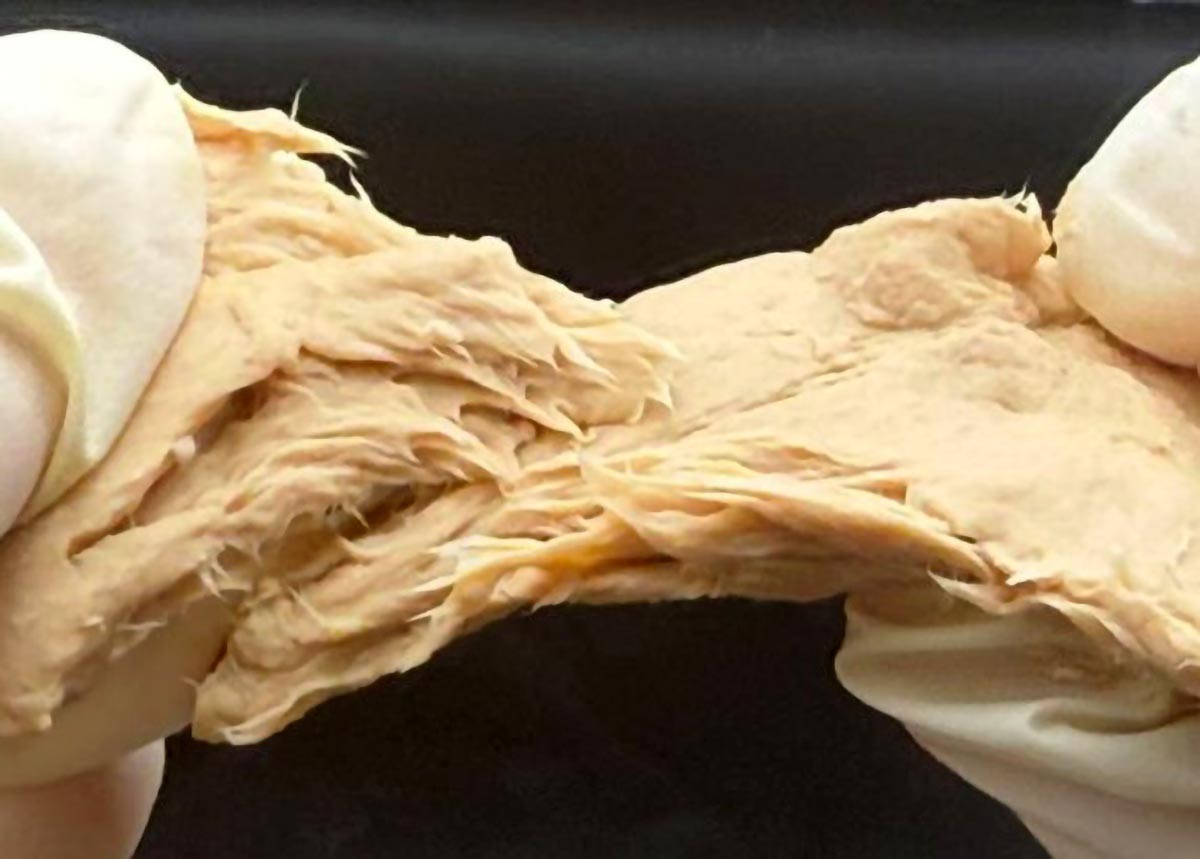
Researchers used CRISPR to enhance a naturally meat-like fungus, boosting its digestibility and production efficiency.
The modified strain grows faster, uses far fewer resources, and lowers greenhouse gas emissions by up to 60%. It also dramatically outperforms chicken farming in land and water use. The findings highlight a promising path for eco-friendly protein.
CRISPR Boosts Sustainable Protein Production
A study released today (November 19) in the journal Trends in Biotechnology describes how scientists used the gene-editing tool CRISPR to improve a fungus’s ability to produce protein while lowering the environmental impact of its production by up to 61%—and they achieved this without inserting any foreign DNA. The modified fungus has a meatlike flavor and is easier for people to digest than the wild form.
“There is a popular demand for better and more sustainable protein for food,” says corresponding author Xiao Liu of Jiangnan University in Wuxi, China. “We successfully made a fungus not only more nutritious but also more environmentally friendly by tweaking its genes.”
Animal agriculture contributes roughly 14% of global greenhouse gas emissions. It also requires large areas of land and significant amounts of fresh water, which are already under pressure from climate change and human activity. Because of these drawbacks, microbial proteins found in organisms such as yeast and fungi are gaining attention as a more sustainable alternative to traditional meat.
Why Fungi Are Key to Cutting Food Emissions
Among the different mycoprotein sources that researchers have examined, the fungus Fusarium venenatum has become a leading candidate because its natural taste and fibrous structure resemble meat. It is already approved for consumption in several countries, including the United Kingdom, China, and the United States.
Despite these benefits, Fusarium venenatum has thick cell walls that limit the extent to which humans can digest its nutrients. Producing it also requires considerable resources. The spores must be grown in large metal tanks filled with a mixture of sugar and nutrients such as ammonium sulfate.
Liu and his colleagues wanted to determine whether CRISPR could improve both digestibility and production efficiency in Fusarium venenatum without introducing foreign DNA into its genome.
Gene Tweaks That Transform Fusarium venenatum
To test this idea, the researchers deleted two genes linked to the enzymes chitin synthase and pyruvate decarboxylase. Removing the chitin synthase gene reduced the thickness of the cell wall, making more of the protein inside the fungus accessible for digestion. Eliminating the pyruvate decarboxylase gene adjusted the organism’s metabolic pathways so that it could create protein using fewer nutrients.
Their analyses showed that the resulting strain, named FCPD, used 44% less sugar to generate the same amount of protein as the unmodified strain and did so 88% more quickly.
“A lot of people thought growing mycoprotein was more sustainable, but no one had really considered how to reduce the environmental impact of the entire production process, especially when compared to other alternative protein products” says first author, Xiaohui Wu of Jiangnan University.
Reducing the Full Life-Cycle Environmental Impact
The researchers then calculated the environmental footprint of FCPD, from spores in the laboratory to inactivated meat-like products, at an industrial scale. They simulated FCPD production in six countries with different energy structures—including Finland, which uses mostly renewable energy, and China, which relies more heavily on coal—and found that FCPD had a lower environmental impact than traditional Fusarium venenatum production did, regardless of location. Overall, FCPD production resulted in up to 60% less greenhouse gas emissions for the entirety of its life cycle.
Comparing Fungal Protein to Animal Agriculture
The team also investigated the impact of FCPD production compared to the resources required to produce animal protein. When compared to chicken production in China, they found that myoprotein from FCPD requires 70% less land and reduces the risk of freshwater pollution by 78%.
“Gene-edited foods like this can meet growing food demands without the environmental costs of conventional farming,” says Liu.
Reference: “Dual enhancement of mycoprotein nutrition and sustainability via CRISPR-mediated metabolic engineering of Fusarium venenatum” by Xiaohui Wu, Mengru Wang, Shijun Luo, Zhitong Zhou, Yanan Wang, Guocheng Du, Jian Chen and Xiao Liu, 19 November 2025, Trends in Biotechnology.
DOI: 10.1016/j.tibtech.2025.09.016
This work was supported by the Key Research and Development Program of China, the Jiangsu Basic Research Center for Synthetic Biology, the Natural Science Foundation of Jiangsu Province, and the Postgraduate Research & Practice Innovation Program of Jiangsu Province.
Never miss a breakthrough: Join the SciTechDaily newsletter.
Follow us on Google and Google News.
11 Comments
I don’t know what sane person cares about the imagined climate impact of the food supply, but if this is tasty, then I’m all for it.
Most time structure study for good natural food development and exiting etc
hmm
Mmmmmmm – Soylent Green
Yep, won’t be spending a dime on fake fungus meat.
Who cares if it is unhealthy and probably will contribute to an early death. As long as it reduces greenhouse gasses. GMO is garage, I say more like OMG, no wonder why life expectancy is shrinking. Between the glp1 and every other drug big pharma pushes and the fake food that isnt even close to being as healthy as the real food, most people are not living as long and have lots of health complications. Eating a fungus for protein instead of meat is absurd. Cows and real meat is not the problem. This kind of garbage being promoted as sustainability is not helping the environment or the people that eat it. Don’t listen to the politicians in the polluted cities claim that the farmers are responsible for pollution. Its obvious where the polution comes from. Everything is green in the country and the air is fresh. Unlike the cities with smog and garbage everywhere.
I agree with you. Beans and lentils have been around for millennia, have been shown to use far fewer resources than animals(ie they have less environmental impact) and have major health benefits. I am certainly not vegan and I have been leery of any genetically modified foods. A balanced mix of natural protein sources is what I propose.
There is much lower-hanging fruit than the elimination of animal agriculture to meet greenhouse gas imperatives but your grasp on reality is very much degraded if you believe the climate impact of livestock proliferation to be imaginary.
Never mind the suffering, huh?
“a mixture of sugar and nutrients such as ammonium sulfate”.
Just wondering about the CO2 footprint of growing sugar cane and harvesting it, as well as burning of the stubble; plus of course that of manufacturing ammonium sulphate; any KNOWLEDGEABLE answers out there?
Most time structure study for good natural food development and exiting etc