
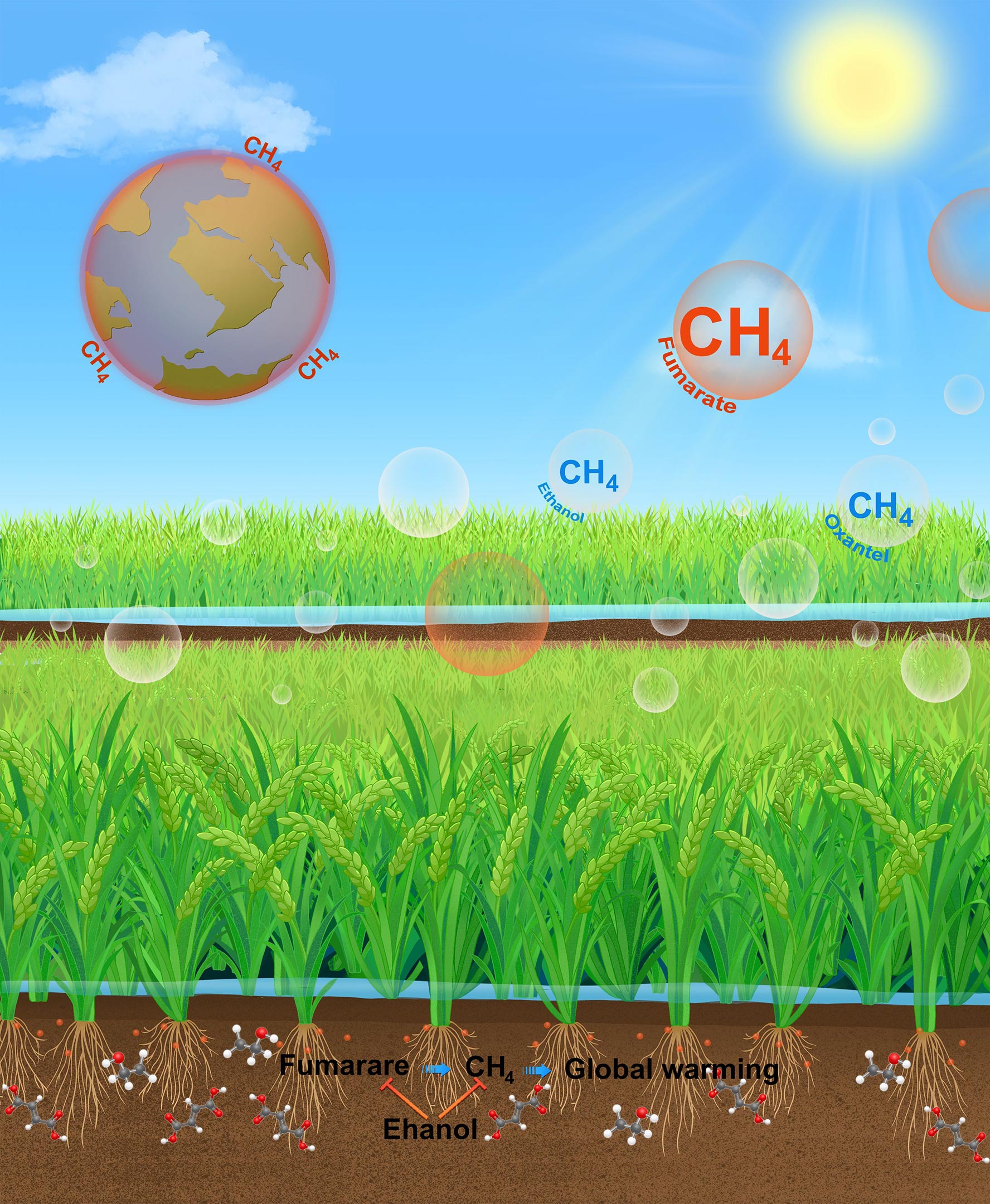
Scientists have developed a new rice strain that emits 70% less methane, addressing a major source of greenhouse gas emissions.
By identifying key compounds in rice root exudates, they bred a non-GMO, high-yield variety with a lower environmental impact. Field tests in China confirmed its effectiveness, and researchers are now working on getting it to market.
The Role of Rice in Methane Emissions
Rice farming contributes about 12% of global methane emissions, a figure expected to rise due to climate change and population growth. Scientists have now identified specific chemical compounds released by rice roots that influence methane production. Their findings, published today (February 3) in Molecular Plant, allowed them to develop a new rice strain that emits up to 70% less methane.
“This study shows that you can have low methane and still have a rice with high yields,” says senior author Anna Schnürer, a microbiologist at the Swedish University of Agricultural Sciences. “And you can do it using traditional breeding methods, without GMO, if you know what you’re looking for.”
Methane emitted from rice paddies is generated by microbes that break down organic compounds released by rice roots. These compounds, called root exudates, help feed soil microbes, which in turn release nutrients that support plant growth. While scientists have long known that root exudates and soil microbes play a role in methane emissions, the specific compounds responsible remained unclear — until now.
Investigating the Key Chemical Compounds
To identify which root exudate compounds are converted into methane, the researchers compared root exudates from two different rice varieties — SUSIBA2, a low-methane emitting GMO variety, and Nipponbare, a non-GMO cultivar with average methane emissions. They found that SUSIBA2 roots produced significantly less fumarate and noted a correlation between the amount of fumarate secreted and the abundance of methane-releasing archaea or “methanogens” in the surrounding soil.
To confirm fumarate’s role, the researchers added fumarate to the soil of rice plants grown in containers, which resulted in increased methane emissions. They also demonstrated that applying oxantel, a chemical that inhibits the enzymatic breakdown of fumarate, effectively reduced methane emissions. However, since the SUSIBA2 plants still produced less methane than the Nipponbare plants, the researchers realized that fumarate isn’t the only piece to the puzzle.
Unlocking the Mystery of Methane Reduction
“It was almost like having a riddle,” says Schnürer. “We noticed that the soil itself contained something that reduced methane emissions, so we started thinking that there must be an inhibitor of some kind that is also causing the difference between the varieties.”
When they re-analyzed the root exudates, the team noticed that SUSIBA2 plants also release significantly more ethanol. Adding ethanol to the soil surrounding rice plants reduced methane emissions.
Next, the team investigated whether they could use traditional breeding methods to produce low methane-emitting rice with high yield. To do this, they crossbred a high-yield or “elite” rice variety with a previously identified low-methane-emitting variety (the Heijing cultivar) whose root exudate was low in fumarate and high in ethanol.
The rice plants from this crossbreeding consistently released root exudates with low fumarate and high ethanol (LFHE) profiles. When the researchers grew these LFHE rice varieties at various field sites throughout China, they showed that the LFHE rice produced 70% less methane on average compared with the elite variety from which it was bred. The LFHE crops also produced relatively high yields — 8.96 tons/hectare on average, compared to the 2024 global average of 4.71 tons/hectare.
Scaling Up the Solution
The researchers also investigated whether ethanol and oxantel could be used to reduce methane emissions at a large scale. Based on a two-year field trial at two different sites in China, this treatment resulted in approximately 60% reduction in methane emissions without impacting crop yield.
Now, the researchers are working to register the LFHE rice as a variety with the Chinese government and others, meaning that it could be marketed to farmers in the future. They’re also working with fertilizer companies to investigate whether oxantel could be added to commercial fertilizers.
“To make these things happen, we’ll also need some encouragement from governments to motivate and support farmers to use these low-methane varieties,” says Schnürer. “It’s one thing to breed eco-friendly rice varieties, but then it’s critical to get them on the market and to get the farmers to accept them.”
Reference: “Reducing methane emissions by developing low-fumarate high-ethanol eco-friendly rice” by Yunkai Jin, Tong Liu, Jia Hu, Kai Sun, Lihong Xue, Mathilde Bettembourg, Girma Bedada, Pengfu Hou, Peiying Hao, Jintian Tang, Zihong Ye, Chunlin Liu, Peng Li, Aihu Pan, Lushui Weng, Guoying Xiao, Ali A. Moazzami, Xiaoping Yu, Jun Wu, Anna Schnürer and Chuanxin Sun, 3 February 2025, Molecular Plant.
DOI: 10.1016/j.molp.2025.01.008
This research was supported by Mr. Zheng Fang, Beijing Xianhe Transportation Technology Co. Ltd., Trees and Crops for the Future, the Swedish Research Council for Environment, Agricultural Sciences and Spatial Planning, NSFC Projects of International Cooperation and Exchanges, and the China Scholarship Council.
Never miss a breakthrough: Join the SciTechDaily newsletter.
Follow us on Google and Google News.
3 Comments
thank you for this
Good news, win-win solution: high rice yield, low methane emission
All the better if the variety increases yield. However, the concern about methane is seriously overblown:
https://wattsupwiththat.com/2023/03/06/the-misguided-crusade-to-reduce-anthropogenic-methane-emissions/