
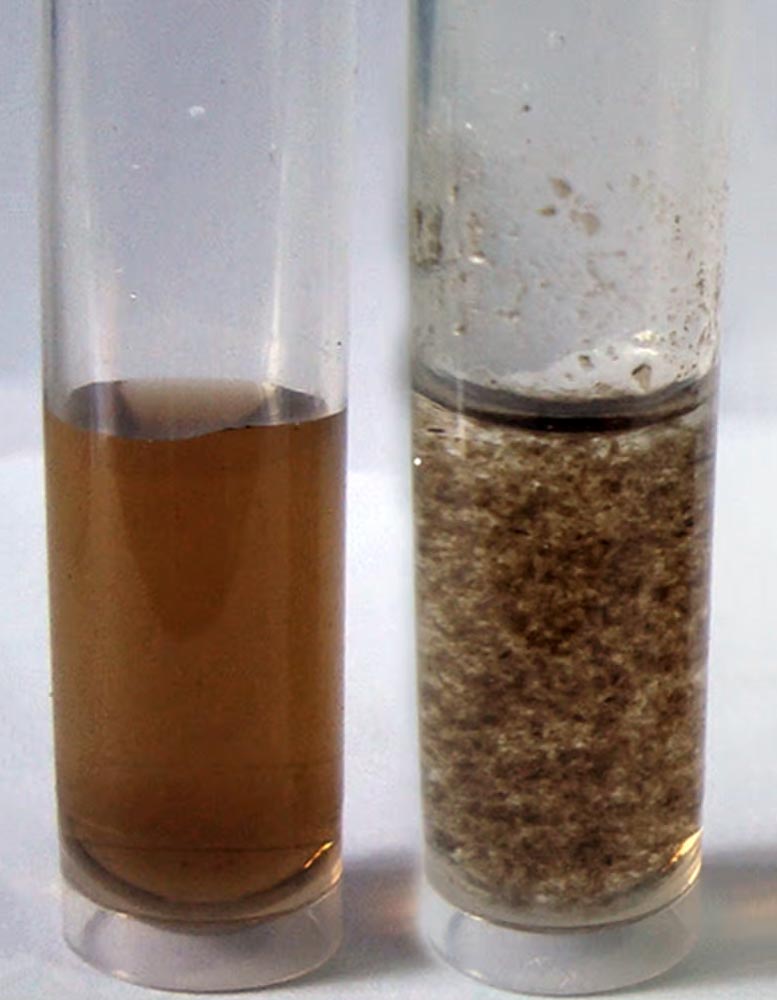
A newly published study has shown that graphene oxide can rapidly remove some of the most toxic and radioactive long-lived human-made radionuclides from contaminated water, providing a simple methodology to reduce nuclear waste contamination and help speed up removal.
Graphene oxide has a remarkable ability to quickly remove radioactive material from contaminated water, researchers at Rice University and Lomonosov Moscow State University have found.
A collaborative effort by the Rice lab of chemist James Tour and the Moscow lab of chemist Stepan Kalmykov determined that microscopic, atom-thick flakes of graphene oxide bind quickly to natural and human-made radionuclides and condense them into solids. The flakes are soluble in liquids and easily produced in bulk.
The experimental results were reported in the Royal Society of Chemistry journal Physical Chemistry Chemical Physics.
The discovery, Tour said, could be a boon in the cleanup of contaminated sites like the Fukushima nuclear plants damaged by the 2011 earthquake and tsunami. It could also cut the cost of hydraulic fracturing (“fracking”) for oil and gas recovery and help reboot American mining of rare earth metals, he said.
Graphene oxide’s large surface area defines its capacity to adsorb toxins, Kalmykov said. “So the high retention properties are not surprising to us,” he said. “What is astonishing is the very fast kinetics of sorption, which is key.”
“In the probabilistic world of chemical reactions where scarce stuff (low concentrations) infrequently bumps into something with which it can react, there is a greater likelihood that the ‘magic’ will happen with graphene oxide than with a big old hunk of bentonite,” said Steven Winston, a former vice president of Lockheed Martin and Parsons Engineering and an expert in nuclear power and remediation who is working with the researchers. “In short, fast is good.”
Determining how fast was the object of experiments by the Kalmykov group. The lab tested graphene oxide synthesized at Rice with simulated nuclear wastes containing uranium, plutonium and substances like sodium and calcium that could negatively affect their adsorption. Even so, graphene oxide proved far better than the bentonite clays and granulated activated carbon commonly used in nuclear cleanup.
Graphene oxide introduced to simulated wastes coagulated within minutes, quickly clumping the worst toxins, Kalmykov said. The process worked across a range of pH values.
“To see Stepan’s amazement at how well this worked was a good confirmation,” Tour said. He noted that the collaboration took root when Alexander Slesarev, a graduate student in his group, and Anna Yu. Romanchuk, a graduate student in Kalmykov’s group, met at a conference several years ago.
The researchers focused on removing radioactive isotopes of the actinides and lanthanides – the 30 rare earth elements in the periodic table – from liquids, rather than solids or gases. “Though they don’t really like water all that much, they can and do hide out there,” Winston said. “From a human health and environment point of view, that’s where they’re least welcome.”
Naturally occurring radionuclides are also unwelcome in fracking fluids that bring them to the surface in drilling operations, Tour said. “When groundwater comes out of a well and it’s radioactive above a certain level, they can’t put it back into the ground,” he said. “It’s too hot. Companies have to ship contaminated water to repository sites around the country at very large expense.” The ability to quickly filter out contaminants on-site would save a great deal of money, he said.
He sees even greater potential benefits for the mining industry. Environmental requirements have “essentially shut down U.S. mining of rare earth metals, which are needed for cell phones,” Tour said. “China owns the market because they’re not subject to the same environmental standards. So if this technology offers the chance to revive mining here, it could be huge.”
Tour said that capturing radionuclides does not make them less radioactive, just easier to handle. “Where you have huge pools of radioactive material, like at Fukushima, you add graphene oxide and get back a solid material from what were just ions in a solution,” he said. “Then you can skim it off and burn it. Graphene oxide burns very rapidly and leaves a cake of radioactive material you can then reuse.”
The low cost and biodegradable qualities of graphene oxide should make it appropriate for use in permeable reactive barriers, a fairly new technology for in situ groundwater remediation, he said.
Reference: “Graphene oxide for effective radionuclide removal” by Anna Yu. Romanchuk, Alexander S. Slesarev, Stepan N. Kalmykov, Dmitry V. Kosynkin and James M. Tour, 20 December 2012, Physical Chemistry Chemical Physics.
DOI: 10.1039/C2CP44593J
Romanchuk, Slesarev, Kalmykov and Tour are co-authors of the paper with Dmitry Kosynkin, a former postdoctoral researcher at Rice, now with Saudi Aramco. Kalmykov is radiochemistry division head and a professor at Lomonosov Moscow State University. Tour is the T.T. and W.F. Chao Chair in Chemistry as well as a professor of mechanical engineering and materials science and of computer science at Rice.
The Office of Naval Research Multidisciplinary University Research Initiative, M-I SWACO and the Air Force Office of Scientific Research funded work at Rice. The Ministry of Education and Science of the Russian Federation, a Russian Federation President stipend to Romanchuk and the Russian Basic Research Foundation funded research at Moscow State.
Never miss a breakthrough: Join the SciTechDaily newsletter.
Follow us on Google and Google News.
1 Comment
Here’s another solution to pollution…. Clean Coal Power Plants or Gasoline or it could be added to your absorbent graphene or other nano absorbents then burned – its an additive invented in Sweden. And I found it on a Bill Gates energy discussion Blog. Also, it could be added into the coal to deisel fuel conversion process plant being built in West Virginia and elsewhere to resolve pollution – its our clean coal pollution solution…..Personally, I’d like to see the US Navy and Army Corps of Engineers start adding this to military fuels to include jet fuels and dirty burning deisels and also incorporate BUTANOL and hydrogen on demand systems.