
Close Menu
    Facebook X (Twitter) Instagram
    SciTechDaily
    • Biology
    • Chemistry
    • Earth
    • Health
    • Physics
    • Science
    • Space
    • Technology
    Facebook X (Twitter) Pinterest YouTube RSS
    SciTechDaily
    Home»Earth»Greenland – Exploring the World’s Largest Island From Space
    Earth

    Greenland – Exploring the World’s Largest Island From Space

    By European Space Agency (ESA)May 29, 2020No Comments3 Mins Read
    Facebook Twitter Pinterest Telegram LinkedIn WhatsApp Email Reddit
    Share
    Facebook Twitter LinkedIn Pinterest Telegram Email Reddit
    Northwest Greenland From Space
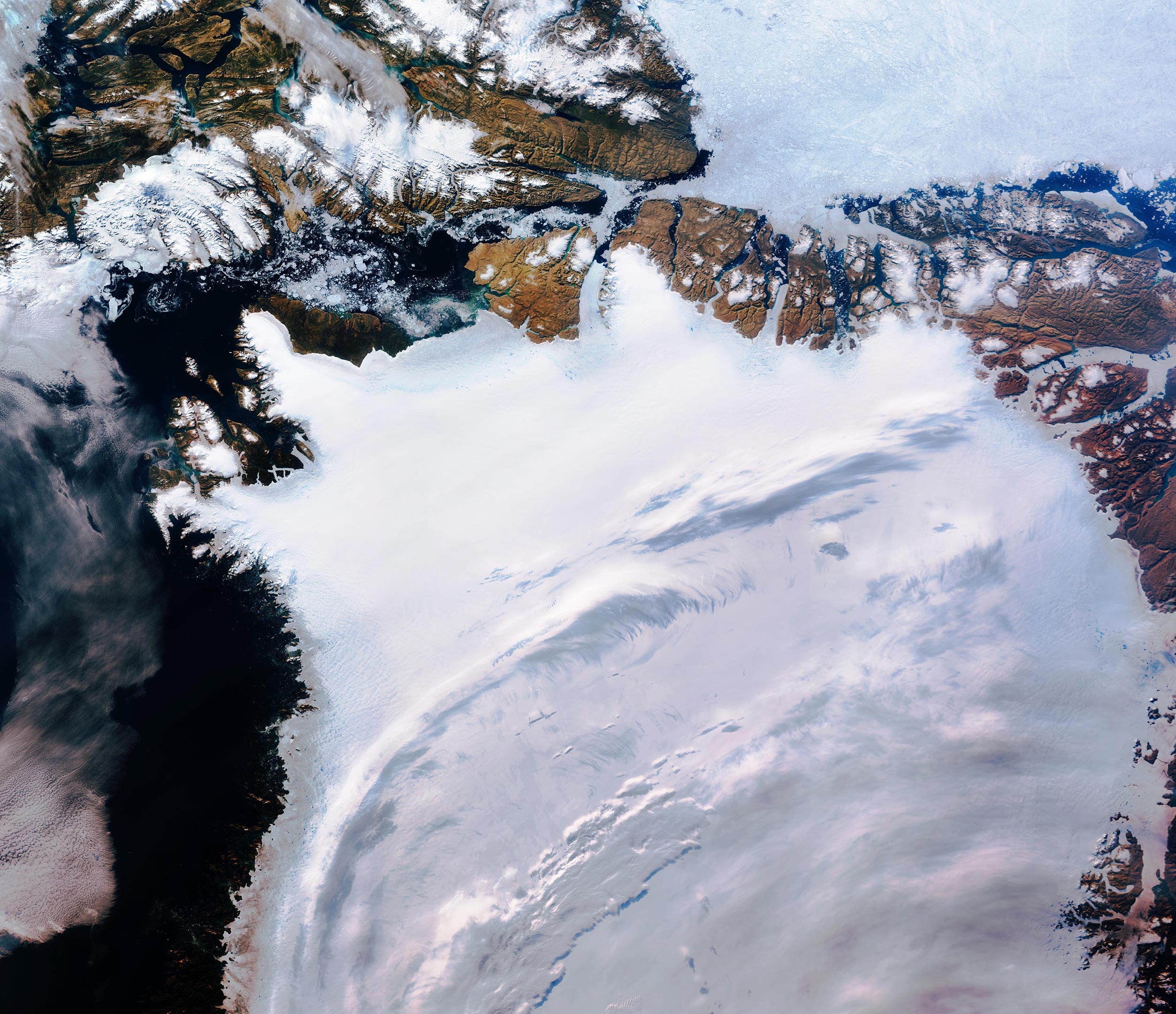
    Northwest Greenland is featured in this icy image captured by the Copernicus Sentinel-3 mission. Sea ice and icebergs can be seen in the Nares Strait – the waterway between Greenland and Canada’s Ellesmere Island, visible top left in the image. Credit: Contains modified Copernicus Sentinel data (2019), processed by ESA, CC BY-SA 3.0 IGO

    Northwest Greenland is featured in this icy image captured by the Copernicus Sentinel-3 mission.

    Lying in the North Atlantic Ocean, Greenland is the world’s largest island and is home to the second largest ice sheet after Antarctica. Greenland’s ice sheet covers more than 1.7 million sq km (670,000 sq mi) and covers most of the island.

    Ice sheets form in areas where snow that falls in winter does not melt entirely over the summer. Over thousands of years, layers of snow pile up into thick masses of ice, growing thicker and denser as the new snow and ice layers compress the older layers.

    Ice sheets are constantly in motion. Near the coast, most of the ice moves through relatively fast-moving outlets called ice streams, glaciers, and ice shelves.

    In the top center of this image, captured on July 29, 2019, the Petermann glacier is visible. Petermann is one of the largest glaciers connecting the Greenland ice sheet with the Arctic Ocean. Upon reaching the sea, a number of these large outlet glaciers extend into the water with a floating ‘ice tongue.’ Icebergs occasionally break or ‘calve’ off these tongues.

    In this image, sea ice and icebergs can be seen in the Nares Strait – the waterway between Greenland and Canada’s Ellesmere Island, visible top left in the image.

    On the tip of Ellesmere Island lies Alert – the northernmost known settlement in the world. Inhabited mainly by military and scientific personnel on rotation, Alert is about 800 km(500 mi) from the closest community, which is roughly the same distance from Alert to the North Pole.

    Scientists have used data from Earth-observing satellites to monitor Greenland’s ice sheet. According to a recent study, both Greenland and Antarctica are losing mass six times faster than they were in the 1990s. Between 1992 and 2017, Greenland lost 3.8 trillion tonnes of ice – corresponding to around 10 mm contribution to global sea-level rise.

    Melting ice sheets caused by rising temperatures and the subsequent rising of sea levels is a devastating consequence of climate change, especially for low-lying coastal areas. The continued satellite observations of the Greenland ice sheet are critical in understanding whether ice mass loss will continue to accelerate and the full implications of this anticipated change.

    Never miss a breakthrough: Join the SciTechDaily newsletter.
    Follow us on Google and Google News.

    European Space Agency Geography Greenland
    Share. Facebook Twitter Pinterest LinkedIn Email Reddit

    Related Articles

    Greenland’s Ice Giants Captured in Breathtaking Satellite Images

    Exploring Earth From Space: Liverpool Land, Greenland

    Exploring Earth From Space: The Stunningly Beautiful Kangerlussuaq Glacier

    Deforestation in Bolivia Spied From Space Satellite

    Earth From Space: Japanese Archipelago [Video]

    Earth From Space: Faroe Islands [Video]

    Earth From Space: Tromsø, Norway [Video]

    Jakobshavn Glacier Sheds a Massive Chunk of Ice

    Scientists Discover Mega-Canyon under Greenland Ice Sheet

    Leave A Reply Cancel Reply

    • Facebook
    • Twitter
    • Pinterest
    • YouTube

    Don't Miss a Discovery

    Subscribe for the Latest in Science & Tech!

    Trending News

    Artificial Sweeteners May Harm Future Generations, Study Suggests

    Splashdown! NASA Artemis II Returns From Record-Breaking Moon Mission

    What If Consciousness Exists Beyond Your Brain

    Scientists Finally Crack the 100-Million-Year Evolutionary Mystery of Squid and Cuttlefish

    Beyond “Safe Levels”: Study Challenges What We Know About Pesticides and Cancer

    Researchers Have Found a Dietary Compound That Increases Longevity

    Scientists Baffled by Bizarre “Living Fossil” From 275 Million Years Ago

    Your IQ at 23 Could Predict Your Wealth at 27, Study Finds

    Follow SciTechDaily
    • Facebook
    • Twitter
    • YouTube
    • Pinterest
    • Newsletter
    • RSS
    SciTech News
    • Biology News
    • Chemistry News
    • Earth News
    • Health News
    • Physics News
    • Science News
    • Space News
    • Technology News
    Recent Posts
    • What if Dark Matter Has Two Forms? Bold New Hypothesis Could Explain a Cosmic Mystery
    • Researchers Expose Hidden Chemistry of “Ore-Forming” Elements in Biology
    • Geologists Reveal the Americas Collided Earlier Than We Thought
    • 20x Difference: Study Reveals True Source of Airborne Microplastics
    • Scientists Uncover Hidden Force Powering Yellowstone’s Supervolcano
    Copyright © 1998 - 2026 SciTechDaily. All Rights Reserved.
    • Science News
    • About
    • Contact
    • Editorial Board
    • Privacy Policy
    • Terms of Use

    Type above and press Enter to search. Press Esc to cancel.