
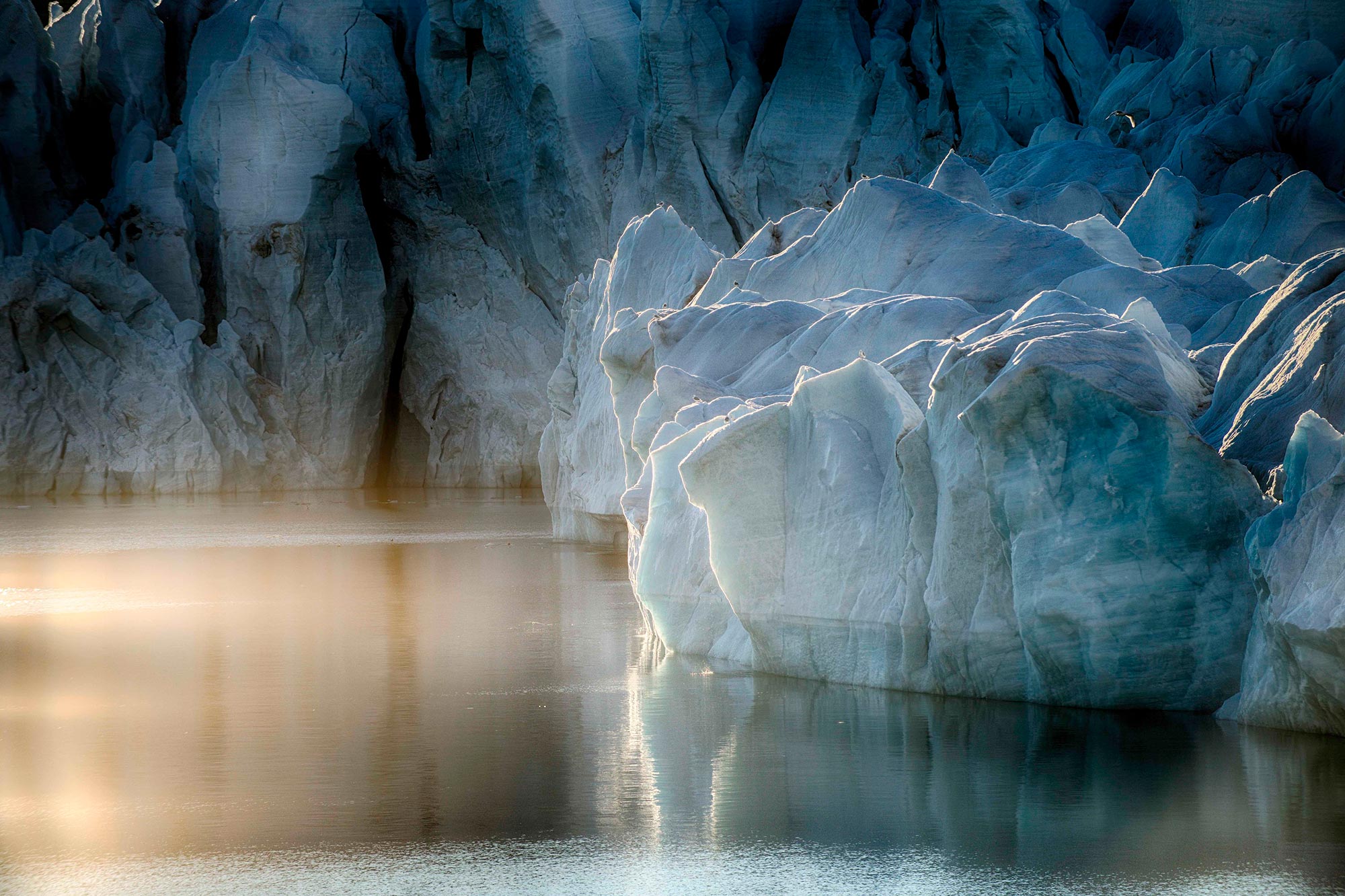
Climate scientists and engineers are urgently advocating for immediate measures to combat global warming and safeguard vulnerable regions.
The melting of Greenland’s ice is accelerating, with projections indicating a loss of 964 to 1,735 gigatonnes of ice annually by 2100 under a high greenhouse gas emissions scenario (SSP585), based on three regional climate models. This significant ice loss could result in a sea level rise of up to one meter, putting millions of people in coastal regions at risk. New research led by the University of Liège, utilizing its NIC5 supercomputer, will play a crucial role in informing future IPCC assessments.
Greenland’s glaciers are melting at an alarming rate. Two recent studies, one coordinated by the University of Liège and published in Geophysical Research Letters, the other published in a scientific press release, reveal the scale of the problem. Three regional climate models (RACMO, MAR and HIRHAM) offer varying predictions for the melting of the ice, but all agree on one conclusion: Greenland will lose a massive amount of ice by 2100, accelerating the rise in sea levels.

According to the projections, the ice sheet could lose between 964 and 1735 gigatonnes of ice per year by the end of the century, depending on the model used,” explains Quentin Glaude, an engineer at the Montefiore Insitute at ULiège. These differences, although significant, do not hide the essential fact: the melting of the ice is an irreversible process if greenhouse gas emissions are not drastically reduced.”
The research team pointed out that these differences stem from the way in which each model treats the flow of meltwater. For example, when snow melts, some of the water infiltrates and refreezes, while the rest flows directly into the ocean. This complex process, influenced by feedback linked to albedo (surface reflectivity), is a key factor in the discrepancies between the models.

“Greenland currently contributes 25% to global sea level rise, or 0.6 mm per year. If the current melting continues, this contribution could reach up to 1 meter by 2100,” adds Xavier Fettweis, a climatologist at ULiège. This would put millions of lives at risk in coastal areas around the world, exposed to increased risks of flooding and submersion.”
The research results that have just been published were made possible by the Walloon region’s high-performance computing infrastructure, in particular the NIC5 supercomputer at the University of Liège. These tools make it possible to explore complex climate scenarios by simulating the interactions between ice, the atmosphere and the oceans.
Towards even more accurate models
Despite their advances, the researchers insist on the need to improve the climate models. A better understanding of the processes involved in retaining water in the snow and the integration of dynamic parameters, such as changes in the altitude of the ice sheet, are essential to reduce uncertainties.
This work, the fruit of collaboration between European institutions, illustrates the importance of cooperation in the face of global climate challenges. The results obtained will be incorporated into future IPCC assessments, helping to refine projections of sea-level rise.
The melting of the Greenland ice sheet is a wake-up call that cannot be ignored. It calls for immediate action to limit global warming, protect vulnerable communities, and preserve the world’s ecosystems.
Reference: “A Factor Two Difference in 21st-Century Greenland Ice Sheet Surface Mass Balance Projections From Three Regional Climate Models Under a Strong Warming Scenario (SSP5-8.5)” by Q. Glaude, B. Noel, M. Olesen, M. Van den Broeke, W. J. van de Berg, R. Mottram, N. Hansen, A. Delhasse, C. Amory, C. Kittel, H. Goelzer and X. Fettweis, 21 November 2024, Geophysical Research Letters.
DOI: 10.1029/2024GL111902
Never miss a breakthrough: Join the SciTechDaily newsletter.
Follow us on Google and Google News.
3 Comments
It looks like the University of Liège didn’t get the memo:
https://judithcurry.com/2019/03/28/whats-the-worst-case-emissions-concentration-scenarios/
“…, a categorization of RCP8.5 as ‘borderline impossible’ is justified based on our current background knowledge.”
Three feet in 75 years? Not even the Netherlands has to worry about that. Why should we?
0.6 mm per year, times 76 years to 2100=45.6mm. or just about 2 inches plus/minus a few 1/16ths of an inch. Odd how sea-water overtopping a dyke by a couple of inches during a depression, heavy rainfall and a king tide could result in someone getting wet feet. It’s happened.