
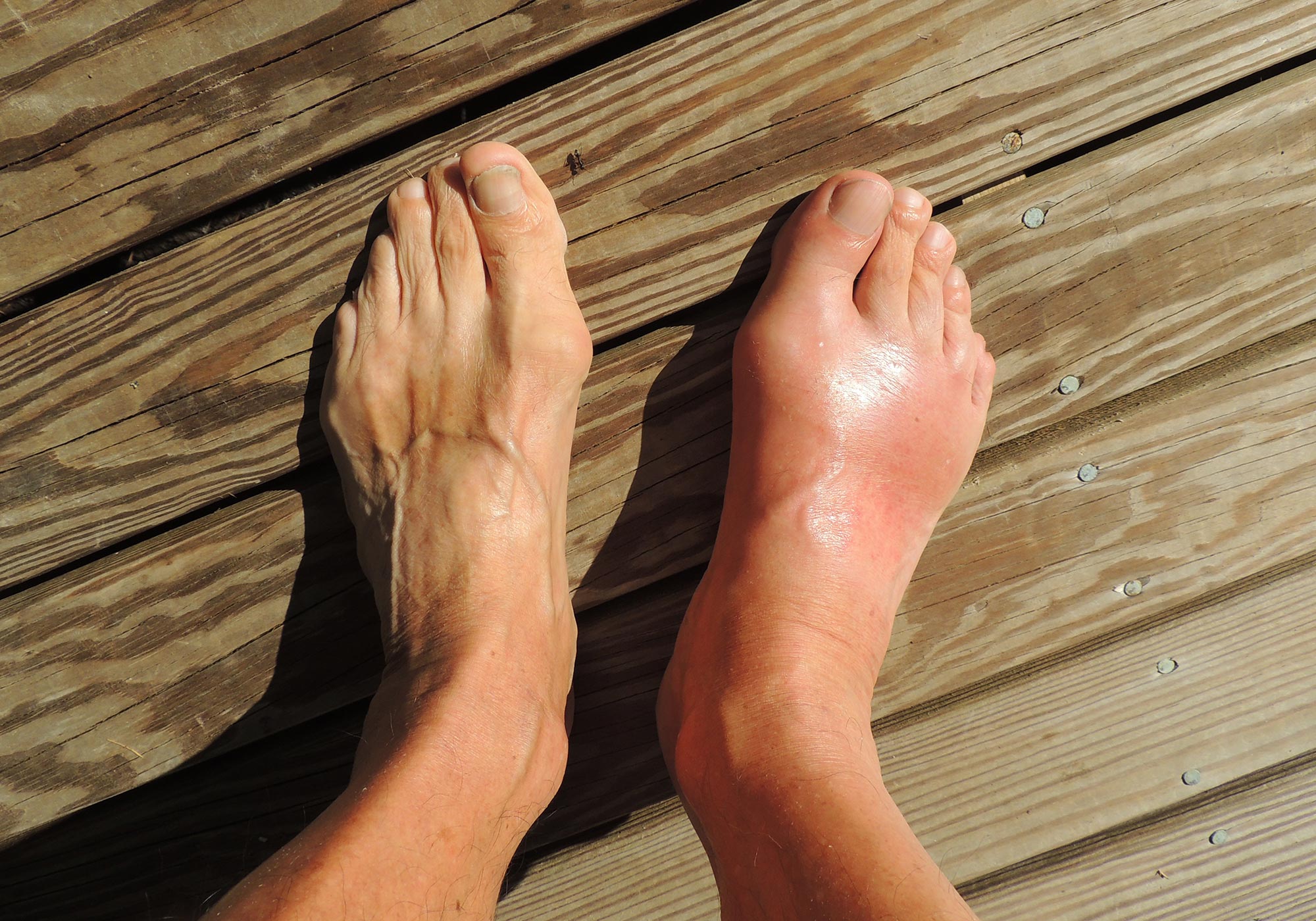
New research has found that genetics, not lifestyle, is the primary cause of gout. The study identified key genes and immune pathways, opening the door to improved treatments and challenging the stigma that links gout to poor lifestyle choices.
A major international study has revealed that gout is primarily a chronic illness driven by genetic factors, rather than the result of lifestyle choices made by those affected.
Conducted by researchers from the University of Otago, the genome-wide association study, published in Nature Genetics, examined the genetic data of 2.6 million individuals.
Researchers analyzed amalgamated DNA data sets from around the world. About three-quarters of the data was from customers of 23andMe, Inc, a direct-to-consumer genetics and preventative health company, who consented to participate in research.
They found that inherited genetics is an important part of why some people get gout and most others don’t.
Reducing the Stigma Around Gout
Senior author Professor Tony Merriman, of Otago’s Department of Microbiology and Immunology, hopes the findings will remove some of the stigma around gout.
“Gout is a chronic disease with a genetic basis and is not the fault of the sufferer – the myth that gout is caused by lifestyle or diet needs to be busted. This widespread myth causes shame in people with gout, making some people more likely to suffer in silence and not go and see the doctor to get a preventive drug that lowers urate in the blood and will prevent their pain.”
He continues, “People need to understand that while specific dietary factors, such as eating red meat, can trigger gout attacks, the fundamental cause is high urate levels, crystals in the joints, and an immune system primed to ‘attack’ the crystals – genetics plays an important role in all of these processes.”
The research identified a large number of immune genes and immune pathways that provide new targets and approaches for preventing gout attacks.
Genetics and Gout Mechanisms
Professor Merriman hopes these findings will lead to improved treatment for gout sufferers.
“We hope that, in time, better and more accessible treatments will become available with the new targets we identified,” he says.
One such option could be the repurposing of a drug used to treat a range of other immune-related diseases, including rheumatoid arthritis – tocilizumab targets a receptor for an immune signaller, interleukin-6, which the research identified as a new gene for gout.
“Gout deserves more health spend resources and greater prioritization in the health system.”
Reference: “A genome-wide association analysis reveals new pathogenic pathways in gout” by Tanya J. Major, Riku Takei, Hirotaka Matsuo, Megan P. Leask, Nicholas A. Sumpter, Ruth K. Topless, Yuya Shirai, Wei Wang, Murray J. Cadzow, Amanda J. Phipps-Green, Zhiqiang Li, Aichang Ji, Marilyn E. Merriman, Emily Morice, Eric E. Kelley, Wen-Hua Wei, Sally P. A. McCormick, Matthew J. Bixley, Richard J. Reynolds, Kenneth G. Saag, Tayaza Fadason, Evgenia Golovina, Justin M. O’Sullivan, Lisa K. Stamp, Nicola Dalbeth, Abhishek Abhishek, Michael Doherty, Edward Roddy, Lennart T. H. Jacobsson, Meliha C. Kapetanovic, Olle Melander, Mariano Andrés, Fernando Pérez-Ruiz, Rosa J. Torres, Timothy Radstake, Timothy L. Jansen, Matthijs Janssen, Leo A. B. Joosten, Ruiqi Liu, Orsolya I. Gaal, Tania O. Crişan, Simona Rednic, Fina Kurreeman, Tom W. J. Huizinga, René Toes, Frédéric Lioté, Pascal Richette, Thomas Bardin, Hang Korng Ea, Tristan Pascart, Geraldine M. McCarthy, Laura Helbert, Blanka Stibůrková, Anne-K. Tausche, Till Uhlig, Véronique Vitart, Thibaud S. Boutin, Caroline Hayward, Philip L. Riches, Stuart H. Ralston, Archie Campbell, Thomas M. MacDonald, FAST Study Group, Akiyoshi Nakayama, Tappei Takada, Masahiro Nakatochi, Seiko Shimizu, Yusuke Kawamura, Yu Toyoda, Hirofumi Nakaoka, Ken Yamamoto, Keitaro Matsuo, Nariyoshi Shinomiya, Kimiyoshi Ichida, Japan Gout Genomics Consortium, Chaeyoung Lee, Asia Pacific Gout Consortium, Linda A. Bradbury, Matthew A. Brown, Philip C. Robinson, Russell R. C. Buchanan, Catherine L. Hill, Susan Lester, Malcolm D. Smith, Maureen Rischmueller, Hyon K. Choi, Eli A. Stahl, Jeff N. Miner, Daniel H. Solomon, Jing Cui, Kathleen M. Giacomini, Deanna J. Brackman, Eric M. Jorgenson, GlobalGout Genetics Consortium, Hongbo Liu, Katalin Susztak, 23andMe Research Team, Suyash Shringarpure, Alexander So, Yukinori Okada, Changgui Li, Yongyong Shi and Tony R. Merriman, 15 October 2024, Nature Genetics.
DOI: 10.1038/s41588-024-01921-5
Never miss a breakthrough: Join the SciTechDaily newsletter.
Follow us on Google and Google News.
4 Comments
Sorry, Not buying it. Genetics likely is a predisposition but lifestyle can not be ruled out. In this day and age with ubiquitous obesity rampant due to trash filled processed food, a study like this only prolongs the agony by enabling those making poor lifestyle choices.
Gout is a chronic disease with a genetic basis and is not the fault of the sufferer…” – agreed! However, as a now eighty year old victim who was first diagnosed with asymptomatic gout (a high serum level of uric acid) in early 1981 and has had a few crippling-painful ’bouts’ since, I know of at least three dietary factors (e.g., nearly subclinical non-IgE-mediated food allergy reactions, added MSG and added propylene glycol [PG], minimally) the study failed to include, rendering the study just another ignorant, incompetent and misleading exercise in pushing legal drugs for profit, and promoting unnecessary new research. More on the ‘About’ page of my ad free video channel (https://odysee.com/@charlesgshaver:d?view=about).
Great comments. Many foods are high in uric acid. Obviously this is significant cause of gout. Bad scientific study
Thanks for the reply, Larry. I’ve heard for decades that foods rich in purine are gout causing. Not necessarily true, it can be due to the breakdown of xanthine oxidase into uric acid and free radicals from even mild inflammation due to very, very mild food allergy reactions. As I sent via regular email to the corresponding author already, it’s not the team’s fault. More details on the ‘About’ page of my video channel if you’re interested. Basically, no cohort studies are reliable due to the same correctable omissions.