
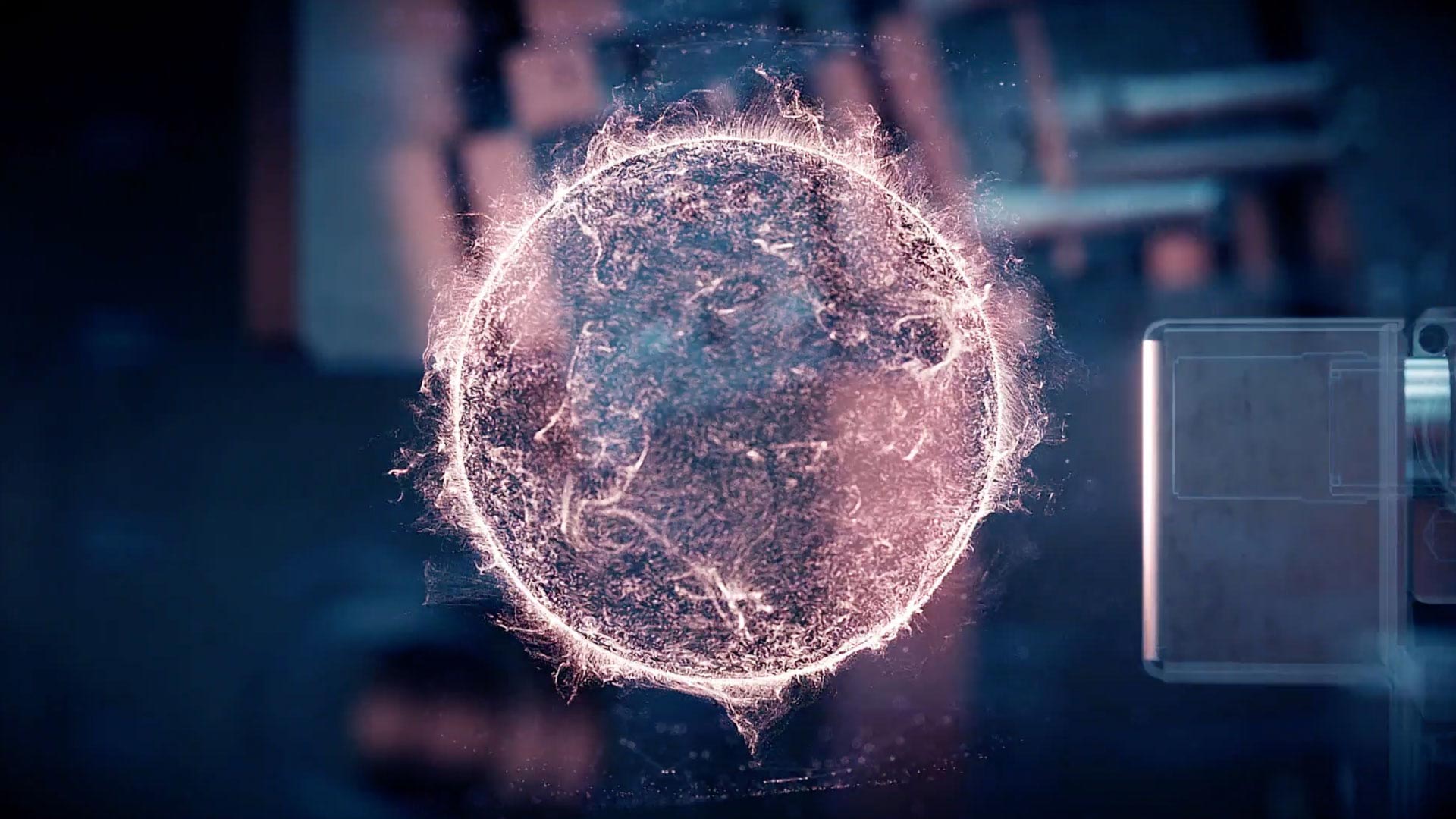
A promising option for creating a productive and sustainable energy source on Earth is the fusion of hydrogen nuclei. The problem? Extremely high pressures and temperatures are required to set the nuclear fusion process off. Technologically, this could be achieved using laser flashes (“laser fusion” or “inertial confinement fusion”). By drafting the “X-ray laser optimization of laser fusion” (Röntgenlaser-Optimierung der Laserfusion, ROLF) project) Dr. Tobias Dornheim from the Center for Advanced Systems Understanding (CASUS) at the Helmholtz-Zentrum Dresden Rossendorf (HZDR) now intends to improve the theoretical understanding of hydrogen compression. Instead of the “trial and error” method, laser fusion experiments could be designed and carried out in a more targeted manner in the future – an essential prerequisite for a commercial fusion power plant. In addition to the EU via the “Just Transition Fund,” the Free State of Saxony also contributes directly to the funding of the project.
The extraordinarily high pressures and temperatures required for fusion processes are achieved by compressing an initially very cold capsule filled with the hydrogen isotopes deuterium and tritium. During the fusion reaction, the hydrogen enters a particular state for a certain time – that of warm dense matter (WDM). This realm, located roughly between condensed matter and hot plasma in terms of pressure and temperature, is Dornheim’s field of expertise. At the end of 2022, the young researcher received a “Starting Grant” from the European Research Council worth almost 1.5 million euros through a competitive procedure. Work on the project is currently underway: Dornheim and his team are developing machine learning methods that should enable a reliable theoretical description of WDM. The structural transition project is now focusing on a more practical challenge.
“One major issue of laser fusion is achieving stable compression with the laser blast,” explains Dornheim, leader of the Young Investigator Group “Frontiers of Computational Quantum Many-Body Theory” at CASUS and responsible for the ROLF project. “It is imperative that the fuel capsule implodes as evenly as possible, i.e., without any instabilities, to ensure that as much fuel as possible is fused and a corresponding amount of usable energy is released. To achieve this, we must first improve our understanding of how WDM behaves.”
Warm dense matter, as can be found, for example, in the cores of planets and stars, is researched experimentally at large-scale research facilities such as the Helmholtz International Beamline for Extreme Fields (HIBEF) at the European XFEL and the National Ignition Facility (NIF) at the Lawrence Livermore National Laboratory in the USA. At these facilities, WDM can be generated for fractions of a second using powerful laser flashes. Dornheim’s team is cooperating with both institutions. An important experimental method for analyzing laser fusion is X-ray Thomson scattering (XRTS), and this is where the new ROLF project comes in.
Making X-ray diagnostics accessible to everyone
For diagnostics using X-ray scattering, an X-ray source is directed at a sample. The energy changes of the photons deflected in the sample are measured and used to draw conclusions about the material’s properties. Until now, the evaluation of the measured data was primarily based on a series of uncontrolled approximations. A year ago, however, the CASUS team demonstrated that precise data evaluation is possible without using any simulations or models with all their approximations and assumptions.
Dornheim and his team are resorting to a fundamental mathematical method, namely the Laplace transform. Within ROLF, the researchers plan to create an open-source software package to make this evaluation method accessible to all laser fusion experts. Additionally, they intend to develop the method further to facilitate applications beyond model-free, high-precision temperature determination using XRTS measurements. In the future, it should also be possible to determine other relevant variables, such as the density or the degree of ionization of WDM.
The team in Görlitz then intends to use the newly designed software to analyze existing XRTS data, for example, from the European XFEL, to develop and experimentally test new measurement methods for X-ray scattering. Once the XRTS diagnostics have a solid foundation, the findings derived from X-ray scattering will be incorporated into laser fusion simulations. “We assume that the parameters derived from these simulations will enable significantly better compression of the capsule and usher in a whole new generation of fusion experiments,” says Dornheim, giving a brief outlook.
HZDR can make a contribution to laser fusion
Recently, the Federal Ministry of Education and Research (BMBF) presented a new funding program for fusion research. The aim is to play a decisive role in the international challenge to achieve the economical operation of a fusion power plant. A recently published BMBF position paper emphasizes the need for “refined diagnostics to validate codes and models.” Prof. Sebastian M. Schmidt, Scientific Director at the HZDR, is extremely pleased about the funding approval for the CASUS project: “With HIBEF, CASUS, and our high-power lasers DRACO and PENELOPE, the HZDR is in an excellent position to make significant contributions to laser fusion research. We can decipher the fundamental processes that pave the way for application.”
The Just Transition Fund (JTF) is a funding instrument of the European Union that primarily benefits regions dependent on hard coal and lignite. A total of 375 million euros is available for the Saxon part of the Lusatian lignite mining region. Although most funding is reserved to support the economy in areas most affected by structural change, academic institutions can also apply for research and development project funding. CASUS was thus able to secure 100% funding of more than 700,000 euros for ROLF via the “Research InfraProNet 2021 – 2027” funding directive.
Never miss a breakthrough: Join the SciTechDaily newsletter.
Follow us on Google and Google News.